Deuteronomy 34 KJV
The Death of Moses
Deuteronomy Chapter 34: The Death of Moses
The chapter's assertion that God personally buried Moses and concealed the site functions as a deliberate polemic against ancient Near Eastern practices of venerating heroic tombs or turning leaders into objects of cultic devotion.
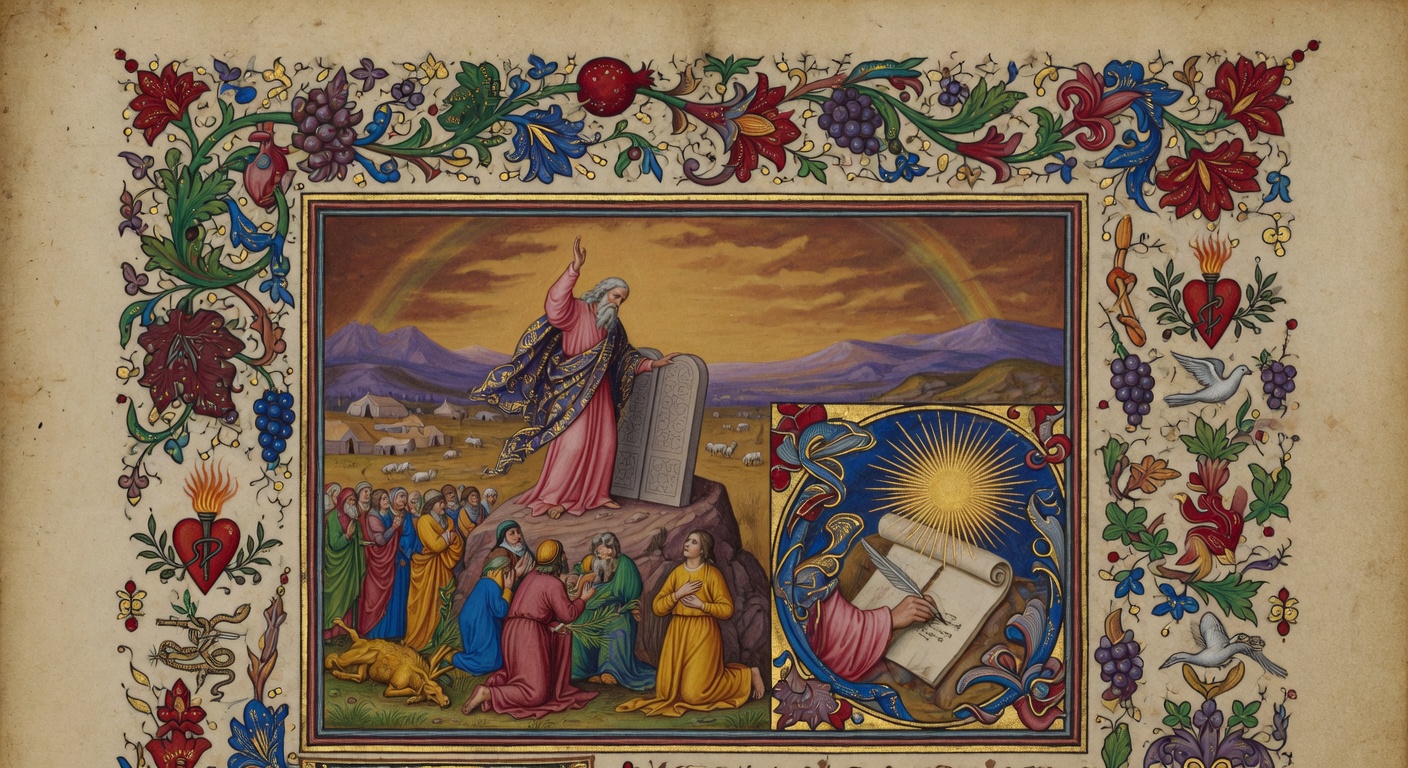
 1nd Moses went up from the plains of Moab unto the mountain of Nebo, to the top of Pisgah, that is over against Jericho. And the LORD shewed him all the land of Gilead, unto Dan,
2 And all Naphtali, and the land of Ephraim, and Manasseh, and all the land of Judah, unto the utmost sea,
3 And the south, and the plain of the valley of Jericho, the city of palm trees, unto Zoar.
4 And the LORD said unto him, This is the land which I sware unto Abraham, unto Isaac, and unto Jacob, saying, I will give it unto thy seed: I have caused thee to see it with thine eyes, but thou shalt not go over thither.
5 So Moses the servant of the LORD died there in the land of Moab, according to the word of the LORD.
6 And he buried him in a valley in the land of Moab, over against Bethpeor: but no man knoweth of his sepulchre unto this day.
7 And Moses was an hundred and twenty years old when he died: his eye was not dim, nor his natural force abated.
8 And the children of Israel wept for Moses in the plains of Moab thirty days: so the days of weeping and mourning for Moses were ended.
9 And Joshua the son of Nun was full of the spirit of wisdom; for Moses had laid his hands upon him: and the children of Israel hearkened unto him, and did as the LORD commanded Moses.
10 And there arose not a prophet since in Israel like unto Moses, whom the LORD knew face to face,
11 In all the signs and the wonders, which the LORD sent him to do in the land of Egypt to Pharaoh, and to all his servants, and to all his land,
12 And in all that mighty hand, and in all the great terror which Moses shewed in the sight of all Israel.
← → arrow keys to navigate chapters · spacebar to play/pause audio
Did You Know?
The chapter's assertion that God personally buried Moses and concealed the site functions as a deliberate polemic against ancient Near Eastern practices of venerating heroic tombs or turning leaders into objects of cultic devotion.
Moses' panoramic vision from Nebo explicitly traces the boundaries of the land promised in Genesis 15 to Abraham, allowing the reader to see the covenant promise visually fulfilled even as its greatest mediator is excluded from possession.
The unique claim that 'there arose not a prophet since in Israel like unto Moses' is written from a perspective after the prophetic era had already begun, creating an implicit canonical bridge that ranks all subsequent prophets as lesser than the archetypal mediator.
By recording that Moses retained undiminished physical vigor at age 120, the text subverts the typical Deuteronomic pattern of age-related decline and instead presents his death as an act of divine will rather than natural limitation.
The transfer of authority is effected solely through the prior laying on of hands and the spirit of wisdom, with no mention of any written document or legal code being handed to Joshua, underscoring that leadership succession rests on charismatic endowment rather than textual succession alone.
Commentary & Study Notes Jamieson-Fausset-Brown (1871) · Public Domain Moses went up from the plains of Moab — This chapter appears from internal evidence to have been written subsequently to the death of Moses, and it probably formed, at one time, an…
Classic verse-by-verse commentary on Deuteronomy 34 from Jamieson, Fausset & Brown (1871). Covers: Moses from mount nebo views the land.
- 1
- Moses went up from the plains of Moab — This chapter appears from internal evidence to have been written subsequently to the death of Moses, and it probably formed, at one time, an introduction to the Book of Joshua. unto the mountain of Nebo, to the top of Pisgah — literally, the head or summit of the Pisgah; that is, the height (compare Nu 23:14; De 3:17-27; 4:49). The general name given to the whole mountain range east of Jordan, was Abarim (compare De 32:49), and the peak to which Moses ascended was dedicated to the heathen Nebo, as Balaam's standing place had been consecrated to Peor. Some modern travellers have fixed on Jebel Attarus, a high mountain south of the Jabbok (Zurka), as the Nebo of this passage [BURCKHARDT, SEETZEN, &c.]. But it is situated too far north for a height which, being described as "over against Jericho," must be looked for above the last stage of the Jordan. the Lord showed him all the land of Gilead — That pastoral region was discernible at the northern extremity of the mountain line on which he stood, till it ended, far beyond his sight in Dan. Westward, there were on the horizon, the distant hills of "all Naphtali." Coming nearer, was "the land of Ephraim and Manasseh." Immediately opposite was "all the land of Judah," a title at first restricted to the portion of this tribe, beyond which were "the utmost sea" (the Mediterranean) and the Desert of the "South." These were the four great marks of the future inheritance of his people, on which the narrative fixes our attention. Immediately below him was "the circle" of the plain of Jericho, with its oasis of palm trees; and far away on his left, the last inhabited spot before the great desert "Zoar." The foreground of the picture alone was clearly discernible. There was no miraculous power of vision imparted to Moses. That he should see all that is described is what any man could do, if he attained sufficient elevation. The atmosphere of the climate is so subtle and free from vapor that the sight is carried to a distance of which the beholder, who judges from the more dense air of Europe, can form no idea [VERE MONRO]. But between him and that "good land," the deep valley of the Jordan intervened; "he was not to go over thither."
- 5
- Moses... died — After having governed the Israelites forty years.
Read all 6 notes on Deuteronomy 34 →