Amos 4 KJV
Israel Has Not Returned to God
Amos Chapter 4: Israel Has Not Returned to God
The repeated refrain 'yet have ye not returned unto me' deliberately echoes the covenant lawsuit pattern of Deuteronomy 28, framing Israel's unrepentance as a direct violation of the Mosaic treaty rather than generic moral failure.
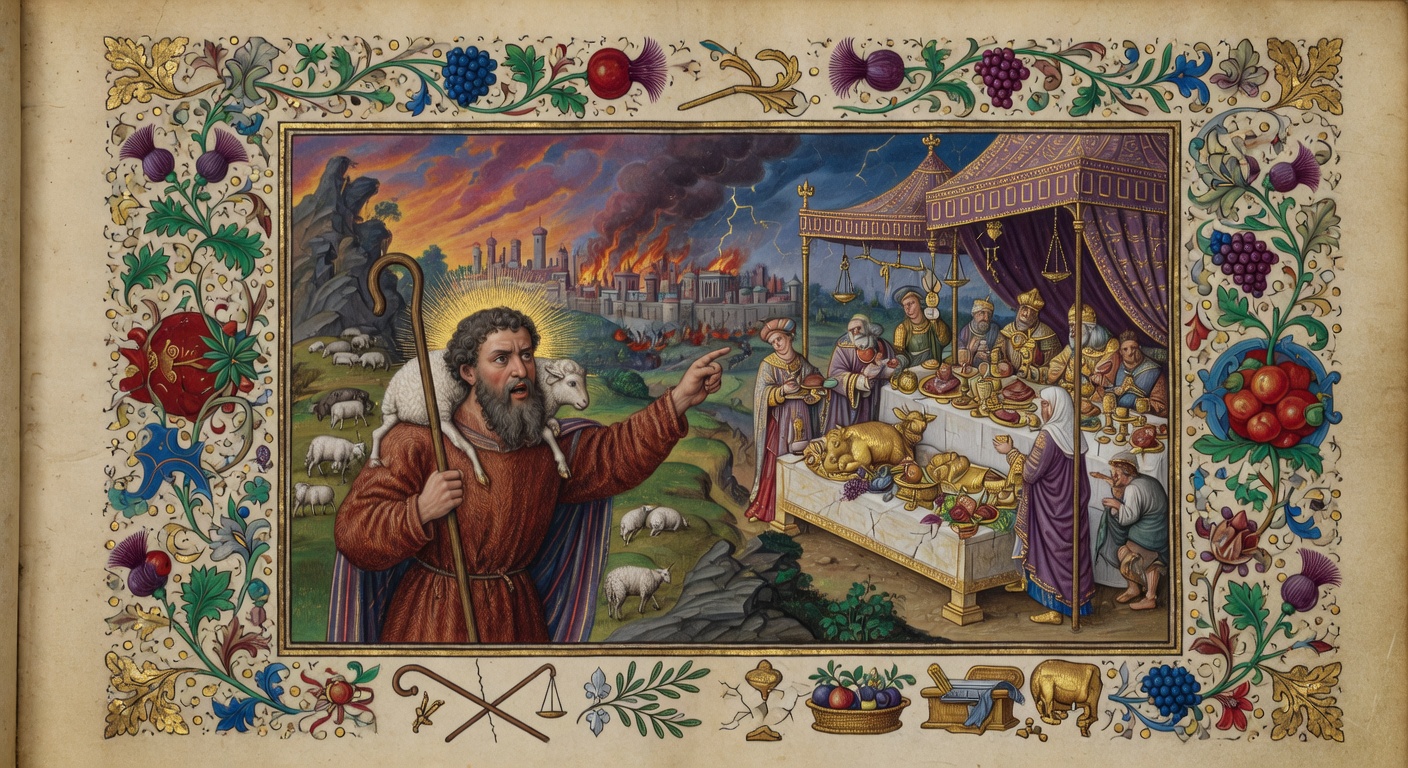
 1ear this word, ye kine of Bashan, that are in the mountain of Samaria, which oppress the poor, which crush the needy, which say to their masters, Bring, and let us drink.
2 The Lord GOD hath sworn by his holiness, that, lo, the days shall come upon you, that he will take you away with hooks, and your posterity with fishhooks.
3 And ye shall go out at the breaches, every cow at that which is before her; and ye shall cast them into the palace, saith the LORD.
4 Come to Bethel, and transgress; at Gilgal multiply transgression; and bring your sacrifices every morning, and your tithes after three years:
5 And offer a sacrifice of thanksgiving with leaven, and proclaim and publish the free offerings: for this liketh you, O ye children of Israel, saith the Lord GOD.
6 And I also have given you cleanness of teeth in all your cities, and want of bread in all your places: yet have ye not returned unto me, saith the LORD.
7 And also I have withholden the rain from you, when there were yet three months to the harvest: and I caused it to rain upon one city, and caused it not to rain upon another city: one piece was rained upon, and the piece whereupon it rained not withered.
8 So two or three cities wandered unto one city, to drink water; but they were not satisfied: yet have ye not returned unto me, saith the LORD.
9 I have smitten you with blasting and mildew: when your gardens and your vineyards and your fig trees and your olive trees increased, the palmerworm devoured them: yet have ye not returned unto me, saith the LORD.
10 I have sent among you the pestilence after the manner of Egypt: your young men have I slain with the sword, and have taken away your horses; and I have made the stink of your camps to come up unto your nostrils: yet have ye not returned unto me, saith the LORD.
11 I have overthrown some of you, as God overthrew Sodom and Gomorrah, and ye were as a firebrand plucked out of the burning: yet have ye not returned unto me, saith the LORD.
12 Therefore thus will I do unto thee, O Israel: and because I will do this unto thee, prepare to meet thy God, O Israel.
13 For, lo, he that formeth the mountains, and createth the wind, and declareth unto man what is his thought, that maketh the morning darkness, and treadeth upon the high places of the earth, The LORD, The God of hosts, is his name.
← → arrow keys to navigate chapters · spacebar to play/pause audio
Did You Know?
The repeated refrain 'yet have ye not returned unto me' deliberately echoes the covenant lawsuit pattern of Deuteronomy 28, framing Israel's unrepentance as a direct violation of the Mosaic treaty rather than generic moral failure.
Bethel and Gilgal are invoked not merely as locations but as corrupted pilgrimage sites whose patriarchal and conquest-era holiness (Genesis 28, Joshua 4-5) has been inverted into centers of state-sponsored idolatry under Jeroboam I.
The 'kine of Bashan' metaphor targets elite Samarian women by alluding to the literal fat cattle of the Transjordanian plateau (Deuteronomy 3:10, Ezekiel 39:18), equating their luxurious consumption with the economic oppression that 'crushes the poor.'
The sequence of judgments (famine, drought, mildew, locusts, pestilence, Sodom-like overthrow) systematically recapitulates the Exodus plagues while reversing their beneficiary, positioning unrepentant Israel as the new Egypt facing divine reversal.
Verse 13's creation doxology, with its rare pairing of 'he that formeth the mountains' and 'declareth unto man what is his thought,' adapts ancient theophanic language to signal an imminent, localized encounter with Yahweh rather than cosmic eschatology.