Hebrews 5 KJV
Jesus the Great High Priest
Hebrews Chapter 5: Jesus the Great High Priest
The invocation of Psalm 110:4 alongside Psalm 2:7 frames Christ's priesthood as a divine appointment merging royal and priestly roles, echoing Melchizedek's pre-Levitical kingship in Genesis 14 and subverting expectations of an exclusively Aaronic lineage.
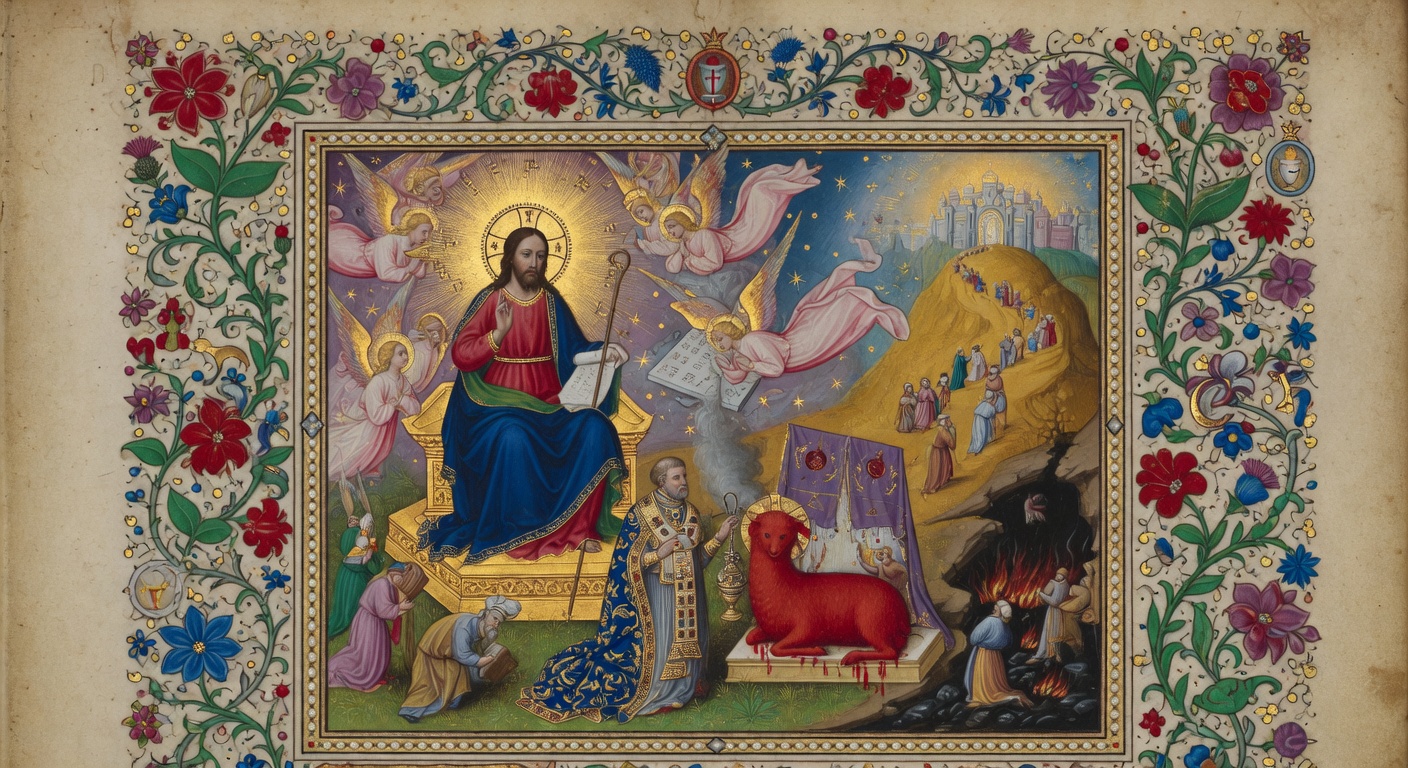
 1or every high priest taken from among men is ordained for men in things pertaining to God, that he may offer both gifts and sacrifices for sins:
2 Who can have compassion on the ignorant, and on them that are out of the way; for that he himself also is compassed with infirmity.
3 And by reason hereof he ought, as for the people, so also for himself, to offer for sins.
4 And no man taketh this honour unto himself, but he that is called of God, as was Aaron.
5 So also Christ glorified not himself to be made an high priest; but he that said unto him, Thou art my Son, to day have I begotten thee.
6 As he saith also in another place, Thou art a priest for ever after the order of Melchisedec.
7 Who in the days of his flesh, when he had offered up prayers and supplications with strong crying and tears unto him that was able to save him from death, and was heard in that he feared;
8 Though he were a Son, yet learned he obedience by the things which he suffered;
9 And being made perfect, he became the author of eternal salvation unto all them that obey him;
10 Called of God an high priest after the order of Melchisedec.
11 Of whom we have many things to say, and hard to be uttered, seeing ye are dull of hearing.
12 For when for the time ye ought to be teachers, ye have need that one teach you again which be the first principles of the oracles of God; and are become such as have need of milk, and not of strong meat.
13 For every one that useth milk is unskilful in the word of righteousness: for he is a babe.
14 But strong meat belongeth to them that are of full age, even those who by reason of use have their senses exercised to discern both good and evil.
← → arrow keys to navigate chapters · spacebar to play/pause audio
Did You Know?
The invocation of Psalm 110:4 alongside Psalm 2:7 frames Christ's priesthood as a divine appointment merging royal and priestly roles, echoing Melchizedek's pre-Levitical kingship in Genesis 14 and subverting expectations of an exclusively Aaronic lineage.
Verse 8's statement that Jesus 'learned obedience by the things which he suffered' highlights the incarnational paradox of acquired experiential submission, distinguishing his sinless development from any prior moral failing while grounding atonement in genuine human growth.
The description in verse 7 of prayers offered 'with strong crying and tears' directly evokes Gethsemane yet ties it to priestly qualification, emphasizing that reverent fear enabled the Son's supplications to be heard, thus modeling intercession through embodied vulnerability.
By rebuking the readers' need for 'milk' instead of 'strong meat' regarding the Melchizedekian order, the chapter positions this priesthood as advanced theological insight accessible only to the spiritually mature, foreshadowing the warnings of apostasy in chapter 6.
The high priest's compassion on those 'that are ignorant, and on them that are out of the way' in verse 2 draws from Old Testament provisions for unintentional sins, contrasting the limited Levitical scope with Christ's eternal salvation that encompasses willful and comprehensive human failure.
Commentary & Study Notes Jamieson-Fausset-Brown (1871) · Public Domain For — substantiating Heb 4:15. every — that is, every legitimate high priest; for instance, the Levitical, as he is addressing Hebrews, among whom the Levitical priesthood was esta…
Classic verse-by-verse commentary on Hebrews 5 from Jamieson, Fausset & Brown (1871). Covers: Christ's high priesthood; Needed qualifications; Must be a man; Must not have assumed the dignity himself, but have been appointed by God; Their low spiritual perceptions a bar to paul's saying all he might on Christ's melchisedec-like priesthood.
- 1
- For — substantiating Heb 4:15. every — that is, every legitimate high priest; for instance, the Levitical, as he is addressing Hebrews, among whom the Levitical priesthood was established as the legitimate one. Whatever, reasons Paul, is excellent in the Levitical priests, is also in Christ, and besides excellencies which are not in the Levitical priests. taken from among men — not from among angels, who could not have a fellow feeling with us men. This qualification Christ has, as being, like the Levitical priest, a man (Heb 2:14, 16). Being "from men," He can be "for (that is, in behalf of, for the good of) men." ordained — Greek, "constituted," "appointed." both gifts — to be joined with "for sins," as "sacrifices" is (the "both... and" requires this); therefore not the Hebrew, "mincha," "unbloody offerings," but animal whole burnt offerings, spontaneously given. "Sacrifices" are the animal sacrifices due according to the legal ordinance [ESTIUS].
- 2
- Who can — Greek, "being able"; not pleasing himself (Ro 15:3). have compassion — Greek, "estimate mildly," "feel leniently," or "moderately towards"; "to make allowance for"; not showing stern rigor save to the obstinate (Heb 10:28). ignorant — sins not committed in resistance of light and knowledge, but as Paul's past sin (1Ti 1:13). No sacrifice was appointed for wilful sin committed with a high hand; for such were to be punished with death; all other sins, namely, ignorances and errors, were confessed and expiated with sacrifices by the high priest. out of the way — not deliberately and altogether wilfully erring, but deluded through the fraud of Satan and their own carnal frailty and thoughtlessness. infirmity — moral weakness which is sinful, and makes men capable of sin, and so requires to be expiated by sacrifices. This kind of "infirmity" Christ had not; He had the "infirmity" of body whereby He was capable of suffering and death.
Read all 15 notes on Hebrews 5 →