Jonah 3 KJV
Nineveh Repents
Jonah Chapter 3: Nineveh Repents
The decree that even animals must wear sackcloth and fast reveals an ancient Near Eastern view of corporate solidarity extending to the non-human creation, underscoring the totality of Nineveh's turning rather than mere human ritual.
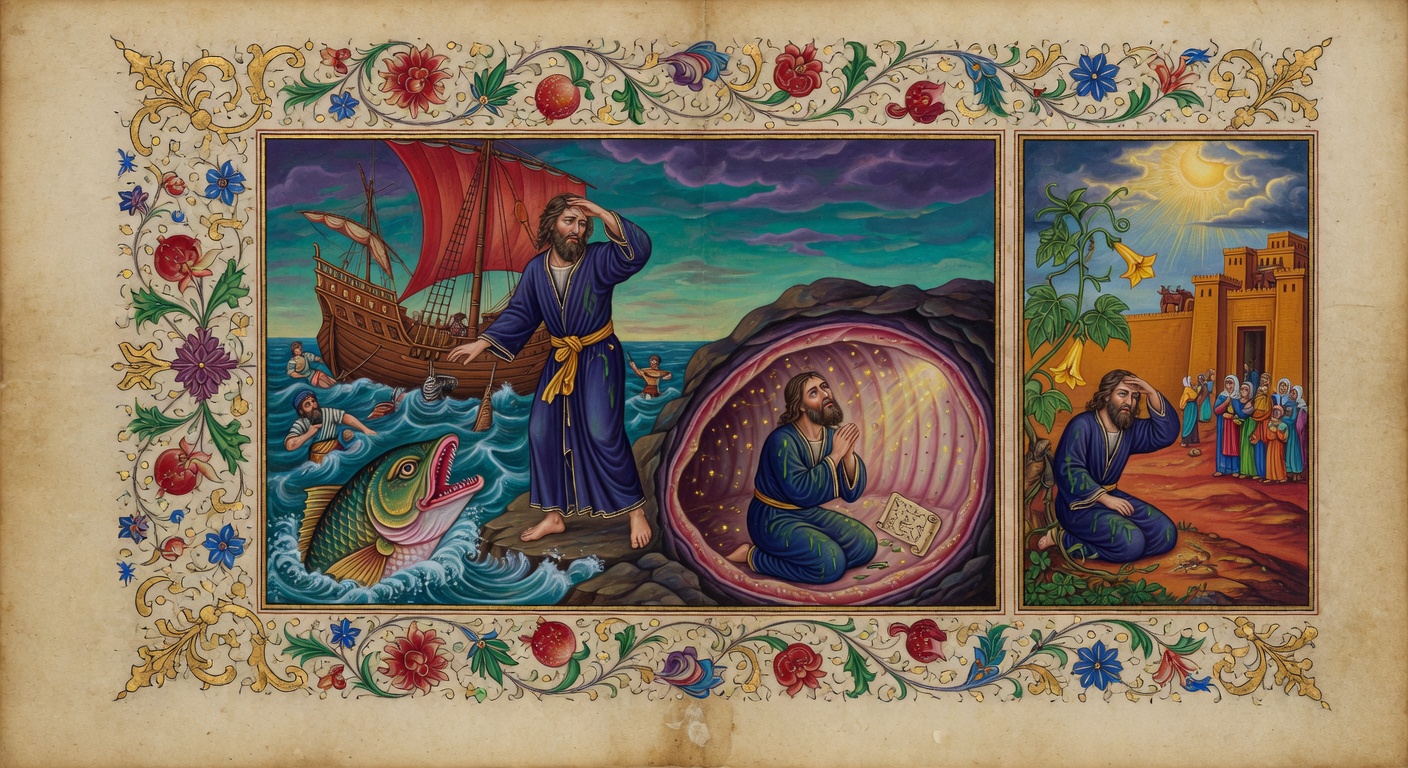
 1nd the word of the LORD came unto Jonah the second time, saying,
2 Arise, go unto Nineveh, that great city, and preach unto it the preaching that I bid thee.
3 So Jonah arose, and went unto Nineveh, according to the word of the LORD. Now Nineveh was an exceeding great city of three days’ journey.
4 And Jonah began to enter into the city a day’s journey, and he cried, and said, Yet forty days, and Nineveh shall be overthrown.
5 So the people of Nineveh believed God, and proclaimed a fast, and put on sackcloth, from the greatest of them even to the least of them.
6 For word came unto the king of Nineveh, and he arose from his throne, and he laid his robe from him, and covered him with sackcloth, and sat in ashes.
7 And he caused it to be proclaimed and published through Nineveh by the decree of the king and his nobles, saying, Let neither man nor beast, herd nor flock, taste any thing: let them not feed, nor drink water:
8 But let man and beast be covered with sackcloth, and cry mightily unto God: yea, let them turn every one from his evil way, and from the violence that is in their hands.
9 Who can tell if God will turn and repent, and turn away from his fierce anger, that we perish not?
10 And God saw their works, that they turned from their evil way; and God repented of the evil, that he had said that he would do unto them; and he did it not.
← → arrow keys to navigate chapters · spacebar to play/pause audio
Did You Know?
The decree that even animals must wear sackcloth and fast reveals an ancient Near Eastern view of corporate solidarity extending to the non-human creation, underscoring the totality of Nineveh's turning rather than mere human ritual.
Jonah's terse five-word oracle in Hebrew deliberately echoes the forty-day periods of testing in Genesis and Exodus, framing Nineveh's fate within Israel's own history of divine judgment and reprieve.
God's use of the same verb 'repent' (nacham) for both the Ninevites' action and His own change of mind creates a theological symmetry that portrays divine justice as genuinely responsive rather than mechanical.
The Assyrian capital's instant, city-wide response stands in ironic contrast to Israel's repeated resistance to its own prophets, highlighting the narrative's theme that pagan outsiders can outdo the covenant people in heeding the word.
This episode supplies the precise precedent Jesus invokes in Matthew 12:41, positioning Nineveh's repentance as eschatological evidence that Gentile responsiveness will condemn unrepentant Israel at the judgment.
Commentary & Study Notes Jamieson-Fausset-Brown (1871) · Public Domain preach... the preaching — literally, "proclaim the proclamation." On the former occasion the specific object of his commission to Nineveh was declared; here it is indeterminate. Th…
Classic verse-by-verse commentary on Jonah 3 from Jamieson, Fausset & Brown (1871). Covers: Jonah's second commission to nineveh: the ninevites repent of their evil way: so God repents of the evil threatened.
- 2
- preach... the preaching — literally, "proclaim the proclamation." On the former occasion the specific object of his commission to Nineveh was declared; here it is indeterminate. This is to show how freely he yields himself, in the spirit of unconditional obedience, to speak whatever God may please.
- 3
- arose and went — like the son who was at first disobedient to the father's command, "Go work in my vineyard," but who afterwards "repented and went" (Mt 21:28, 29). Jonah was thus the fittest instrument for proclaiming judgment, and yet hope of mercy on repentance to Nineveh, being himself a living exemplification of both — judgment in his entombment in the fish, mercy on repentance in his deliverance. Israel professing to obey, but not obeying, and so doomed to exile in the same Nineveh, answers to the son who said, "I go, sir, and went not." In Lu 11:30 it is said that Jonas was not only a sign to the men in Christ's time, but also "unto the Ninevites." On the latter occasion (Mt 16:1-4) when the Pharisees and Sadducees tempted Him, asking a sign from heaven, He answered, "No sign shall be given, but the sign of the prophet Jonas," Mt 12:39. Thus the sign had a twofold aspect, a direct bearing on the Ninevites, an indirect bearing on the Jews in Christ's time. To the Ninevites he was not merely a prophet, but himself a wonder in the earth, as one who had tasted of death, and yet had not seen corruption, but had now returned to witness among them for God. If the Ninevites had indulged in a captious spirit, they never would have inquired and so known Jonah's wonderful history; but being humbled by God's awful message, they learned from Jonah himself that it was the previous concealing in his bosom of the same message of their own doom that caused him to be entombed as an outcast from the living. Thus he was a "sign" to them of wrath on the one hand, and, on the other, of mercy. Guilty Jonah saved from the jaws of death gives a ray of hope to guilty Nineveh. Thus God, who brings good from evil, made Jonah in his fall, punishment, and restoration, a sign (an embodied lesson or living symbol) through which the Ninevites were roused to hear and repent, as they would not have been likely to do, had he gone on the first commission before his living entombment and resurrection. To do evil that good may come, is a policy which can only come from Satan; but from evil already done to extract an instrument against the kingdom of darkness, is a triumphant display of the grace and wisdom of God. To the Pharisees in Christ's time, who, not content with the many signs exhibited by Him, still demanded a sign from heaven, He gave a sign in the opposite quarter, namely, Jonah, who came "out of the belly of hell" (the unseen region). They looked for a Messiah gloriously coming in the clouds of heaven; the Messiah, on the contrary, is to pass through a like, though a deeper, humiliation than Jonah; He is to lie "in the heart of the earth." Jonah and his Antitype alike appeared low and friendless among their hearers; both victims to death for God's wrath against sin, both preaching repentance. Repentance derives all its efficacy from the death of Christ, just as Jonah's message derived its weight with the Ninevites from his entombment. The Jews stumbled at Christ's death, the very fact which ought to have led them to Him, as Jonah's entombment attracted the Ninevites to his message. As Jonah's restoration gave hope of God's placability to Nineveh, so Christ's resurrection assures us God is fully reconciled to man by Christ's death. But Jonah's entombment only had the effect of a moral suasive; Christ's death is an efficacious instrument of reconciliation between God and man [FAIRBAIRN]. Nineveh was an exceeding great city — literally, "great to God," that is, before God. All greatness was in the Hebrew mind associated with GOD; hence arose the idiom (compare "great mountains," Margin, "mountains of God," Ps 36:6; "goodly cedars," Margin, "cedars of God," Ps 80:10; "a mighty hunter before the Lord," Ge 10:9). three days' journey — that is, about sixty miles, allowing about twenty miles for a day's journey. Jonah's statement is confirmed by heathen writers, who describe Nineveh as four hundred eighty stadia in circumference [DIODORUS SICULUS, 2.3]. HERODOTUS defines a day's journey to be one hundred fifty stadia; so three days' journey will not be much below DIODORUS' estimate. The parallelogram in Central Assyria covered with remains of buildings has Khorsabad northeast; Koyunjik and Nebbi Yunus near the Tigris, northwest; Nimroud, between the Tigris and the Zab, southwest; and Karamless, at a distance inward from the Zab, southeast. From Koyunjik to Nimroud is about eighteen miles; from Khorsabad to Karamless, the same; from Koyunjik to Khorsabad, thirteen or fourteen miles; from Nimroud to Karamless, fourteen miles. The length thus was greater than the breadth; compare Jon 3:4, "a day's journey," which is confirmed by heathen writers and by modern measurements. The walls were a hundred feet high, and broad enough to allow three chariots abreast, and had moreover fifteen hundred lofty towers. The space between, including large parks and arable ground, as well as houses, was Nineveh in its full extent. The oldest palaces are at Nimroud, which was probably the original site. LAYARD latterly has thought that the name Nineveh belonged originally to Koyunjik, rather than to Nimroud. Jonah (Jon 4:11) mentions the children as numbering one hundred twenty thousand, which would give about a million to the whole population. Existing ruins show that Nineveh acquired its greatest extent under the kings of the second dynasty, that is, the kings mentioned in Scripture; it was then that Jonah visited it, and the reports of its magnificence were carried to the west [LAYARD].
Read all 9 notes on Jonah 3 →