Jonah
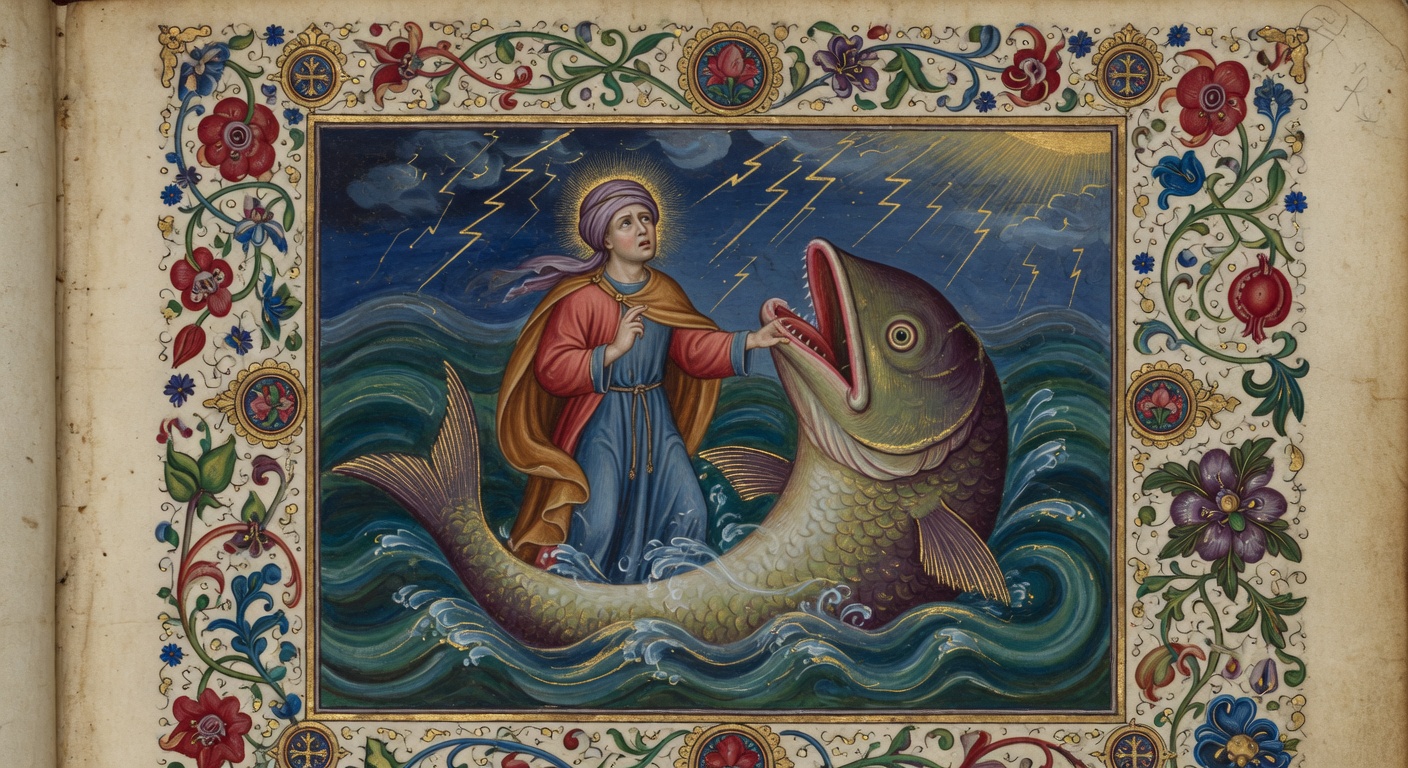
Jonah was an Old Testament prophet commanded by God to preach a message of impending judgment and call for repentance to the people of Nineveh, the capital of the Assyrian Empire known for its cruelty. Instead of obeying, Jonah fled by ship toward Tarshish, prompting a storm that led the crew to cast him overboard, after which he was swallowed by a great fish and remained inside it for three days before being delivered onto dry land. He then fulfilled his mission, resulting in the mass repentance of Nineveh's inhabitants and God's decision to withhold destruction, underscoring divine mercy toward Gentiles. The account, recorded in the Book of Jonah, illustrates themes of obedience, God's sovereignty over creation, and the possibility of redemption, while also serving in the New Testament as a sign foreshadowing Christ's resurrection.
Video from BibleProject
Jonah Overview
God sends Jonah to Nineveh, challenging assumptions about who deserves mercy.
BibleProject is the author and owner of this content. To find more BibleProject resources, visit bibleproject.com. Bible Navigator is not affiliated with BibleProject.
Biography
- Occupation
- Prophet
- Tribe
- Zebulun
- Father
- Amittai
- Era
- Divided Kingdom (c. 780-750 BC)
- Nationality
- Israelite
Family
Did You Know?
Jonah is the only Old Testament prophet whose personal narrative is told almost entirely through his reluctance and flight, with his actual oracle to Nineveh consisting of just five Hebrew words in Jonah 3:4.
The book identifies Jonah as the son of Amittai from Gath-hepher and cross-references him in 2 Kings 14:25 as the prophet who predicted Jeroboam II's territorial restoration, placing him firmly in the northern kingdom's 8th-century prophetic circle.
Nineveh's king responded to Jonah's warning by issuing a decree that even livestock must fast and wear sackcloth, an Assyrian practice attested in royal penitential rituals but unparalleled in Israelite records.
The Hebrew text never calls the creature that swallows Jonah a whale, using only the generic term dag (fish), while the Septuagint and Matthew 12:40 later specify a 'great fish' or 'whale' to emphasize divine control over sea monsters known in Canaanite myth.
Jonah's psalm inside the fish (Jonah 2) weaves together verbatim phrases from Psalms 3, 5, 18, 31, 42, 69, 120, and 142, indicating the author crafted it as a pastiche of existing temple liturgy rather than an original composition.
Key Passages
Jonah Flees
Jonah 1:1-17
Jonah runs from God's command to preach to Israel's enemies - revealing the human tendency to limit God's mercy to those we consider deserving.
 1ow the word of the LORD came unto Jonah the son of Amittai, saying,
Jonah's Prayer
Jonah 2:1-10
From inside the fish, Jonah prays a psalm of thanksgiving - discovering that even in the consequences of disobedience, God's salvation reaches to the depths.
 1hen Jonah prayed unto the LORD his God out of the fish’s belly,
Nineveh Repents
Jonah 3:1-10
The entire city of Nineveh repents at Jonah's preaching - the greatest revival in Scripture, demonstrating God's desire to show mercy to all nations, not just Israel.
 1nd the word of the LORD came unto Jonah the second time, saying,