Jonah 4 KJV
Jonah's Anger and God's Mercy
Jonah Chapter 4: Jonah's Anger and God's Mercy
Jonah's selective quotation of Exodus 34:6-7 in verse 2 deliberately drops the clause about forgiving iniquity, exposing his theological distortion to resist Gentile inclusion in divine mercy.
 1ut it displeased Jonah exceedingly, and he was very angry.
2 And he prayed unto the LORD, and said, I pray thee, O LORD, was not this my saying, when I was yet in my country? Therefore I fled before unto Tarshish: for I knew that thou art a gracious God, and merciful, slow to anger, and of great kindness, and repentest thee of the evil.
3 Therefore now, O LORD, take, I beseech thee, my life from me; for it is better for me to die than to live.
4 Then said the LORD, Doest thou well to be angry?
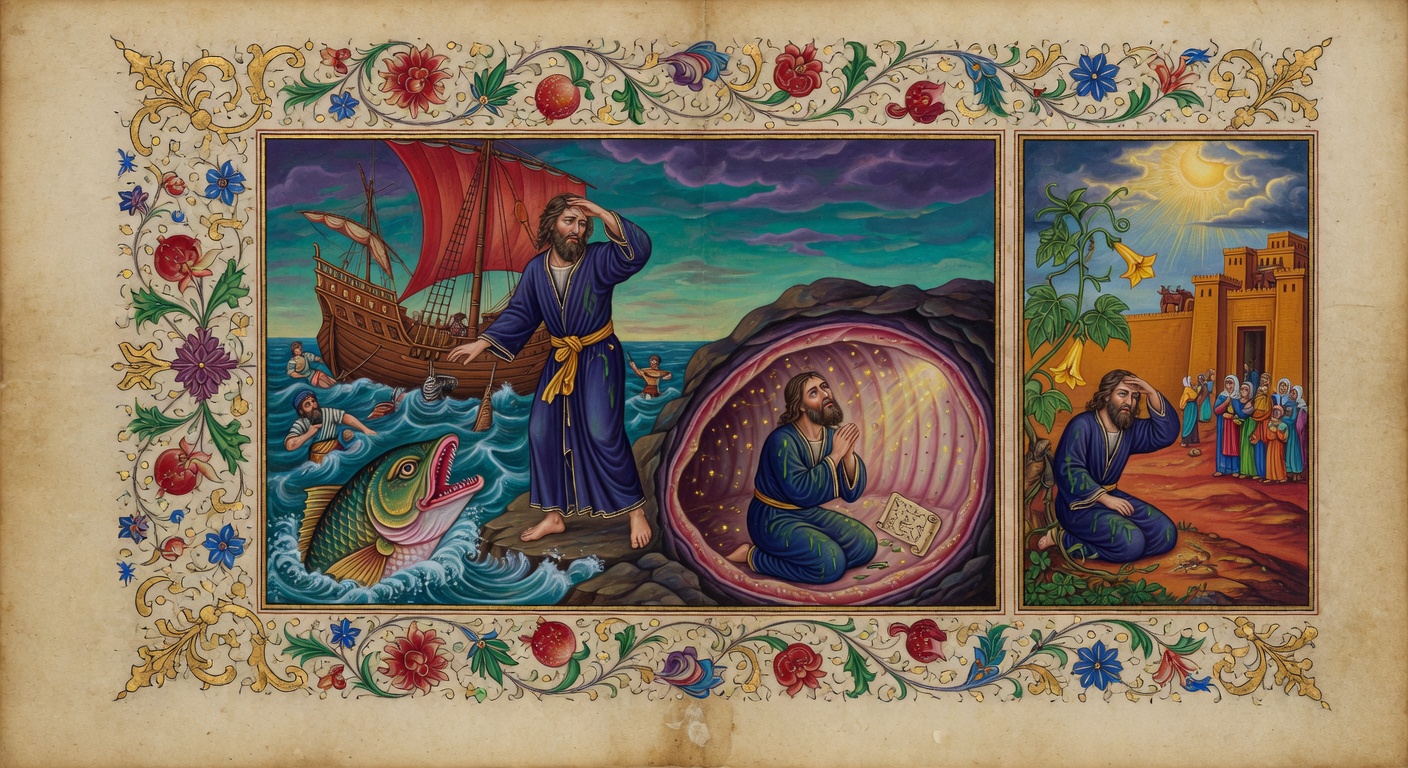
5 So Jonah went out of the city, and sat on the east side of the city, and there made him a booth, and sat under it in the shadow, till he might see what would become of the city.
6 And the LORD God prepared a gourd, and made it to come up over Jonah, that it might be a shadow over his head, to deliver him from his grief. So Jonah was exceeding glad of the gourd.
7 But God prepared a worm when the morning rose the next day, and it smote the gourd that it withered.
8 And it came to pass, when the sun did arise, that God prepared a vehement east wind; and the sun beat upon the head of Jonah, that he fainted, and wished in himself to die, and said, It is better for me to die than to live.
9 And God said to Jonah, Doest thou well to be angry for the gourd? And he said, I do well to be angry, even unto death.
10 Then said the LORD, Thou hast had pity on the gourd, for the which thou hast not laboured, neither madest it grow; which came up in a night, and perished in a night:
11 And should not I spare Nineveh, that great city, wherein are more than sixscore thousand persons that cannot discern between their right hand and their left hand; and also much cattle?
← → arrow keys to navigate chapters · spacebar to play/pause audio
Did You Know?
Jonah's selective quotation of Exodus 34:6-7 in verse 2 deliberately drops the clause about forgiving iniquity, exposing his theological distortion to resist Gentile inclusion in divine mercy.
The double death wish in verses 3 and 8 parallels Elijah's despair in 1 Kings 19 after his victory over Baal, linking both prophets' crises to encounters with pagan powers and divine compassion overriding judgment.
God's progression of object lessons. The plant, worm, and scorching wind. Forms a miniature creation-uncreation sequence that mirrors the flood narrative, teaching Jonah about sovereignty over both nature and nations.
The phrase 'cannot discern between their right hand and their left' in verse 11 points specifically to infants and toddlers, framing Nineveh's repentance as including the vulnerable and subverting Assyrian imperial propaganda of unassailable strength.
The chapter's abrupt close with an unanswered divine question leaves the reader implicated in Jonah's dilemma, prefiguring later biblical tensions over Israel's mission to the Gentiles as seen in Acts and Romans.