Micah 5 KJV
A Ruler from Bethlehem
Micah Chapter 5: A Ruler from Bethlehem
The specification of Bethlehem Ephrathah in verse 2 deliberately recalls Rachel's tomb and the site of her death in childbirth (Genesis 35), framing the Messiah's birthplace as the location where maternal sorrow is prophetically reversed into national deliverance.
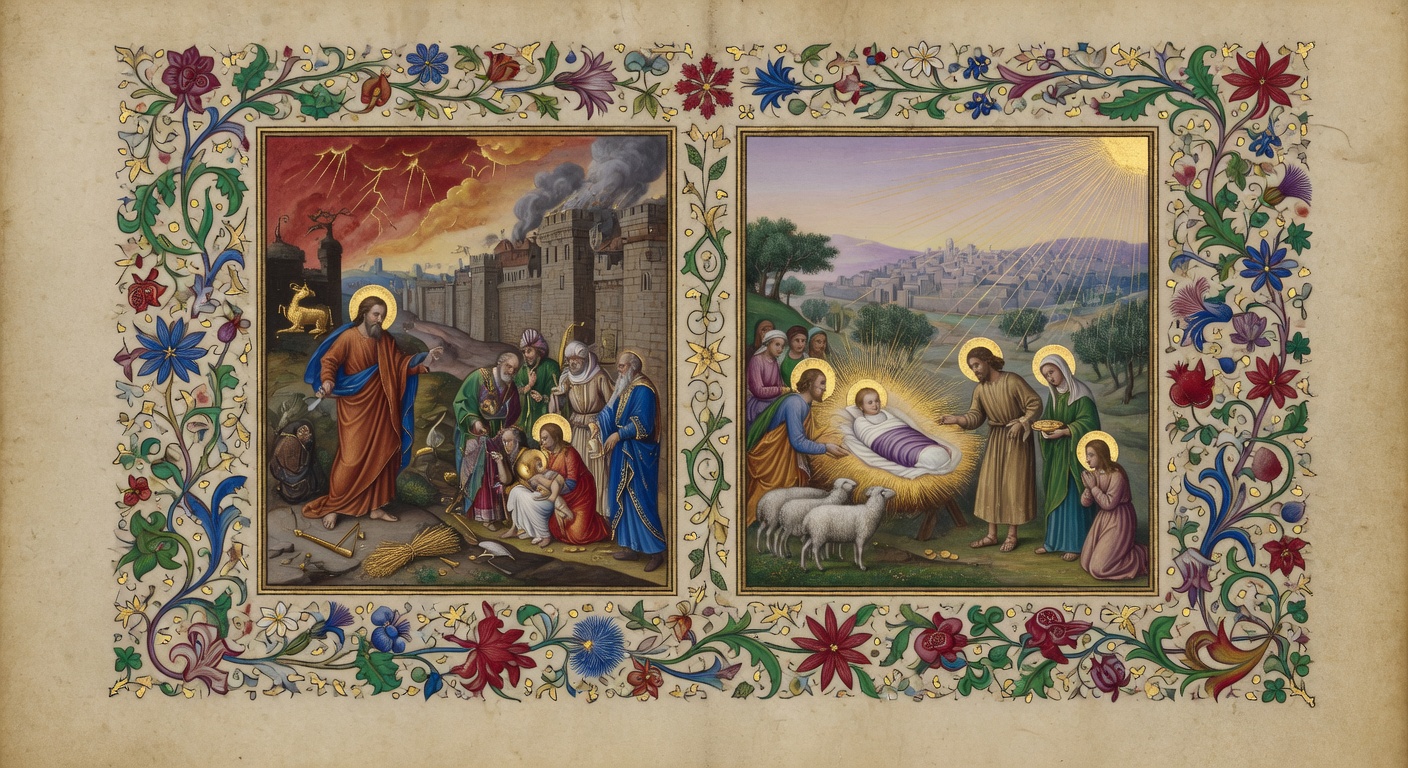
 1ow gather thyself in troops, O daughter of troops: he hath laid siege against us: they shall smite the judge of Israel with a rod upon the cheek.
2 But thou, Bethlehem Ephratah, though thou be little among the thousands of Judah, yet out of thee shall he come forth unto me that is to be ruler in Israel; whose goings forth have been from of old, from everlasting.
3 Therefore will he give them up, until the time that she which travaileth hath brought forth: then the remnant of his brethren shall return unto the children of Israel.
4 And he shall stand and feed in the strength of the LORD, in the majesty of the name of the LORD his God; and they shall abide: for now shall he be great unto the ends of the earth.
5 And this man shall be the peace, when the Assyrian shall come into our land: and when he shall tread in our palaces, then shall we raise against him seven shepherds, and eight principal men.
6 And they shall waste the land of Assyria with the sword, and the land of Nimrod in the entrances thereof: thus shall he deliver us from the Assyrian, when he cometh into our land, and when he treadeth within our borders.
7 And the remnant of Jacob shall be in the midst of many people as a dew from the LORD, as the showers upon the grass, that tarrieth not for man, nor waiteth for the sons of men.
8 And the remnant of Jacob shall be among the Gentiles in the midst of many people as a lion among the beasts of the forest, as a young lion among the flocks of sheep: who, if he go through, both treadeth down, and teareth in pieces, and none can deliver.
9 Thine hand shall be lifted up upon thine adversaries, and all thine enemies shall be cut off.
10 And it shall come to pass in that day, saith the LORD, that I will cut off thy horses out of the midst of thee, and I will destroy thy chariots:
11 And I will cut off the cities of thy land, and throw down all thy strong holds:
12 And I will cut off witchcrafts out of thine hand; and thou shalt have no more soothsayers:
13 Thy graven images also will I cut off, and thy standing images out of the midst of thee; and thou shalt no more worship the work of thine hands.
14 And I will pluck up thy groves out of the midst of thee: so will I destroy thy cities.
15 And I will execute vengeance in anger and fury upon the heathen, such as they have not heard.
← → arrow keys to navigate chapters · spacebar to play/pause audio
Did You Know?
The specification of Bethlehem Ephrathah in verse 2 deliberately recalls Rachel's tomb and the site of her death in childbirth (Genesis 35), framing the Messiah's birthplace as the location where maternal sorrow is prophetically reversed into national deliverance.
Verse 5's promise of 'seven shepherds, and eight principal men' employs a Hebrew numerical idiom of excess (seven as completeness, eight as surpassing it) to depict an amplified leadership that will 'waste the land of Assyria,' echoing but surpassing the era of the judges.
The remnant described as 'dew from the Lord' and 'showers upon the grass' in verse 7 repurposes ancient Near Eastern storm-god imagery for Yahweh alone, portraying Israel's future influence as silent, sovereign, and independent of human armies.
Verse 2's phrase 'whose goings forth have been from of old, from everlasting' uses the rare plural form of motsa'ot to evoke repeated divine appearances throughout Israel's history, grounding the Bethlehem ruler's identity in pre-incarnate theophanies.
The chapter's closing vow to cut off horses and chariots (verse 10) and destroy cities (verse 14) reverses the very military assets Israel once trusted, enacting a covenantal purge that prepares the way for the peaceful rule announced at the chapter's opening.