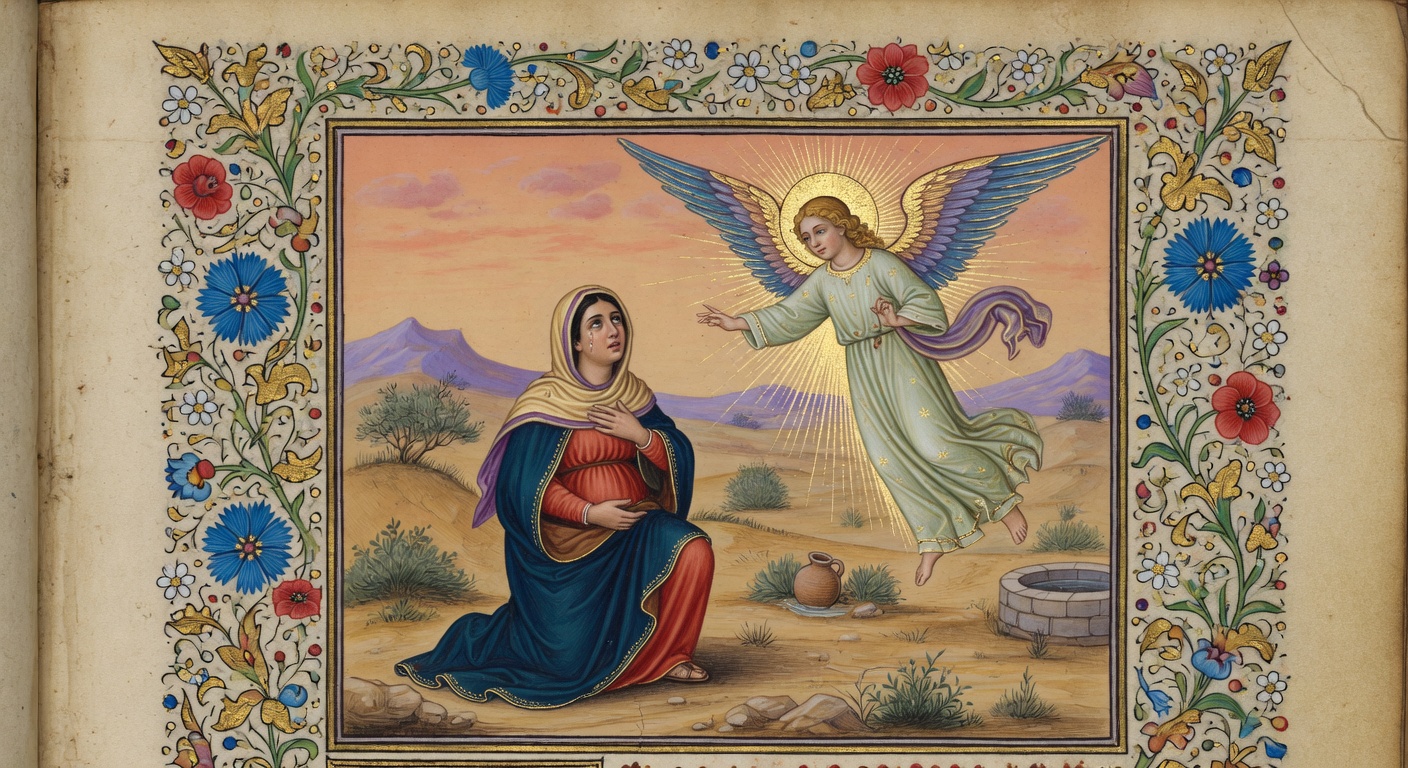
Hagar

Portrait of Hagar

Hagar was the Egyptian maidservant of Sarah, wife of the patriarch Abraham. When Sarah remained childless, she gave Hagar to Abraham as a surrogate, resulting in the birth of Ishmael, who became the ancestor of many Arab tribes. After tensions arose in the household, Hagar fled into the desert, where God encountered her and promised to multiply her offspring greatly, affirming that He had heard her affliction. This account in Genesis underscores God's compassion toward the outcast and plays a key role in the biblical narrative of Abraham's covenant and the origins of two distinct lineages.

0:00

Commentary

The God Who Sees You

When Hagar was rejected and alone, God found her. She named him El Roi.

Commentary by Bible Navigator.

This commentary is for inspirational and educational purposes only. It is not professional counseling, therapy, medical advice, or a substitute for professional help. If you are in crisis or need support, please reach out to a licensed professional or call 988 (Suicide & Crisis Lifeline).

Biography

Occupation
Servant
Spouse
Abraham (concubine)
Children
Ishmael
Era
Patriarchs
Nationality
Egyptian

Family

Hagar โšญ Abraham
โ†“
Children
Old Testament Patriarchs Woman Genesis

Did You Know?

1

Hagar, an Egyptian servant likely acquired during Abraham's sojourn in Egypt, became the first individual in the Bible to receive a direct angelic visitation promising that her offspring would form a multitude too numerous to count, a covenant parallel to Abraham's yet given to a marginalized woman.

2

She alone among biblical figures named God "El Roi" (the God who sees me) after her encounter at a desert spring, which she then called Beer Lahai Roi, highlighting a personal theophany rare for non-Israelite women in the patriarchal narratives.

3

When expelled into the wilderness a second time with the teenage Ishmael, Hagar secured an Egyptian wife for her son from her native land, preserving cultural ties and ensuring Ishmael's lineage as ancestor to twelve tribal princes mirroring Israel's structure.

4

The narrative depicts Ishmael as a youth capable of being carried briefly yet able to survive independently, underscoring ancient Near Eastern customs of surrogate motherhood where a handmaid's child could inherit status before displacement.

5

Hagar's two wilderness encounters with the divine emphasize God's attention to foreign slaves, a detail often overlooked yet central to the text's portrayal of providence extending beyond the chosen family line.

Key Passages

Hagar Flees from Sarah

Genesis 16:1-16

This story shows God's tender care for the overlooked, meeting Hagar in her pain with promise and renewed purpose.
N1ow Sarai Abramโ€™s wife bare him no children: and she had an handmaid, an Egyptian, whose name was Hagar.

2 And Sarai said unto Abram, Behold now, the LORD hath restrained me from bearing: I pray thee, go in unto my maid; it may be that I may obtain children by her. And Abram hearkened to the voice of Sarai. 3 And Sarai Abramโ€™s wife took Hagar her maid the Egyptian, after Abram had dwelt ten years in the land of Canaan, and gave her to her husband Abram to be his wife. 4 And he went in unto Hagar, and she conceived: and when she saw that she had conceived, her mistress was despised in her eyes. 5 And Sarai said unto Abram, My wrong be upon thee: I have given my maid into thy bosom; and when she saw that she had conceived, I was despised in her eyes: the LORD judge between me and thee. 6 But Abram said unto Sarai, Behold, thy maid is in thy hand; do to her as it pleaseth thee. And when Sarai dealt hardly with her, she fled from her face. 7 And the angel of the LORD found her by a fountain of water in the wilderness, by the fountain in the way to Shur. 8 And he said, Hagar, Saraiโ€™s maid, whence camest thou? and whither wilt thou go? And she said, I flee from the face of my mistress Sarai. 9 And the angel of the LORD said unto her, Return to thy mistress, and submit thyself under her hands. 10 And the angel of the LORD said unto her, I will multiply thy seed exceedingly, that it shall not be numbered for multitude. 11 And the angel of the LORD said unto her, Behold, thou art with child, and shalt bear a son, and shalt call his name Ishmael; because the LORD hath heard thy affliction. 12 And he will be a wild man; his hand will be against every man, and every manโ€™s hand against him; and he shall dwell in the presence of all his brethren. 13 And she called the name of the LORD that spake unto her, Thou God seest me: for she said, Have I also here looked after him that seeth me? 14 Wherefore the well was called Beerlahairoi; behold, it is between Kadesh and Bered. 15 And Hagar bare Abram a son: and Abram called his sonโ€™s name, which Hagar bare, Ishmael. 16 And Abram was fourscore and six years old, when Hagar bare Ishmael to Abram.

Read full chapter: Genesis 16 โ†’

Hagar and Ishmael Sent Away

Genesis 21:8-21

This passage reveals God's compassionate care for the outcast, showing He hears desperate cries and faithfully provides hope and provision.
A8nd the child grew, and was weaned: and Abraham made a great feast the same day that Isaac was weaned.

9 And Sarah saw the son of Hagar the Egyptian, which she had born unto Abraham, mocking. 10 Wherefore she said unto Abraham, Cast out this bondwoman and her son: for the son of this bondwoman shall not be heir with my son, even with Isaac. 11 And the thing was very grievous in Abrahamโ€™s sight because of his son. 12 And God said unto Abraham, Let it not be grievous in thy sight because of the lad, and because of thy bondwoman; in all that Sarah hath said unto thee, hearken unto her voice; for in Isaac shall thy seed be called. 13 And also of the son of the bondwoman will I make a nation, because he is thy seed. 14 And Abraham rose up early in the morning, and took bread, and a bottle of water, and gave it unto Hagar, putting it on her shoulder, and the child, and sent her away: and she departed, and wandered in the wilderness of Beersheba. 15 And the water was spent in the bottle, and she cast the child under one of the shrubs. 16 And she went, and sat her down over against him a good way off, as it were a bow shot: for she said, Let me not see the death of the child. And she sat over against him, and lift up her voice, and wept. 17 And God heard the voice of the lad; and the angel of God called to Hagar out of heaven, and said unto her, What aileth thee, Hagar? fear not; for God hath heard the voice of the lad where he is. 18 Arise, lift up the lad, and hold him in thine hand; for I will make him a great nation. 19 And God opened her eyes, and she saw a well of water; and she went, and filled the bottle with water, and gave the lad drink. 20 And God was with the lad; and he grew, and dwelt in the wilderness, and became an archer. 21 And he dwelt in the wilderness of Paran: and his mother took him a wife out of the land of Egypt.

Read full chapter: Genesis 21 โ†’