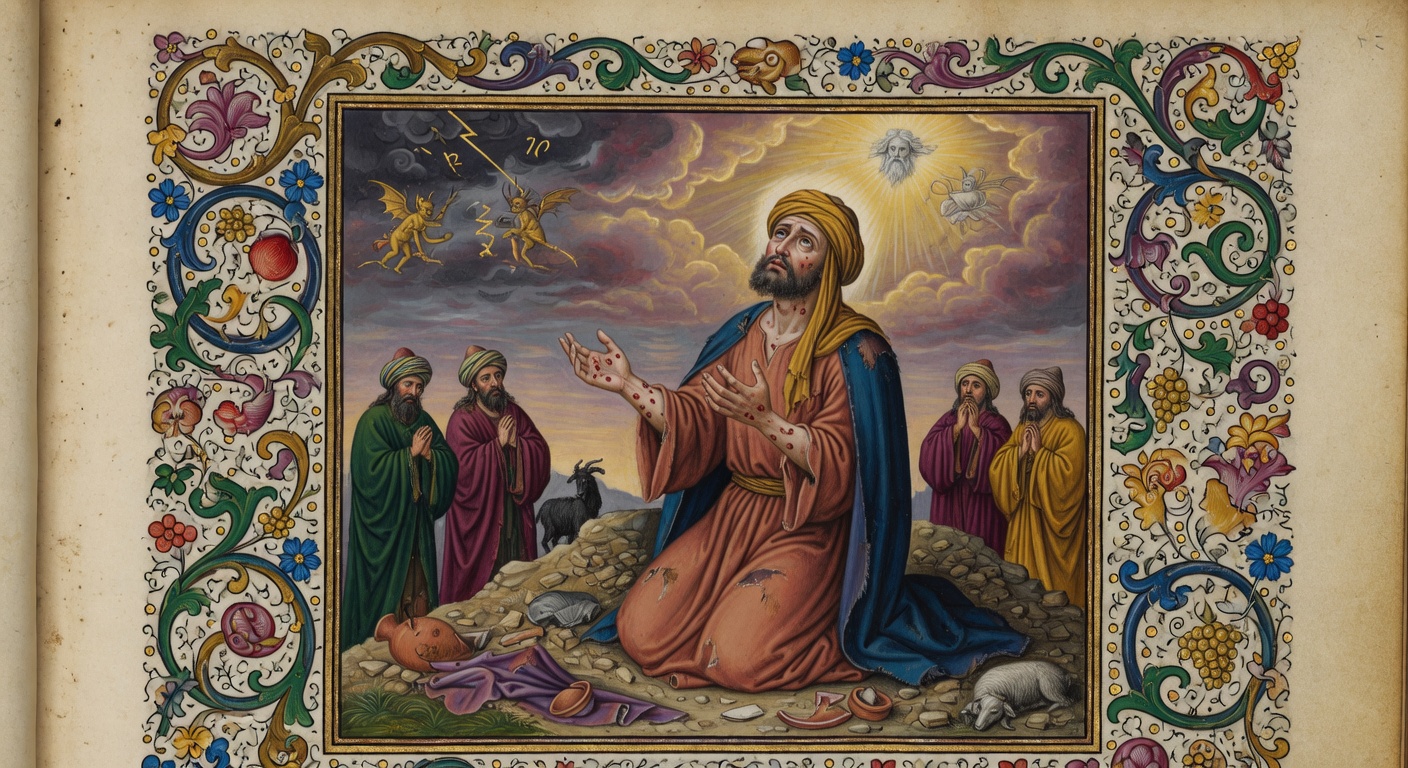
Job

Portrait of Job

Job was a righteous and prosperous man living in the land of Uz, known for his deep faith and integrity. In the biblical narrative, God permitted Satan to afflict Job with immense suffering, including the loss of his children, possessions, and physical health, to test whether his devotion was genuine. Despite his profound grief and questioning, Job refused to curse God and ultimately received restoration and greater blessings. The story of Job holds significant importance in Scripture as it addresses the complex issue of why the righteous suffer and affirms God's sovereignty and wisdom beyond human understanding.

0:00

Video from BibleProject

Job Overview

Job wrestles with the question of why the righteous suffer and encounters God's mysterious wisdom.

BibleProject is the author and owner of this content. To find more BibleProject resources, visit bibleproject.com. Bible Navigator is not affiliated with BibleProject.

Commentary

Job: When Life Makes No Sense

Job lost everything at once. His story shows that real faith can survive even when life makes no sense.

Commentary by Bible Navigator.

This commentary is for inspirational and educational purposes only. It is not professional counseling, therapy, medical advice, or a substitute for professional help. If you are in crisis or need support, please reach out to a licensed professional or call 988 (Suicide & Crisis Lifeline).

Biography

Occupation
Wealthy Landowner
Spouse
Unnamed wife
Children
Seven sons, three daughters (twice)
Era
Patriarchs (uncertain)
Nationality
Uzzite

Family

Job โšญ Unnamed wife
โ†“
Children
Seven sons, three daughters (twice)
Old Testament Patriarchs Other Job

Did You Know?

1

Although often assumed to be an Israelite, Job hailed from the land of Uz, which biblical genealogies link to the descendants of Aram or Esau in Edom, marking him as a non-Israelite Gentile whose story transcends national boundaries.

2

Job served as a family priest by regularly offering burnt sacrifices for his children, reflecting patriarchal-era practices that predated the formal Levitical system established later in Israelite history.

3

The Book of Job contains more than 100 Hebrew words that appear nowhere else in the Bible, highlighting its unique archaic vocabulary and suggesting composition possibly earlier than many other Old Testament texts.

4

Following his restoration, Job received exactly double his original livestock holdings except for his three daughters, whose exceptional beauty is singled out in the text as surpassing that of any other women in the land.

5

The prologue depicts a divine council where the "sons of God" assemble before the Lord and Satan functions as an accuser, offering one of the rare Old Testament portrayals of such a heavenly court scene.

Key Passages

Jobs Suffering Begins

Job 1:13-22

In a single day, Job loses his wealth, his children, and his health - yet his initial response of worship rather than blame establishes him as a model of faith under extreme testing.
A13nd there was a day when his sons and his daughters were eating and drinking wine in their eldest brotherโ€™s house:

14 And there came a messenger unto Job, and said, The oxen were plowing, and the asses feeding beside them: 15 And the Sabeans fell upon them, and took them away; yea, they have slain the servants with the edge of the sword; and I only am escaped alone to tell thee. 16 While he was yet speaking, there came also another, and said, The fire of God is fallen from heaven, and hath burned up the sheep, and the servants, and consumed them; and I only am escaped alone to tell thee. 17 While he was yet speaking, there came also another, and said, The Chaldeans made out three bands, and fell upon the camels, and have carried them away, yea, and slain the servants with the edge of the sword; and I only am escaped alone to tell thee. 18 While he was yet speaking, there came also another, and said, Thy sons and thy daughters were eating and drinking wine in their eldest brotherโ€™s house: 19 And, behold, there came a great wind from the wilderness, and smote the four corners of the house, and it fell upon the young men, and they are dead; and I only am escaped alone to tell thee. 20 Then Job arose, and rent his mantle, and shaved his head, and fell down upon the ground, and worshipped, 21 And said, Naked came I out of my motherโ€™s womb, and naked shall I return thither: the LORD gave, and the LORD hath taken away; blessed be the name of the LORD. 22 In all this Job sinned not, nor charged God foolishly.

Read full chapter: Job 1 โ†’

Job Questions God

Job 3:1-26

Job's raw, honest complaints to God demonstrate that faith does not require suppressing doubt or pain - God welcomes honest wrestling over pious pretense.

A1fter this opened Job his mouth, and cursed his day.

2 And Job spake, and said, 3 Let the day perish wherein I was born, and the night in which it was said, There is a man child conceived. 4 Let that day be darkness; let not God regard it from above, neither let the light shine upon it. 5 Let darkness and the shadow of death stain it; let a cloud dwell upon it; let the blackness of the day terrify it. 6 As for that night, let darkness seize upon it; let it not be joined unto the days of the year, let it not come into the number of the months. 7 Lo, let that night be solitary, let no joyful voice come therein. 8 Let them curse it that curse the day, who are ready to raise up their mourning. 9 Let the stars of the twilight thereof be dark; let it look for light, but have none; neither let it see the dawning of the day: 10 Because it shut not up the doors of my motherโ€™s womb, nor hid sorrow from mine eyes. 11 Why died I not from the womb? why did I not give up the ghost when I came out of the belly? 12 Why did the knees prevent me? or why the breasts that I should suck? 13 For now should I have lain still and been quiet, I should have slept: then had I been at rest, 14 With kings and counsellors of the earth, which built desolate places for themselves; 15 Or with princes that had gold, who filled their houses with silver: 16 Or as an hidden untimely birth I had not been; as infants which never saw light. 17 There the wicked cease from troubling; and there the weary be at rest. 18 There the prisoners rest together; they hear not the voice of the oppressor. 19 The small and great are there; and the servant is free from his master. 20 Wherefore is light given to him that is in misery, and life unto the bitter in soul; 21 Which long for death, but it cometh not; and dig for it more than for hid treasures; 22 Which rejoice exceedingly, and are glad, when they can find the grave? 23 Why is light given to a man whose way is hid, and whom God hath hedged in? 24 For my sighing cometh before I eat, and my roarings are poured out like the waters. 25 For the thing which I greatly feared is come upon me, and that which I was afraid of is come unto me. 26 I was not in safety, neither had I rest, neither was I quiet; yet trouble came.

Read full chapter: Job 3 โ†’

God Answers Job

Job 38:1-11

God responds not with explanations but with overwhelming questions about creation - revealing that trust in God's character must sometimes replace understanding of His purposes.
T1hen the LORD answered Job out of the whirlwind, and said,

2 Who is this that darkeneth counsel by words without knowledge? 3 Gird up now thy loins like a man; for I will demand of thee, and answer thou me. 4 Where wast thou when I laid the foundations of the earth? declare, if thou hast understanding. 5 Who hath laid the measures thereof, if thou knowest? or who hath stretched the line upon it? 6 Whereupon are the foundations thereof fastened? or who laid the corner stone thereof; 7 When the morning stars sang together, and all the sons of God shouted for joy? 8 Or who shut up the sea with doors, when it brake forth, as if it had issued out of the womb? 9 When I made the cloud the garment thereof, and thick darkness a swaddlingband for it, 10 And brake up for it my decreed place, and set bars and doors, 11 And said, Hitherto shalt thou come, but no further: and here shall thy proud waves be stayed?

Read full chapter: Job 38 โ†’

Jobs Restoration

Job 42:10-17

God restores Job's fortunes doubly, vindicating his integrity. Yet the deeper restoration is relational - Job declares 'now my eyes have seen you,' moving from theology to encounter.

A10nd the LORD turned the captivity of Job, when he prayed for his friends: also the LORD gave Job twice as much as he had before.

11 Then came there unto him all his brethren, and all his sisters, and all they that had been of his acquaintance before, and did eat bread with him in his house: and they bemoaned him, and comforted him over all the evil that the LORD had brought upon him: every man also gave him a piece of money, and every one an earring of gold. 12 So the LORD blessed the latter end of Job more than his beginning: for he had fourteen thousand sheep, and six thousand camels, and a thousand yoke of oxen, and a thousand she asses. 13 He had also seven sons and three daughters. 14 And he called the name of the first, Jemima; and the name of the second, Kezia; and the name of the third, Kerenhappuch. 15 And in all the land were no women found so fair as the daughters of Job: and their father gave them inheritance among their brethren. 16 After this lived Job an hundred and forty years, and saw his sons, and his sonsโ€™ sons, even four generations. 17 So Job died, being old and full of days.

Read full chapter: Job 42 โ†’