The Rich Young Ruler
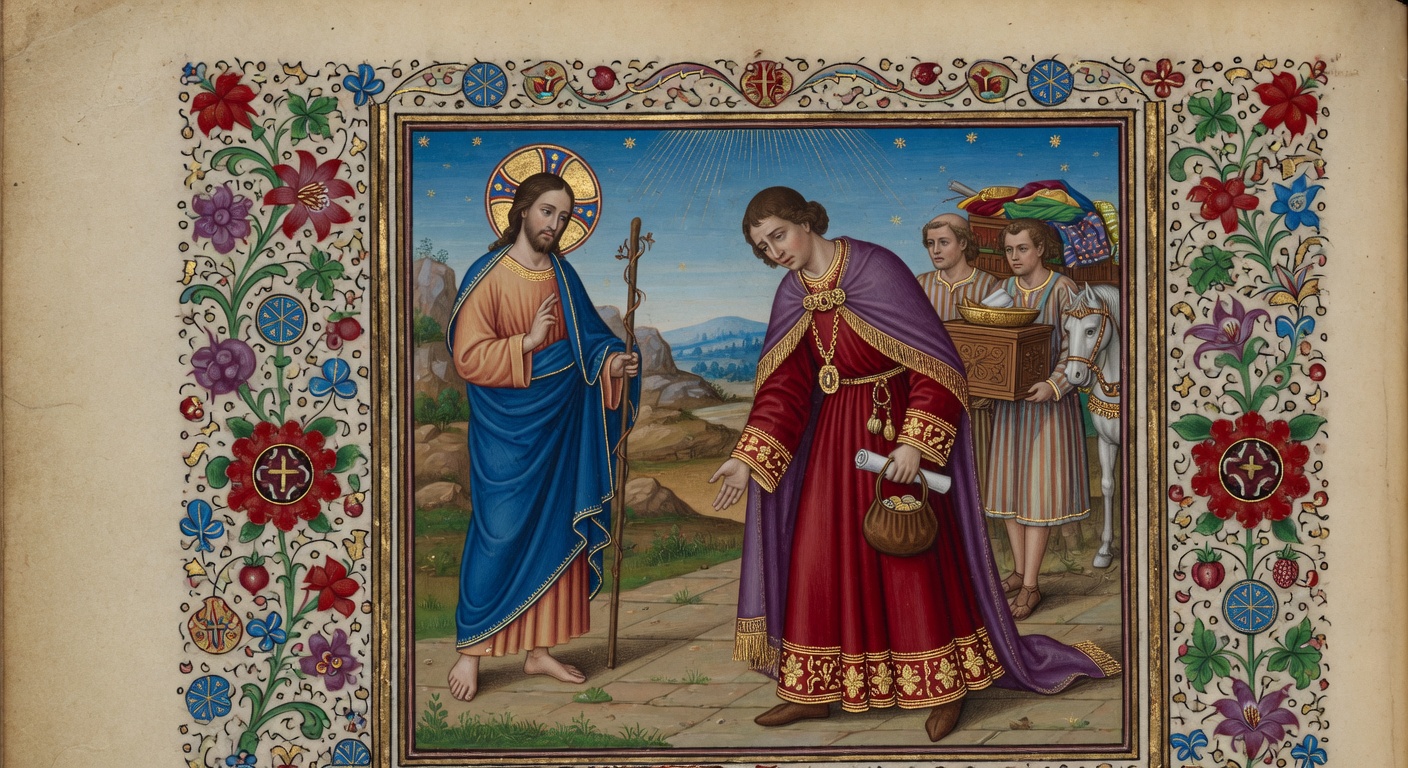
The Rich Young Ruler was a wealthy individual who approached Jesus inquiring about the requirements for obtaining eternal life. When Jesus instructed him to sell his possessions, give to the poor, and follow him, the man departed in sorrow due to his attachment to his riches. This encounter highlights the challenge of prioritizing spiritual devotion over material wealth, as Jesus remarked that it is easier for a camel to pass through the eye of a needle than for a rich man to enter the kingdom of God. The account serves as a cautionary lesson in the Gospels about the potential spiritual barriers posed by wealth and the call to wholehearted discipleship.
Biography
- Occupation
- Ruler, Wealthy Landowner
- Era
- New Testament (c. AD 30)
- Nationality
- Jewish
Did You Know?
Although commonly referred to as the rich young ruler, no single Gospel combines all three descriptors; Mark notes his wealth, Matthew his youth, and Luke his civic authority as an archon, likely a synagogue or municipal official in 1st-century Galilee or Judea.
The Greek verb stygnias as used in Mark 10:22 conveys not mere sadness but a shocked, gloomy astonishment, reflecting how Jesus' demand directly contradicted the widespread Jewish belief that material prosperity signified divine favor and covenant obedience.
By claiming to have observed all commandments since youth, the man invoked a standard of piety that even respected Pharisees viewed as nearly impossible, underscoring the radical nature of Jesus then identifying his unaddressed attachment to possessions as the decisive failure.
Jesus' call to liquidate assets and distribute them to the poor challenged Torah-based inheritance laws that tied land to tribal and family identity, effectively requiring the ruler to renounce both economic security and ancestral covenant status.
This pericope is unique in the Synoptics for pairing the full Decalogue recitation with an explicit invitation to follow Jesus, illustrating Mark's recurring motif that wealth functions as a spiritual barrier more insidious than overt transgression.
Key Passages
The Rich Young Ruler
Matthew 19:16-26
This passage shows how our attachments can keep us from fully following Jesus, yet God makes the impossible gift of eternal life possible.
 16nd, behold, one came and said unto him, Good Master, what good thing shall I do, that I may have eternal life?
Account in Mark
Mark 10:17-27
This story shows that following Jesus calls for wholehearted surrender above all else, yet God's grace makes the impossible possible.
17nd when he was gone forth into the way, there came one running, and kneeled to him, and asked him, Good Master, what shall I do that I may inherit eternal life?