Golgotha
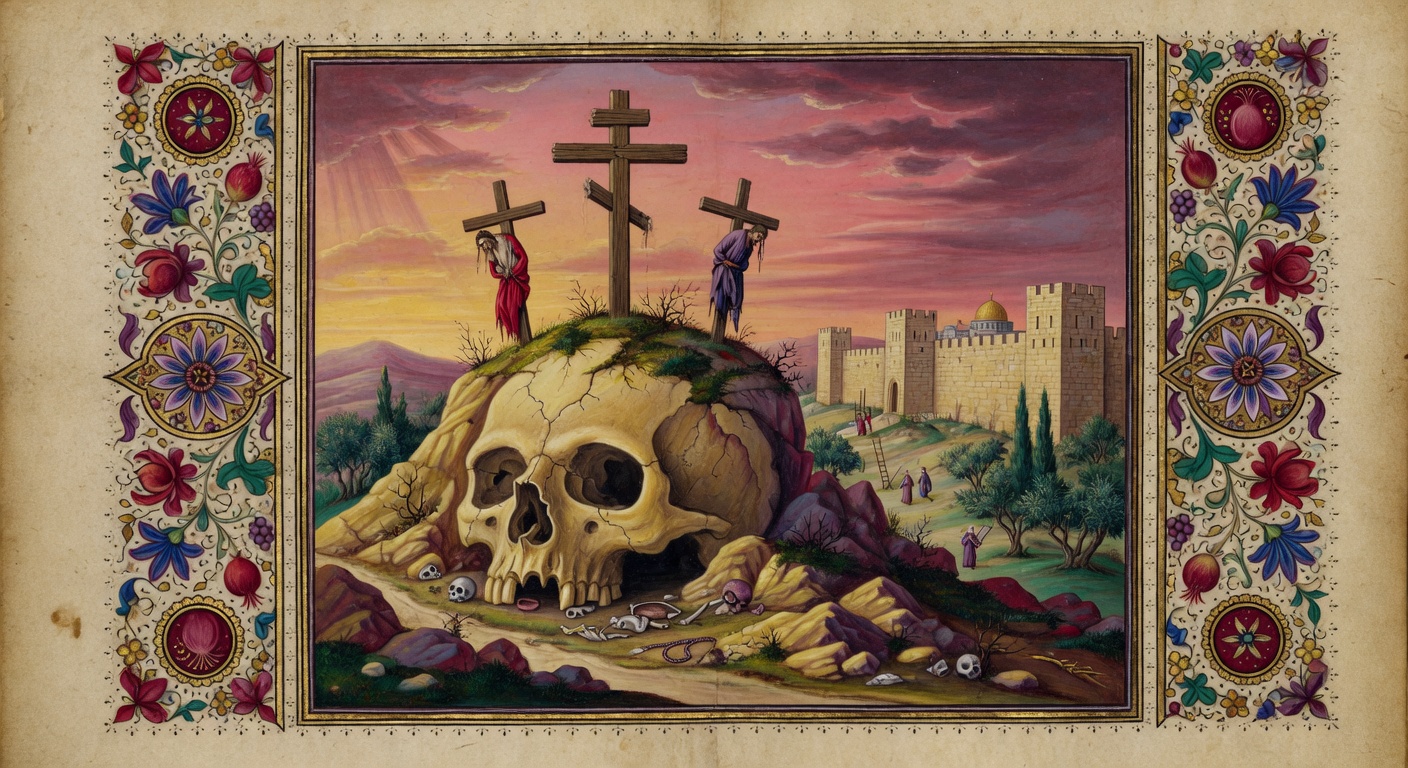
Golgotha, meaning the Place of the Skull, was an execution site located just outside the walls of Jerusalem during the first century. The New Testament Gospels record that Roman authorities crucified Jesus there between two criminals after his trial before Pontius Pilate, an event that fulfilled multiple Old Testament prophecies about the Messiah's suffering and death. This location holds central significance in Scripture because it marks the site where Jesus atoned for human sin through his sacrificial death, enabling reconciliation between God and humanity. The accounts in Matthew, Mark, Luke, and John emphasize Golgotha as the pivotal setting for the crucifixion, which Christians view as the foundation for salvation and the subsequent resurrection.
Details
- Region
- Canaan
- Modern Location
- Church of the Holy Sepulchre or Gordon's Calvary, Jerusalem, Israel
Journey Paths
Key Passages
The Crucifixion
John 19:17-30
At this 'place of the skull' outside Jerusalem's walls, Jesus is crucified between two criminals - the most sacred ground in Christian faith, where sin is atoned.
 17nd he bearing his cross went forth into a place called the place of a skull, which is called in the Hebrew Golgotha:
Darkness Over the Land
Matthew 27:45-50
Three hours of supernatural darkness cover the land during the crucifixion - creation itself responds to the Creator's suffering, veiling the horror in cosmic mourning.
 45ow from the sixth hour there was darkness over all the land unto the ninth hour.
Did You Know?
Golgotha means 'Place of the Skull'. Possibly named for the skull-shaped rock formation.
The site was outside the city walls, as Roman law required executions outside city limits.
Two competing sites claim to be Golgotha: the Church of the Holy Sepulchre and Gordon's Calvary.