1 Corinthians 4 KJV
Apostles of Christ
1 Corinthians Chapter 4: Apostles of Christ
This chapter explores themes of Stewardship. Paul's self-description as a 'steward of the mysteries of God' draws on the Greco-Roman household manager (oikonomos) role, implying accountability to an absent master whose return will audit hidden motives rather than visible success.
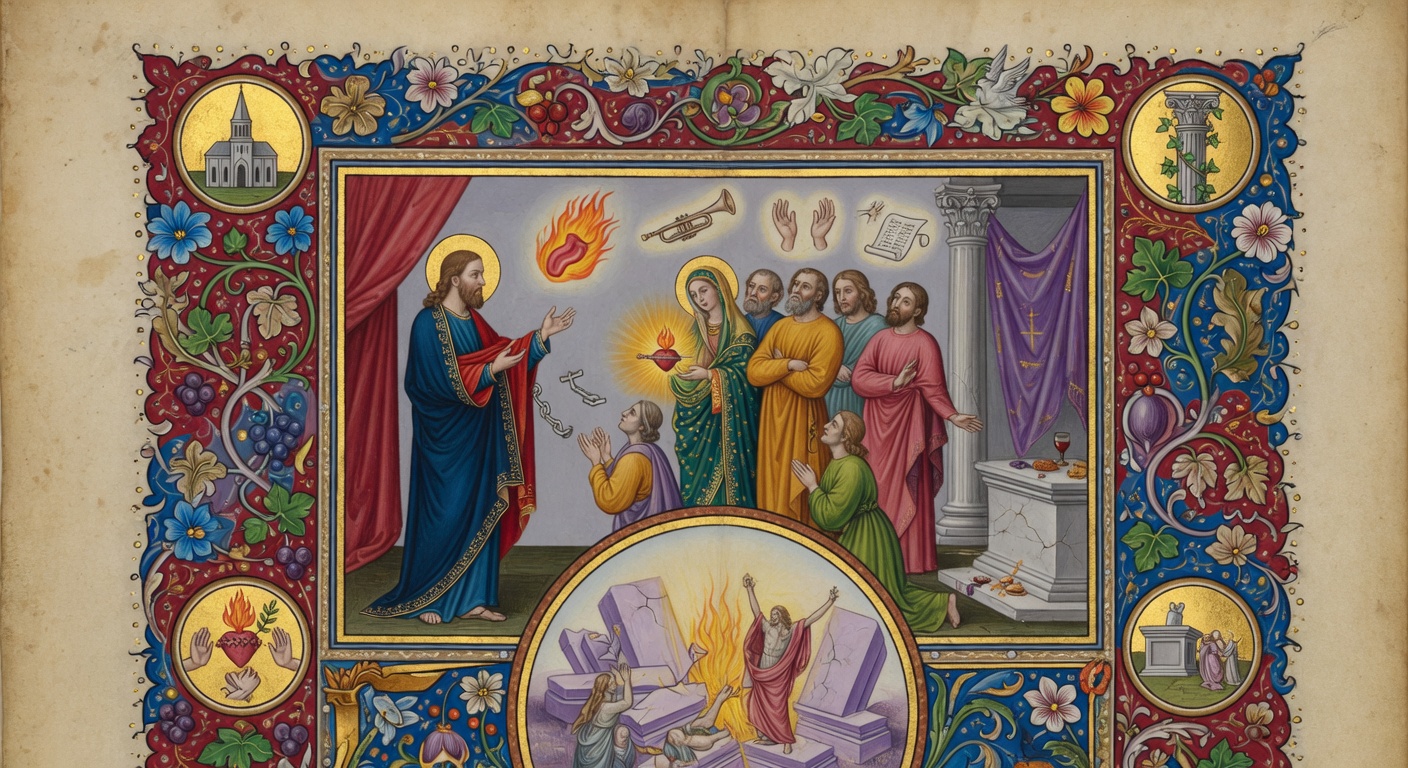
 1et a man so account of us, as of the ministers of Christ, and stewards of the mysteries of God.
2 Moreover it is required in stewards, that a man be found faithful.
3 But with me it is a very small thing that I should be judged of you, or of man’s judgment: yea, I judge not mine own self.
4 For I know nothing by myself; yet am I not hereby justified: but he that judgeth me is the Lord.
5 Therefore judge nothing before the time, until the Lord come, who both will bring to light the hidden things of darkness, and will make manifest the counsels of the hearts: and then shall every man have praise of God.
6 And these things, brethren, I have in a figure transferred to myself and to Apollos for your sakes; that ye might learn in us not to think of men above that which is written, that no one of you be puffed up for one against another.
7 For who maketh thee to differ from another? and what hast thou that thou didst not receive? now if thou didst receive it, why dost thou glory, as if thou hadst not received it?
8 Now ye are full, now ye are rich, ye have reigned as kings without us: and I would to God ye did reign, that we also might reign with you.
9 For I think that God hath set forth us the apostles last, as it were appointed to death: for we are made a spectacle unto the world, and to angels, and to men.
10 We are fools for Christ’s sake, but ye are wise in Christ; we are weak, but ye are strong; ye are honourable, but we are despised.
11 Even unto this present hour we both hunger, and thirst, and are naked, and are buffeted, and have no certain dwellingplace;
12 And labour, working with our own hands: being reviled, we bless; being persecuted, we suffer it:
13 Being defamed, we intreat: we are made as the filth of the world, and are the offscouring of all things unto this day.
14 I write not these things to shame you, but as my beloved sons I warn you.
15 For though ye have ten thousand instructors in Christ, yet have ye not many fathers: for in Christ Jesus I have begotten you through the gospel.
16 Wherefore I beseech you, be ye followers of me.
17 For this cause have I sent unto you Timotheus, who is my beloved son, and faithful in the Lord, who shall bring you into remembrance of my ways which be in Christ, as I teach every where in every church.
18 Now some are puffed up, as though I would not come to you.
19 But I will come to you shortly, if the Lord will, and will know, not the speech of them which are puffed up, but the power.
20 For the kingdom of God is not in word, but in power.
21 What will ye? shall I come unto you with a rod, or in love, and in the spirit of meekness?
← → arrow keys to navigate chapters · spacebar to play/pause audio
Did You Know?
Paul's self-description as a 'steward of the mysteries of God' draws on the Greco-Roman household manager (oikonomos) role, implying accountability to an absent master whose return will audit hidden motives rather than visible success.
The 'spectacle' (theatron) imagery in verse 9 alludes to Roman arena processions where condemned criminals or captives were paraded last before execution, inverting Corinthian notions of honor by casting apostles as public objects of derision under divine reversal.
Paul's claim that he does not even judge himself anticipates later patristic thought on the limits of introspection, subordinating conscience to the Lord's future disclosure of 'the hidden things of darkness' at the parousia.
The contrast between 'many tutors' (paidagōgoi) and 'not many fathers' exploits the Roman distinction between slave-attendants who enforced discipline and the authoritative paterfamilias, critiquing factional loyalties in Corinth as immature dependence on secondary figures.
The closing warning that the kingdom comes 'not in word, but in power' functions as a direct rebuttal to Corinthian rhetorical culture, where sophistic eloquence was prized, by tying authentic apostolic presence to Spirit-demonstrated authority rather than persuasive speech.
Commentary & Study Notes Jamieson-Fausset-Brown (1871) · Public Domain account... us — Paul and Apollos. ministers of Christ — not heads of the Church in whom ye are severally to glory (1Co 1:12); the headship belongs to Christ alone; we are but His s…
Classic verse-by-verse commentary on 1 Corinthians 4 from Jamieson, Fausset & Brown (1871). Covers: True view of ministers: the judgment is not to be forestalled; Meanwhile the apostles' low state contrasts with the corinthians' party pride, not that paul would shame them, but as a father warn them; For which end he sent timothy, and will soon come himself.
- 1
- account... us — Paul and Apollos. ministers of Christ — not heads of the Church in whom ye are severally to glory (1Co 1:12); the headship belongs to Christ alone; we are but His servants ministering to you (1Co 1:13; 3:5, 22). stewards — (Lu 12:42; 1Pe 4:10). Not the depositories of grace, but dispensers of it ("rightly dividing" or dispensing it), so far as God gives us it, to others. The chazan, or "overseer," in the synagogue answered to the bishop or "angel" of the Church, who called seven of the synagogue to read the law every sabbath, and oversaw them. The parnasin of the synagogue, like the ancient "deacon" of the Church, took care of the poor (Ac 6:1-7) and subsequently preached in subordination to the presbyters or bishops, as Stephen and Philip did. The Church is not the appendage to the priesthood; but the minister is the steward of God to the Church. Man shrinks from too close contact with God; hence he willingly puts a priesthood between, and would serve God by deputy. The pagan (like the modern Romish) priest was rather to conceal than to explain "the mysteries of God." The minister's office is to "preach" (literally, "proclaim as a herald," Mt 10:27) the deep truths of God ("mysteries," heavenly truths, only known by revelation), so far as they have been revealed, and so far as his hearers are disposed to receive them. JOSEPHUS says that the Jewish religion made known to all the people the mysteries of their religion, while the pagans concealed from all but the "initiated" few, the mysteries of theirs.
- 2
- Moreover — The oldest manuscripts read, "Moreover here" (that is, on earth). The contrast thus is between man's usage as to stewards (1Co 4:2), and God's way (1Co 4:3). Though here below, in the case of stewards, inquiry is made, that one man be found (that is, proved to be) faithful; yet God's steward awaits no such judgment of man, in man's day, but the Lord's judgment in His great day. Another argument against the Corinthians for their partial preferences of certain teachers for their gifts: whereas what God requires in His stewards is faithfulness (1Sa 3:20, Margin; Heb 3:5); as indeed is required in earthly stewards, but with this difference (1Co 4:3), that God's stewards await not man's judgment to test them, but the testing which shall be in the day of the Lord.
Read all 21 notes on 1 Corinthians 4 →