2 Peter 1 KJV
Growing in Faith
2 Peter Chapter 1: Growing in Faith
The virtue list in vv. 5-7 adapts Greco-Roman ethical catalogs but reorders them so that agape crowns the sequence, transforming Stoic self-mastery into participation in divine nature rather than mere human excellence.
 1imon Peter, a servant and an apostle of Jesus Christ, to them that have obtained like precious faith with us through the righteousness of God and our Saviour Jesus Christ:
2 Grace and peace be multiplied unto you through the knowledge of God, and of Jesus our Lord,
3 According as his divine power hath given unto us all things that pertain unto life and godliness, through the knowledge of him that hath called us to glory and virtue:
4 Whereby are given unto us exceeding great and precious promises: that by these ye might be partakers of the divine nature, having escaped the corruption that is in the world through lust.
5 And beside this, giving all diligence, add to your faith virtue; and to virtue knowledge;
6 And to knowledge temperance; and to temperance patience; and to patience godliness;
7 And to godliness brotherly kindness; and to brotherly kindness charity.
8 For if these things be in you, and abound, they make you that ye shall neither be barren nor unfruitful in the knowledge of our Lord Jesus Christ.
9 But he that lacketh these things is blind, and cannot see afar off, and hath forgotten that he was purged from his old sins.
10 Wherefore the rather, brethren, give diligence to make your calling and election sure: for if ye do these things, ye shall never fall:
11 For so an entrance shall be ministered unto you abundantly into the everlasting kingdom of our Lord and Saviour Jesus Christ.
12 Wherefore I will not be negligent to put you always in remembrance of these things, though ye know them, and be established in the present truth.
13 Yea, I think it meet, as long as I am in this tabernacle, to stir you up by putting you in remembrance;
14 Knowing that shortly I must put off this my tabernacle, even as our Lord Jesus Christ hath shewed me.
15 Moreover I will endeavour that ye may be able after my decease to have these things always in remembrance.
16 For we have not followed cunningly devised fables, when we made known unto you the power and coming of our Lord Jesus Christ, but were eyewitnesses of his majesty.
17 For he received from God the Father honour and glory, when there came such a voice to him from the excellent glory, This is my beloved Son, in whom I am well pleased.
18 And this voice which came from heaven we heard, when we were with him in the holy mount.
19 We have also a more sure word of prophecy; whereunto ye do well that ye take heed, as unto a light that shineth in a dark place, until the day dawn, and the day star arise in your hearts:
20 Knowing this first, that no prophecy of the scripture is of any private interpretation.
21 For the prophecy came not in old time by the will of man: but holy men of God spake as they were moved by the Holy Ghost.
← → arrow keys to navigate chapters · spacebar to play/pause audio
Did You Know?
The virtue list in vv. 5-7 adapts Greco-Roman ethical catalogs but reorders them so that agape crowns the sequence, transforming Stoic self-mastery into participation in divine nature rather than mere human excellence.
Verse 14's phrase 'shortly I must put off this tabernacle' employs tabernacle imagery from Exodus to frame Peter's death as priestly departure, echoing early traditions of his upside-down crucifixion in Rome under Nero.
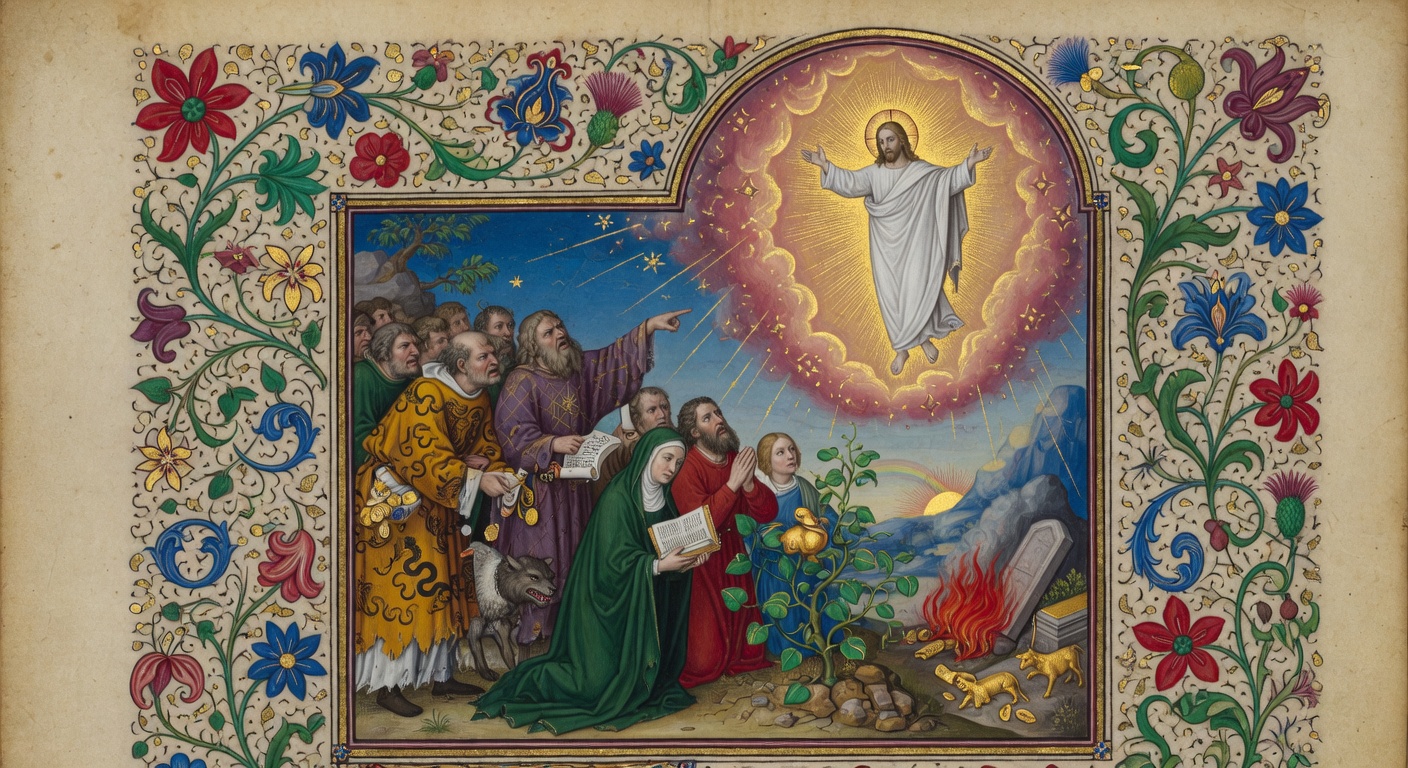
The rare term 'epoptai' (eyewitnesses) in v. 16, drawn from mystery-cult initiation language, is applied to the Transfiguration to present apostolic testimony as superior public revelation over private visionary claims of false teachers.
'Partakers of the divine nature' (v. 4) echoes Philonic and Hellenistic Jewish ideas of assimilation to God yet ties this sharing explicitly to future escape from corruption, giving an eschatological rather than mystical reading of theosis.
Verse 20's denial that prophecy arises from 'private interpretation' (idias epilyseos) functions not as a general hermeneutic rule but as a claim that true prophecy originates solely in the Spirit's movement, countering both charismatic excess and Gnostic secret exegesis.
Commentary & Study Notes Jamieson-Fausset-Brown (1871) · Public Domain Simon — the Greek form: in oldest manuscripts, "Symeon" (Hebrew, that is, "hearing), as in Ac 15:14. His mention of his original name accords with the design of this Second Epistle…
Classic verse-by-verse commentary on 2 Peter 1 from Jamieson, Fausset & Brown (1871). Covers: Address: exhortation to all graces, as God has given us, in the knowledge of Christ, all things pertaining to life: confirmed by the testimony of apostles, and also prophets, to the power and coming of Christ.
- 1
- Simon — the Greek form: in oldest manuscripts, "Symeon" (Hebrew, that is, "hearing), as in Ac 15:14. His mention of his original name accords with the design of this Second Epistle, which is to warn against the coming false teachers, by setting forth the true "knowledge" of Christ on the testimony of the original apostolic eye-witnesses like himself. This was not required in the First Epistle. servant — "slave": so Paul, Ro 1:1. to them, &c. — He addresses a wider range of readers (all believers) than in the First Epistle, 2Pe 1:1, but means to include especially those addressed in the First Epistle, as 2Pe 3:1 proves. obtained — by grace. Applied by Peter to the receiving of the apostleship, literally, "by allotment": as the Greek is, Lu 1:9; Joh 19:24. They did not acquire it for themselves; the divine election is as independent of man's control, as the lot which is east forth. like precious — "equally precious" to all: to those who believe, though not having seen Christ, as well as to Peter and those who have seen Him. For it lays hold of the same "exceeding great and precious promises," and the same "righteousness of God our Saviour." "The common salvation... the faith once delivered unto the saints" (Jude 3). with us — apostles and eye-witnesses (2Pe 1:18). Though putting forward his apostleship to enforce his exhortation, he with true humility puts himself, as to "the faith," on a level with all other believers. The degree of faith varies in different believers; but in respect to its objects, present justification, sanctification, and future glorification, it is common alike to all. Christ is to all believers "made of God wisdom, righteousness, sanctification, and redemption." through — Greek, "in." Translate, as the one article to both nouns requires, "the righteousness of Him who is (at once) our God and (our) Saviour." Peter, confirming Pau;'s testimony to the same churches, adopts Paul's inspired phraseology. The Gospel plan sets forth God's righteousness, which is Christ's righteousness, in the brightest light. Faith has its sphere IN it as its peculiar element: God is in redemption "righteous," and at the same time a "Saviour"; compare Isa 45:21, "a just God and a Saviour.
- 2
- Grace... peace — (1Pe 1:2). through — Greek, "in": the sphere IN which alone grace and peace can be multiplied. knowledge — Greek, "full knowledge." of God, and of Jesus our Lord — The Father is here meant by "God," but the Son in 2Pe 1:1: marking how entirely one the Father and Son are (Joh 14:7-11). The Vulgate omits "of God and"; but oldest manuscripts support the words. Still the prominent object of Peter's exhortation is "the knowledge of Jesus our Lord" (a phrase only in Ro 4:24), and, only secondarily, of the Father through Him (2Pe 1:8; 2Pe 2:20; 3:18).
Read all 21 notes on 2 Peter 1 →