2 Timothy 4 KJV
Preach the Word
2 Timothy Chapter 4: Preach the Word
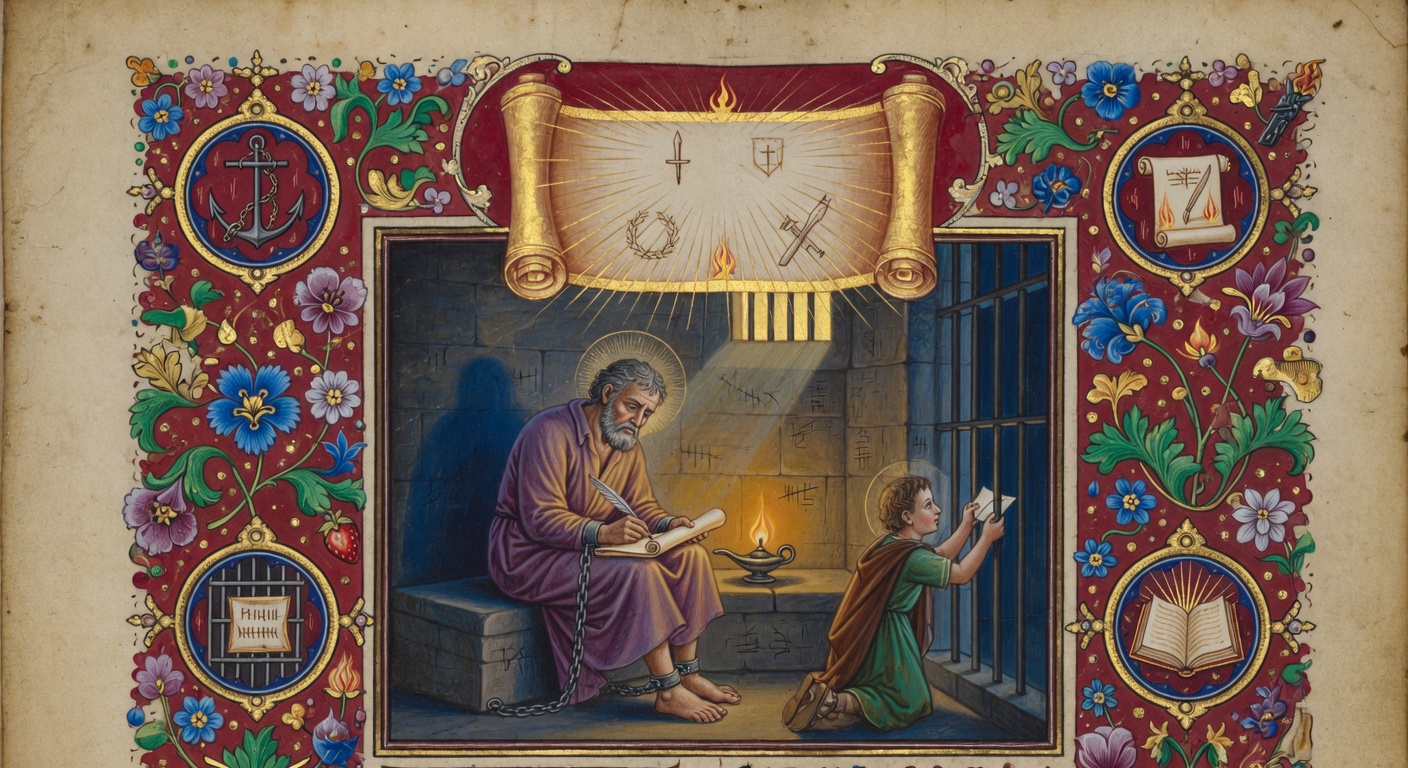
Paul's request for the cloak left with Carpus at Troas underscores his vulnerability to cold in a Roman dungeon, humanizing the apostle while echoing Old Testament prophetic calls like Elijah's mantle as symbols of transferred spiritual authority.
 1 charge thee therefore before God, and the Lord Jesus Christ, who shall judge the quick and the dead at his appearing and his kingdom;
2 Preach the word; be instant in season, out of season; reprove, rebuke, exhort with all longsuffering and doctrine.
3 For the time will come when they will not endure sound doctrine; but after their own lusts shall they heap to themselves teachers, having itching ears;
4 And they shall turn away their ears from the truth, and shall be turned unto fables.
5 But watch thou in all things, endure afflictions, do the work of an evangelist, make full proof of thy ministry.
6 For I am now ready to be offered, and the time of my departure is at hand.
7 I have fought a good fight, I have finished my course, I have kept the faith:
8 Henceforth there is laid up for me a crown of righteousness, which the Lord, the righteous judge, shall give me at that day: and not to me only, but unto all them also that love his appearing.
9 Do thy diligence to come shortly unto me:
10 For Demas hath forsaken me, having loved this present world, and is departed unto Thessalonica; Crescens to Galatia, Titus unto Dalmatia.
11 Only Luke is with me. Take Mark, and bring him with thee: for he is profitable to me for the ministry.
12 And Tychicus have I sent to Ephesus.
13 The cloke that I left at Troas with Carpus, when thou comest, bring with thee, and the books, but especially the parchments.
14 Alexander the coppersmith did me much evil: the Lord reward him according to his works:
15 Of whom be thou ware also; for he hath greatly withstood our words.
16 At my first answer no man stood with me, but all men forsook me: I pray God that it may not be laid to their charge.
17 Notwithstanding the Lord stood with me, and strengthened me; that by me the preaching might be fully known, and that all the Gentiles might hear: and I was delivered out of the mouth of the lion.
18 And the Lord shall deliver me from every evil work, and will preserve me unto his heavenly kingdom: to whom be glory for ever and ever. Amen.
19 Salute Prisca and Aquila, and the household of Onesiphorus.
20 Erastus abode at Corinth: but Trophimus have I left at Miletum sick.
21 Do thy diligence to come before winter. Eubulus greeteth thee, and Pudens, and Linus, and Claudia, and all the brethren.
22 The Lord Jesus Christ be with thy spirit. Grace be with you. Amen.
← → arrow keys to navigate chapters · spacebar to play/pause audio
Did You Know?
Paul's request for the cloak left with Carpus at Troas underscores his vulnerability to cold in a Roman dungeon, humanizing the apostle while echoing Old Testament prophetic calls like Elijah's mantle as symbols of transferred spiritual authority.
The warning against Alexander the coppersmith, who 'did me much evil,' likely alludes to a figure from Acts 19's Ephesian riot but shifts from silversmith to metalworker, highlighting ongoing personal opposition to Paul's mission from trade guilds threatened by Christian conversion.
The phrase 'I have fought a good fight, I have finished my course' draws on Greco-Roman athletic imagery from the Isthmian games near Corinth, framing Paul's ministry as a completed contest whose victor receives not a fading wreath but the 'crown of righteousness' shared with all believers.
Paul's note that only Luke remained with him during his final imprisonment contrasts with the desertion of Demas for 'this present world,' illustrating the theological tension between worldly attachment and endurance that echoes Jesus' warnings in the Parable of the Sower.
The appeal to 'the books, but especially the parchments' suggests Paul sought either Old Testament scrolls or personal writings for continued study and composition, revealing an expectation of further ministry or defense even after his 'departure' was at hand.
Commentary & Study Notes Jamieson-Fausset-Brown (1871) · Public Domain charge — Greek, "adjure." therefore — omitted in the oldest manuscripts. the Lord Jesus Christ — The oldest manuscripts read simply, "Christ Jesus." shall judge — His commission fr…
Classic verse-by-verse commentary on 2 Timothy 4 from Jamieson, Fausset & Brown (1871). Covers: Solemn charge to timothy to do his duty zealously, for times of apostasy are at hand, and the apostle is near his triumphant end: requests him to come and bring mark with him to rome, as luke alone is with him, the others having gone: also his cloak and parchments: warns him against alexander: tells what befell him at his first defense: greetings: benediction.
- 1
- charge — Greek, "adjure." therefore — omitted in the oldest manuscripts. the Lord Jesus Christ — The oldest manuscripts read simply, "Christ Jesus." shall judge — His commission from God is mentioned, Ac 10:42; his resolution to do so, 1Pe 4:5; the execution of his commission, here. at his appearing — The oldest manuscripts read, "and" for "at"; then translate, "(I charge thee before God... ) and by His appearing." and his kingdom — to be set at His appearing, when we hope to reign with Him. His kingdom is real now, but not visible. It shall then be both real and visible (Lu 22:18, 30; Re 1:7; 11:15; 19:6). Now he reigns in the midst of His enemies expecting till they shall be overthrown (Ps 110:2; Heb 10:13). Then He shall reign with His adversaries prostrate.
- 2
- Preach — literally, "proclaim as a herald." The term for the discourses in the synagogue was daraschoth; the corresponding Greek term (implying dialectial style, dialogue, and discussion, Ac 17:2, 18; 18:4, 19) is applied in Acts to discourses in the Christian Church. JUSTIN MARTYR [Apology, 2], describes the order of public worship, "On Sunday all meet and the writings of the apostles and prophets are read; then the president delivers a discourse; after this all stand up and pray; then there is offered bread and wine and water; the president likewise prays and gives thanks, and the people solemnly assent, saying, Amen." The bishops and presbyters had the right and duty to preach, but they sometimes called on deacons, and even laymen, to preach. EUSEBIUS [Ecclesiastical History, 6.19]; in this the Church imitated the synagogue (Lu 4:17-22; Ac 13:15, 16). be instant — that is, urgent, earnest, in the whole work of the ministry. in season, out of season — that is, at all seasons; whether they regard your speaking as seasonable or unseasonable. "Just as the fountains, though none may draw from them, still flow on; and the rivers, though none drink of them, still run; so must we do all on our part in speaking, though none give heed to us" [CHRYSOSTOM, Homily, 30, vol. 5., p. 221]. I think with CHRYSOSTOM, there is included also the idea of times whether seasonable or unseasonable to Timothy himself; not merely when convenient, but when inconvenient to thee, night as well as day (Ac 20:31), in danger as well as in safety, in prison and when doomed to death as well as when at large, not only in church, but everywhere and on all occasions, whenever and wherever the Lord's work requires it. reprove — "convict," "confute." with, &c. — Greek, "IN (the element in which the exhortation ought to have place) all long-suffering (2Ti 2:24, 25; 3:10) and teaching"; compare 2Ti 2:24, "apt to teach." The Greek for "doctrine" here is didache, but in 2Ti 3:16, didascalia. "Didascalia" is what one receives; "didache" is what is communicated [TITTMANN].
Read all 22 notes on 2 Timothy 4 →