Deuteronomy 33 KJV
Moses Blesses the Tribes
Deuteronomy Chapter 33: Moses Blesses the Tribes
The omission of Simeon from the tribal blessings, unlike its pairing with Levi in Genesis 49, may reflect the tribe's early historical decline and partial absorption into Judah, a detail underscoring Deuteronomy's concern with the evolving tribal confederacy.
 1nd this is the blessing, wherewith Moses the man of God blessed the children of Israel before his death.
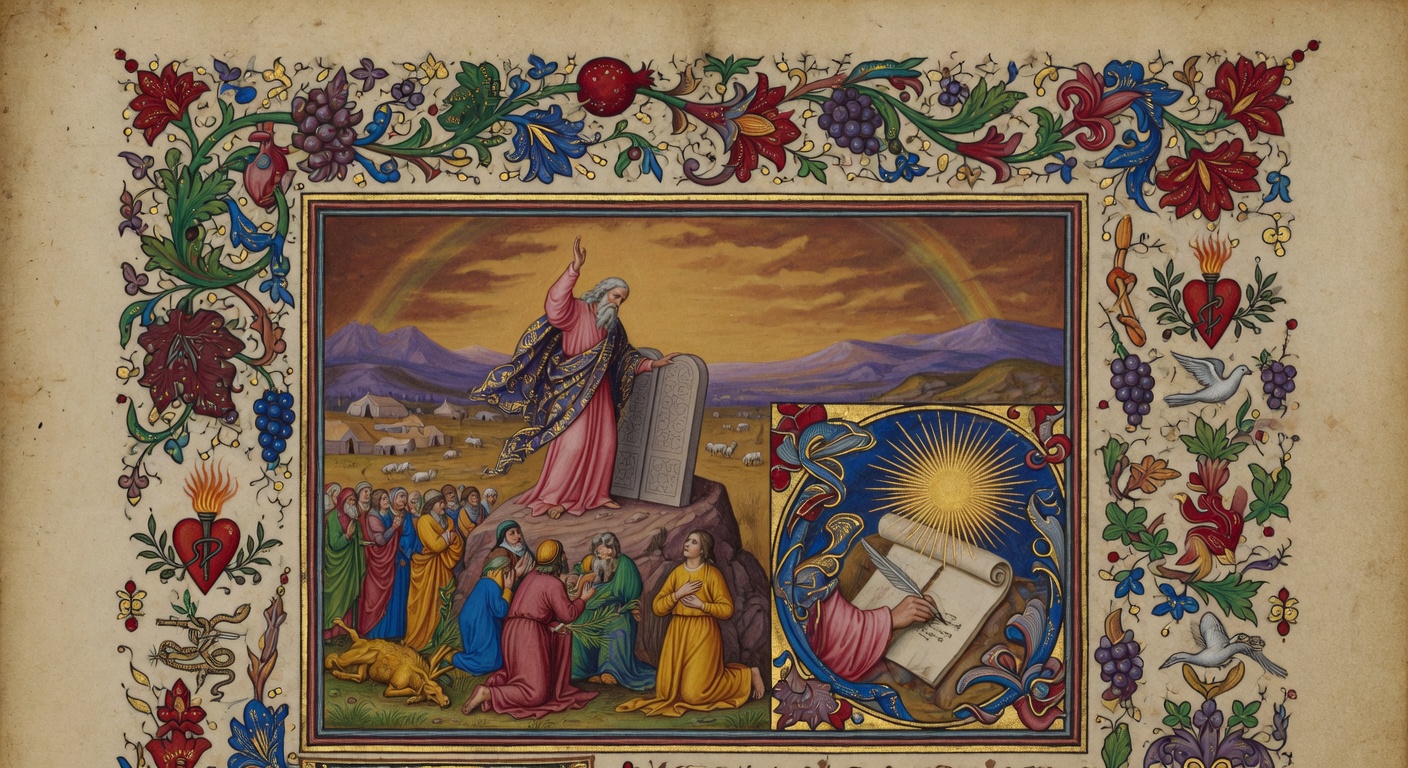
2 And he said, The LORD came from Sinai, and rose up from Seir unto them; he shined forth from mount Paran, and he came with ten thousands of saints: from his right hand went a fiery law for them.
3 Yea, he loved the people; all his saints are in thy hand: and they sat down at thy feet; every one shall receive of thy words.
4 Moses commanded us a law, even the inheritance of the congregation of Jacob.
5 And he was king in Jeshurun, when the heads of the people and the tribes of Israel were gathered together.
6 Let Reuben live, and not die; and let not his men be few.
7 And this is the blessing of Judah: and he said, Hear, LORD, the voice of Judah, and bring him unto his people: let his hands be sufficient for him; and be thou an help to him from his enemies.
8 And of Levi he said, Let thy Thummim and thy Urim be with thy holy one, whom thou didst prove at Massah, and with whom thou didst strive at the waters of Meribah;
9 Who said unto his father and to his mother, I have not seen him; neither did he acknowledge his brethren, nor knew his own children: for they have observed thy word, and kept thy covenant.
10 They shall teach Jacob thy judgments, and Israel thy law: they shall put incense before thee, and whole burnt sacrifice upon thine altar.
11 Bless, LORD, his substance, and accept the work of his hands: smite through the loins of them that rise against him, and of them that hate him, that they rise not again.
12 And of Benjamin he said, The beloved of the LORD shall dwell in safety by him; and the Lord shall cover him all the day long, and he shall dwell between his shoulders.
13 And of Joseph he said, Blessed of the LORD be his land, for the precious things of heaven, for the dew, and for the deep that coucheth beneath,
14 And for the precious fruits brought forth by the sun, and for the precious things put forth by the moon,
15 And for the chief things of the ancient mountains, and for the precious things of the lasting hills,
16 And for the precious things of the earth and fulness thereof, and for the good will of him that dwelt in the bush: let the blessing come upon the head of Joseph, and upon the top of the head of him that was separated from his brethren.
17 His glory is like the firstling of his bullock, and his horns are like the horns of unicorns: with them he shall push the people together to the ends of the earth: and they are the ten thousands of Ephraim, and they are the thousands of Manasseh.
18 And of Zebulun he said, Rejoice, Zebulun, in thy going out; and, Issachar, in thy tents.
19 They shall call the people unto the mountain; there they shall offer sacrifices of righteousness: for they shall suck of the abundance of the seas, and of treasures hid in the sand.
20 And of Gad he said, Blessed be he that enlargeth Gad: he dwelleth as a lion, and teareth the arm with the crown of the head.
21 And he provided the first part for himself, because there, in a portion of the lawgiver, was he seated; and he came with the heads of the people, he executed the justice of the LORD, and his judgments with Israel.
22 And of Dan he said, Dan is a lion’s whelp: he shall leap from Bashan.
23 And of Naphtali he said, O Naphtali, satisfied with favour, and full with the blessing of the LORD: possess thou the west and the south.
24 And of Asher he said, Let Asher be blessed with children; let him be acceptable to his brethren, and let him dip his foot in oil.
25 Thy shoes shall be iron and brass; and as thy days, so shall thy strength be.
26 There is none like unto the God of Jeshurun, who rideth upon the heaven in thy help, and in his excellency on the sky.
27 The eternal God is thy refuge, and underneath are the everlasting arms: and he shall thrust out the enemy from before thee; and shall say, Destroy them.
28 Israel then shall dwell in safety alone: the fountain of Jacob shall be upon a land of corn and wine; also his heavens shall drop down dew.
29 Happy art thou, O Israel: who is like unto thee, O people saved by the LORD, the shield of thy help, and who is the sword of thy excellency! and thine enemies shall be found liars unto thee; and thou shalt tread upon their high places.
← → arrow keys to navigate chapters · spacebar to play/pause audio
Did You Know?
The omission of Simeon from the tribal blessings, unlike its pairing with Levi in Genesis 49, may reflect the tribe's early historical decline and partial absorption into Judah, a detail underscoring Deuteronomy's concern with the evolving tribal confederacy.
Moses' opening theophany in verses 2-3, with Yahweh dawning from Seir and Paran amid myriads of holy ones, parallels archaic poetic fragments in Judges 5 and Habakkuk 3, suggesting the chapter preserves pre-monarchic southern theophanic traditions.
Levi's blessing explicitly praises the tribe's fidelity during the Massah-Meribah testing, inverting the negative portrayal in Exodus 32 and elevating their priestly covenant role above the earlier patriarchal curse.
Joseph's extended oracle employs the rare image of horns like a 'unicorn' (re'em) to evoke ancient Near Eastern bull iconography of strength and double-portion inheritance, distinguishing it from the more agricultural tone of other tribal sayings.
The final benediction on Jeshurun, with its vision of Israel 'dwelling in safety' alone under divine protection, forms a deliberate inclusio with Deuteronomy 32's Song, framing the blessings as a counterpoint to the preceding covenant curses.
Commentary & Study Notes Jamieson-Fausset-Brown (1871) · Public Domain Moses the man of God — This was a common designation of a prophet (1Sa 2:27; 9:6), and it is here applied to Moses, when, like Jacob, he was about to deliver ministerially before h…
Classic verse-by-verse commentary on Deuteronomy 33 from Jamieson, Fausset & Brown (1871). Covers: The majesty of God.
- 1
- Moses the man of God — This was a common designation of a prophet (1Sa 2:27; 9:6), and it is here applied to Moses, when, like Jacob, he was about to deliver ministerially before his death, a prophetic benediction to Israel.
- 2-4
- The Lord came — Under a beautiful metaphor, borrowed from the dawn and progressive splendor of the sun, the Majesty of God is sublimely described as a divine light which appeared in Sinai and scattered its beams on all the adjoining region in directing Israel's march to Canaan. In these descriptions of a theophania, God is represented as coming from the south, and the allusion is in general to the thunderings and lightnings of Sinai; but other mountains in the same direction are mentioned with it. The location of Seir was on the east of the Ghor; mount Paran was either the chain on the west of the Ghor, or rather the mountains on the southern border of the desert towards the peninsula [ROBINSON]. (Compare Jud 5:4, 5; Ps 68:7, 8; Hab 3:3). ten thousands of saints — rendered by some, "with the ten thousand of Kadesh," or perhaps better still, "from Meribah" [EWALD]. a fiery law — so called both because of the thunder and lightning which accompanied its promulgation (Ex 19:16-18; De 4:11), and the fierce, unrelenting curse denounced against the violation of its precepts (2Co 3:7-9). Notwithstanding those awe-inspiring symbols of Majesty that were displayed on Sinai, the law was really given in kindness and love (De 33:3), as a means of promoting both the temporal and eternal welfare of the people. And it was "the inheritance of the congregation of Jacob," not only from the hereditary obligation under which that people were laid to observe it, but from its being the grand distinction, the peculiar privilege of the nation.
Read all 16 notes on Deuteronomy 33 →