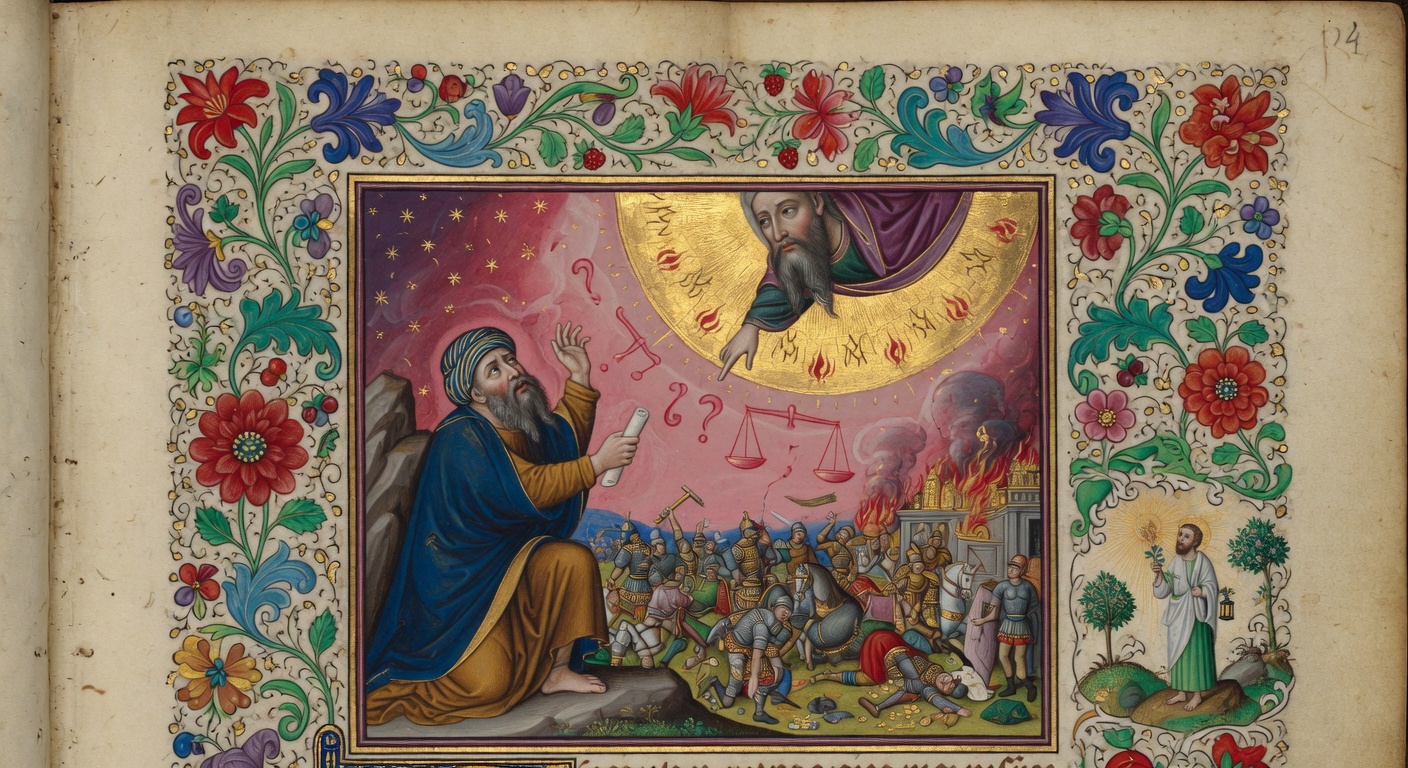
Habakkuk 1 KJV
Habakkuk's Complaint
Habakkuk Chapter 1: Habakkuk's Complaint
Habakkuk's opening complaint employs the Hebrew term 'chamas' (violence) repeatedly in verses 2-3, deliberately echoing its use in Genesis 6:11 to portray Judah's corruption as pre-flood in scale and invoking a covenant lawsuit motif against God.
 1he burden which Habakkuk the prophet did see.
2 O LORD, how long shall I cry, and thou wilt not hear! even cry out unto thee of violence, and thou wilt not save!
3 Why dost thou shew me iniquity, and cause me to behold grievance? for spoiling and violence are before me: and there are that raise up strife and contention.
4 Therefore the law is slacked, and judgment doth never go forth: for the wicked doth compass about the righteous; therefore wrong judgment proceedeth.
5 Behold ye among the heathen, and regard, and wonder marvellously: for I will work a work in your days, which ye will not believe, though it be told you.
6 For, lo, I raise up the Chaldeans, that bitter and hasty nation, which shall march through the breadth of the land, to possess the dwellingplaces that are not theirs.
7 They are terrible and dreadful: their judgment and their dignity shall proceed of themselves.
8 Their horses also are swifter than the leopards, and are more fierce than the evening wolves: and their horsemen shall spread themselves, and their horsemen shall come from far; they shall fly as the eagle that hasteth to eat.
9 They shall come all for violence: their faces shall sup up as the east wind, and they shall gather the captivity as the sand.
10 And they shall scoff at the kings, and the princes shall be a scorn unto them: they shall deride every strong hold; for they shall heap dust, and take it.
11 Then shall his mind change, and he shall pass over, and offend, imputing this his power unto his god.
12 Art thou not from everlasting, O LORD my God, mine Holy One? we shall not die. O LORD, thou hast ordained them for judgment; and, O mighty God, thou hast established them for correction.
13 Thou art of purer eyes than to behold evil, and canst not look on iniquity: wherefore lookest thou upon them that deal treacherously, and holdest thy tongue when the wicked devoureth the man that is more righteous than he?
14 And makest men as the fishes of the sea, as the creeping things, that have no ruler over them?
15 They take up all of them with the angle, they catch them in their net, and gather them in their drag: therefore they rejoice and are glad.
16 Therefore they sacrifice unto their net, and burn incense unto their drag; because by them their portion is fat, and their meat plenteous.
17 Shall they therefore empty their net, and not spare continually to slay the nations?
← → arrow keys to navigate chapters · spacebar to play/pause audio
Did You Know?
Habakkuk's opening complaint employs the Hebrew term 'chamas' (violence) repeatedly in verses 2-3, deliberately echoing its use in Genesis 6:11 to portray Judah's corruption as pre-flood in scale and invoking a covenant lawsuit motif against God.
The Chaldeans are introduced in verse 6 as a 'bitter and hasty nation' whose military advance is likened to leopards and evening wolves, imagery drawn from Assyrian royal annals that depicted swift conquests to terrify vassal states.
Verse 5's directive to 'wonder marvellously' at God's work uses a doubled Hebrew verb construction implying both awe and incredulity, a rhetorical device that later appears in the Septuagint rendering influencing Acts 13:41's warning against scoffing at divine acts.
Habakkuk personifies the Babylonians in verses 14-16 as fishermen dragging nations with hooks and nets, an image directly paralleling Neo-Assyrian and Babylonian victory steles that portrayed subjugated peoples as caught fish to symbolize total domination.
The prophet's rhetorical question in verse 13 about God beholding treachery without intervention mirrors the theodicy structure found in Jeremiah 12:1-2 and Psalm 73, situating Habakkuk within a shared wisdom-prophetic tradition questioning divine justice amid apparent moral inversion.