Habakkuk
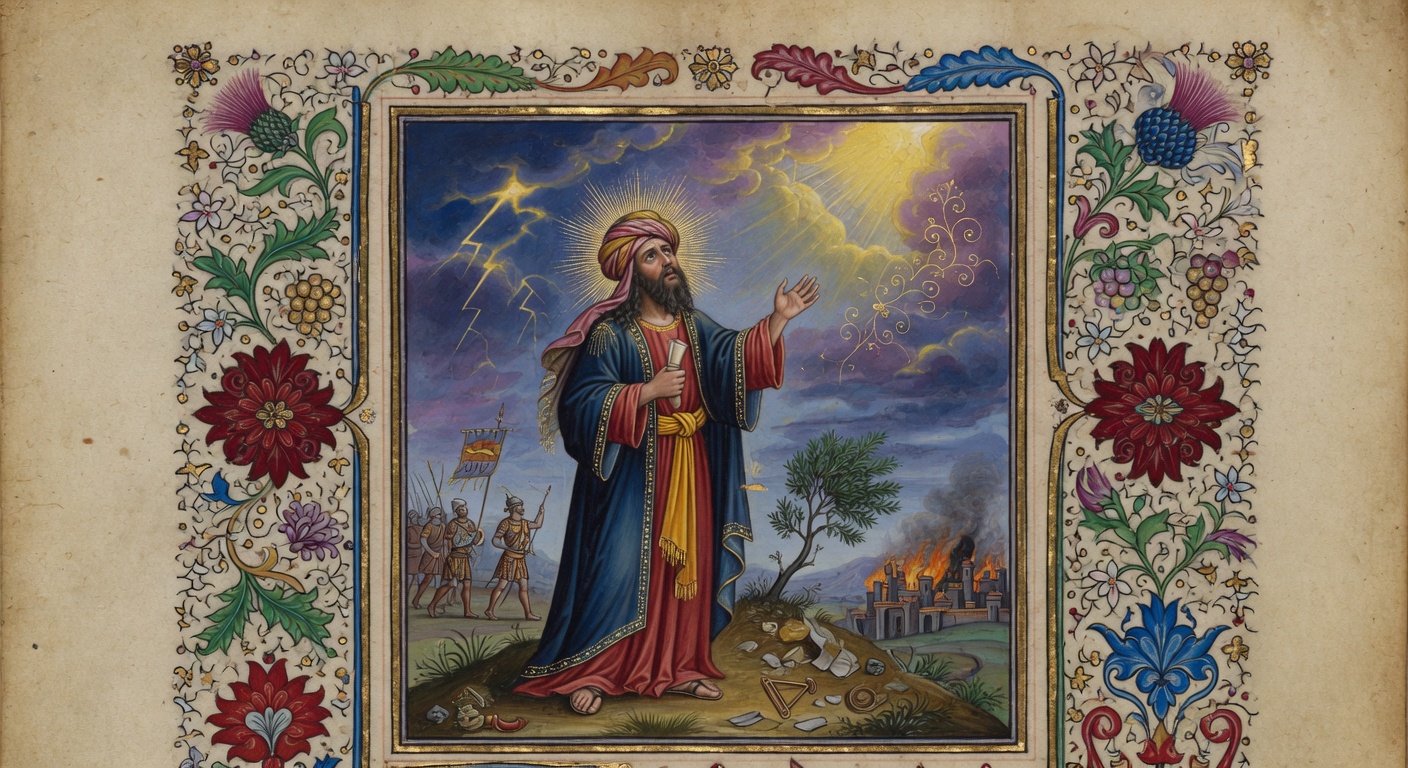
Habakkuk, a prophet active in Judah during the late seventh century BCE, openly questioned God about the unchecked evil and injustice he observed among his people and later about the use of the ruthless Babylonians as agents of divine judgment. Through a series of dialogues, God responded by affirming His sovereign plan and declaring that the righteous must live by faith while patiently awaiting the fulfillment of divine promises. This exchange highlights the tension between human perception of delayed justice and God's ultimate control over history. The book's central message, especially the principle that the just shall live by faith, carries lasting significance in Scripture as it is quoted in Romans, Galatians, and Hebrews to underscore justification by faith rather than works.
Biography
- Occupation
- Prophet
- Era
- Divided Kingdom (c. 610-600 BC)
- Nationality
- Judean
Did You Know?
Habakkuk's prophecy uniquely opens as a direct dialogue where the prophet lodges two complaints against God for tolerating Judah's internal injustice and then the greater violence of the Babylonians, a structure unmatched in other prophetic books.
The closing chapter of Habakkuk is an ancient hymn with musical notations such as "Shigionoth" and "Selah," incorporating theophanic imagery of God marching from Teman and Paran that echoes Canaanite poetic forms while affirming trust amid invasion.
Habakkuk 2:4's declaration that "the righteous shall live by his faith" was cited by Paul in Romans and Galatians to articulate justification by faith, later becoming central to Reformation theology despite originating in a 7th-century BCE context.
Writing shortly before the 605 BCE Battle of Carchemish, Habakkuk accurately foresaw the Neo-Babylonian Empire's sudden rise under the Chaldeans as God's appointed instrument of judgment on Judah, a detail that aligns with Babylonian chronicles.
The name Habakkuk, possibly derived from the Akkadian term for a garden plant or meaning "to embrace," appears nowhere else in the Hebrew Bible, underscoring the prophet's otherwise obscure identity amid the Divided Kingdom's collapse.
Key Passages
Habakkuk's Complaint
Habakkuk 1:1-4
Habakkuk's complaint shows that God welcomes our honest questions about injustice, inviting us to bring every struggle to Him in faith.
 1he burden which Habakkuk the prophet did see.
The Just Shall Live by Faith
Habakkuk 2:1-4
This passage shows that living by faith sustains us through uncertainty as we trust God's perfect plan.
 1 will stand upon my watch, and set me upon the tower, and will watch to see what he will say unto me, and what I shall answer when I am reproved.
Habakkuk's Prayer
Habakkuk 3:17-19
This passage shows how faith in God brings lasting joy and strength, even when every earthly source of security is gone.
 17lthough the fig tree shall not blossom, neither shall fruit be in the vines; the labour of the olive shall fail, and the fields shall yield no meat; the flock shall be cut off from the fold, and there shall be no herd in the stalls: