Habakkuk 3 KJV
Habakkuk's Prayer
Habakkuk Chapter 3: Habakkuk's Prayer
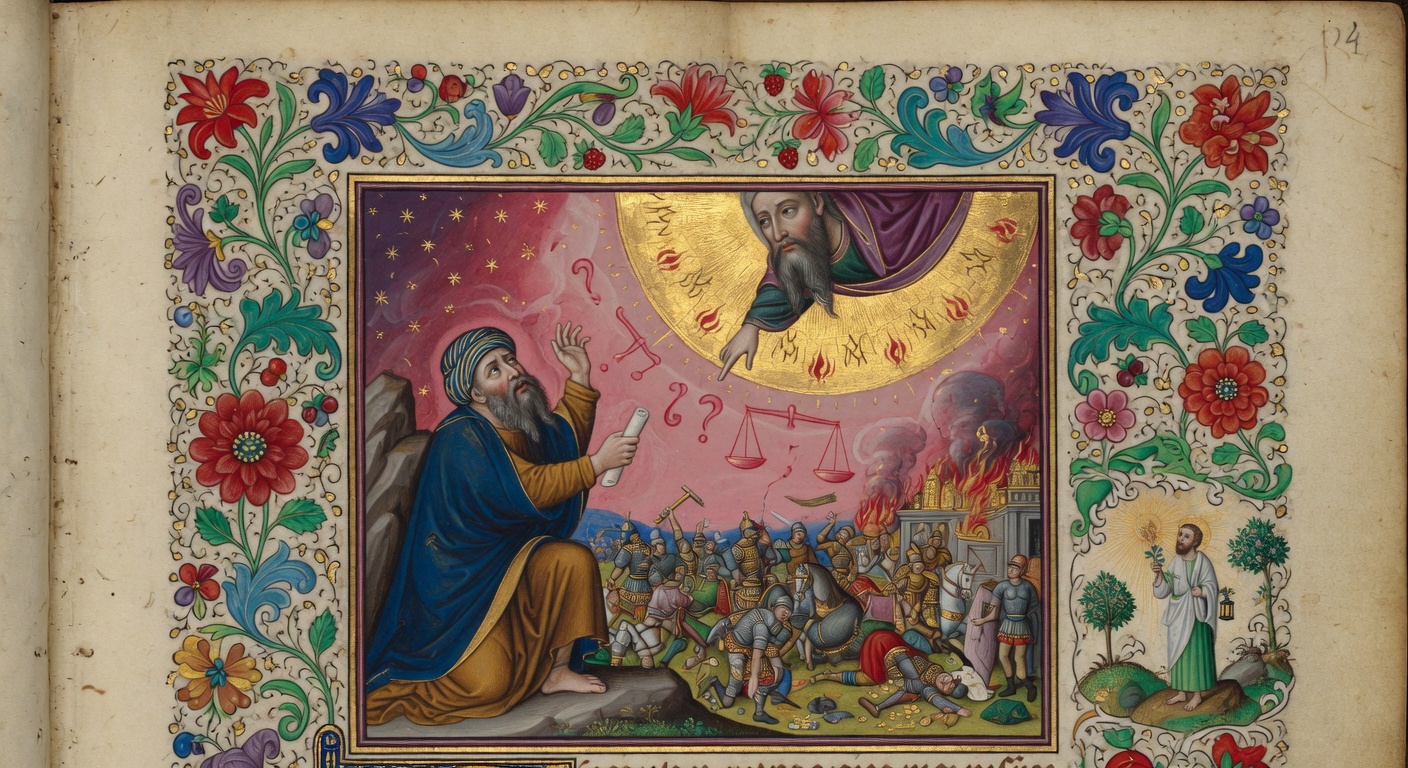
Habakkuk 3 reemploys the divine warrior theophany of Judges 5, reusing phrases about stars fighting and rivers sweeping away to portray Yahweh marching from southern deserts against new oppressors rather than Canaanites.
 1 prayer of Habakkuk the prophet upon Shigionoth.
2 O LORD, I have heard thy speech, and was afraid: O LORD, revive thy work in the midst of the years, in the midst of the years make known; in wrath remember mercy.
3 God came from Teman, and the Holy One from mount Paran. Selah. His glory covered the heavens, and the earth was full of his praise.
4 And his brightness was as the light; he had horns coming out of his hand: and there was the hiding of his power.
5 Before him went the pestilence, and burning coals went forth at his feet.
6 He stood, and measured the earth: he beheld, and drove asunder the nations; and the everlasting mountains were scattered, the perpetual hills did bow: his ways are everlasting.
7 I saw the tents of Cushan in affliction: and the curtains of the land of Midian did tremble.
8 Was the LORD displeased against the rivers? was thine anger against the rivers? was thy wrath against the sea, that thou didst ride upon thine horses and thy chariots of salvation?
9 Thy bow was made quite naked, according to the oaths of the tribes, even thy word. Selah. Thou didst cleave the earth with rivers.
10 The mountains saw thee, and they trembled: the overflowing of the water passed by: the deep uttered his voice, and lifted up his hands on high.
11 The sun and moon stood still in their habitation: at the light of thine arrows they went, and at the shining of thy glittering spear.
12 Thou didst march through the land in indignation, thou didst thresh the heathen in anger.
13 Thou wentest forth for the salvation of thy people, even for salvation with thine anointed; thou woundedst the head out of the house of the wicked, by discovering the foundation unto the neck. Selah.
14 Thou didst strike through with his staves the head of his villages: they came out as a whirlwind to scatter me: their rejoicing was as to devour the poor secretly.
15 Thou didst walk through the sea with thine horses, through the heap of great waters.
16 When I heard, my belly trembled; my lips quivered at the voice: rottenness entered into my bones, and I trembled in myself, that I might rest in the day of trouble: when he cometh up unto the people, he will invade them with his troops.
17 Although the fig tree shall not blossom, neither shall fruit be in the vines; the labour of the olive shall fail, and the fields shall yield no meat; the flock shall be cut off from the fold, and there shall be no herd in the stalls:
18 Yet I will rejoice in the LORD, I will joy in the God of my salvation.
19 The LORD God is my strength, and he will make my feet like hinds’ feet, and he will make me to walk upon mine high places. To the chief singer on my stringed instruments.
← → arrow keys to navigate chapters · spacebar to play/pause audio
Did You Know?
Habakkuk 3 reemploys the divine warrior theophany of Judges 5, reusing phrases about stars fighting and rivers sweeping away to portray Yahweh marching from southern deserts against new oppressors rather than Canaanites.
The Hebrew term qaran in verse 4 for rays or horns emerging from God's hand is identical to the word used for Moses' shining face in Exodus 34, creating a deliberate literary bridge between the Sinai revelation and this new vision of divine glory.
Verse 5 places deber and resheph (pestilence and fiery bolts) at God's feet, transforming Canaanite plague deities into subservient agents and echoing the Exodus plagues as a pattern for future judgment on nations.
The closing subscription directing the prayer to the chief singer on stringed instruments shows a prophetic oracle repurposed for temple liturgy, implying integration into post-exilic worship despite its origin outside the Psalter.
Verse 2's petition to revive God's work 'in the midst of the years' frames the chapter as an eschatological plea situated between past exodus acts and future fulfillment, modeling patient faith amid deferred salvation.
Commentary & Study Notes Jamieson-Fausset-Brown (1871) · Public Domain prayer — the only strictly called prayers are in Hab 3:2. But all devotional addresses to God are called "prayers" (Ps 72:20). The Hebrew is from a root "to apply to a judge for a…
Classic verse-by-verse commentary on Habakkuk 3 from Jamieson, Fausset & Brown (1871). Covers: Habakkuk's prayer to God: God's glorious revelation of himself at sinai and at gibeon, a pledge of his interposing again in behalf of Israel against Babylon, and all other foes; Hence the prophet's confidence amid calamities.
- 1
- prayer — the only strictly called prayers are in Hab 3:2. But all devotional addresses to God are called "prayers" (Ps 72:20). The Hebrew is from a root "to apply to a judge for a favorable decision." Prayers in which praises to God for deliverance, anticipated in the sure confidence of faith, are especially calculated to enlist Jehovah on His people's side (2Ch 20:20-22, 26). upon Shigionoth — a musical phrase, "after the manner of elegies," or mournful odes, from an Arabic root [LEE]; the phrase is singular in Ps 7:1, title. More simply, from a Hebrew root to "err," "on account of sins of ignorance." Habakkuk thus teaches his countrymen to confess not only their more grievous sins, but also their errors and negligences, into which they were especially likely to fall when in exile away from the Holy Land [CALVIN]. So Vulgate and AQUILA, and SYMMACHUS. "For voluntary transgressors" [JEROME]. Probably the subject would regulate the kind of music. DELITZSCH and HENDERSON translate, "With triumphal music," from the same root "to err," implying its enthusiastic irregularity.
- 2
- I have heard thy speech — Thy revelation to me concerning the coming chastisement of the Jews [CALVIN], and the destruction of their oppressors. This is Habakkuk's reply to God's communication [GROTIUS]. MAURER translates, "the report of Thy coming," literally, "Thy report." and was afraid — reverential fear of God's judgments (Hab 3:16). revive thy work — Perfect the work of delivering Thy people, and do not let Thy promise lie as if it were dead, but give it new life by performing it [MENOCHIUS]. CALVIN explains "thy work" to be Israel; called "the work of My hands" (Isa 45:11). God's elect people are peculiarly His work (Isa 43:1), pre-eminently illustrating His power, wisdom, and goodness. "Though we seem, as it were, dead nationally, revive us" (Ps 85:6). However (Ps 64:9), where "the work of God" refers to His judgment on their enemies, favors the former view (Ps 90:16, 17; Isa 51:9, 10). in the midst of the years — namely, of calamity in which we live. Now that our calamities are at their height; during our seventy years' captivity. CALVIN more fancifully explains it, in the midst of the years of Thy people, extending from Abraham to Messiah; if they be cut off before His coming, they will be cut off as it were in the midst of their years, before attaining their maturity. So BENGEL makes the midst of the years to be the middle point of the years of the world. There is a strikingly similar phrase (Da 9:27), In the midst of the week. The parallel clause, "in wrath" (that is, in the midst of wrath), however, shows that "in the midst of the years" means "in the years of our present exile and calamity." make known — Made it (Thy work) known by experimental proof; show in very deed, that this is Thy work.
Read all 19 notes on Habakkuk 3 →