Job 12 KJV
Job's Reply: God's Sovereignty
Job Chapter 12: Job's Reply: God's Sovereignty
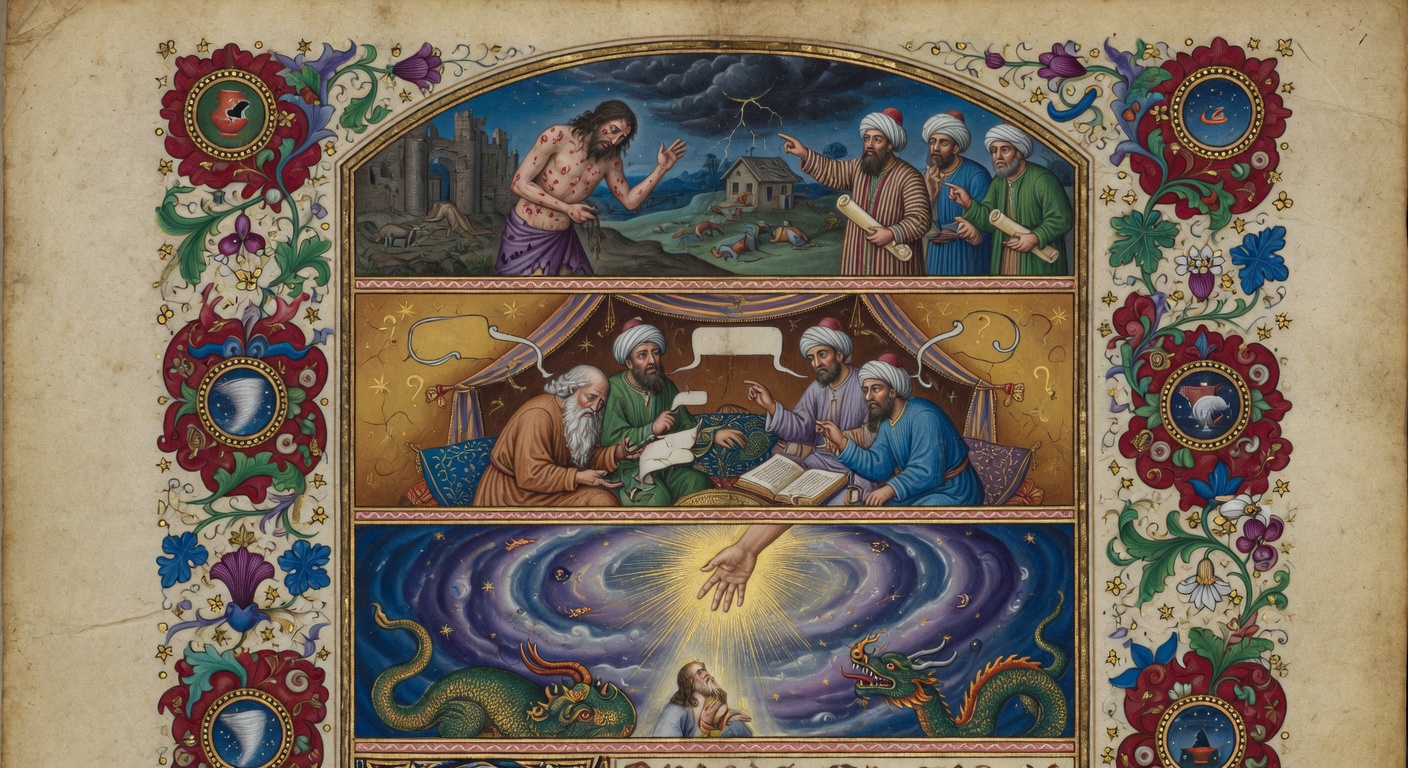
Job's appeal to the instinctive knowledge of beasts, fowls, and fish (vv. 7-9) functions as an implicit critique of Eliphaz's earlier claim to special revelation, positioning creation itself as a more reliable witness to divine sovereignty than the friends' accumulated tradition.
 1nd Job answered and said,
2 No doubt but ye are the people, and wisdom shall die with you.
3 But I have understanding as well as you; I am not inferior to you: yea, who knoweth not such things as these?
4 I am as one mocked of his neighbour, who calleth upon God, and he answereth him: the just upright man is laughed to scorn.
5 He that is ready to slip with his feet is as a lamp despised in the thought of him that is at ease.
6 The tabernacles of robbers prosper, and they that provoke God are secure; into whose hand God bringeth abundantly.
7 But ask now the beasts, and they shall teach thee; and the fowls of the air, and they shall tell thee:
8 Or speak to the earth, and it shall teach thee: and the fishes of the sea shall declare unto thee.
9 Who knoweth not in all these that the hand of the LORD hath wrought this?
10 In whose hand is the soul of every living thing, and the breath of all mankind.
11 Doth not the ear try words? and the mouth taste his meat?
12 With the ancient is wisdom; and in length of days understanding.
13 With him is wisdom and strength, he hath counsel and understanding.
14 Behold, he breaketh down, and it cannot be built again: he shutteth up a man, and there can be no opening.
15 Behold, he withholdeth the waters, and they dry up: also he sendeth them out, and they overturn the earth.
16 With him is strength and wisdom: the deceived and the deceiver are his.
17 He leadeth counsellors away spoiled, and maketh the judges fools.
18 He looseth the bond of kings, and girdeth their loins with a girdle.
19 He leadeth princes away spoiled, and overthroweth the mighty.
20 He removeth away the speech of the trusty, and taketh away the understanding of the aged.
21 He poureth contempt upon princes, and weakeneth the strength of the mighty.
22 He discovereth deep things out of darkness, and bringeth out to light the shadow of death.
23 He increaseth the nations, and destroyeth them: he enlargeth the nations, and straiteneth them again.
24 He taketh away the heart of the chief of the people of the earth, and causeth them to wander in a wilderness where there is no way.
25 They grope in the dark without light, and he maketh them to stagger like a drunken man.
← → arrow keys to navigate chapters · spacebar to play/pause audio
Did You Know?
Job's appeal to the instinctive knowledge of beasts, fowls, and fish (vv. 7-9) functions as an implicit critique of Eliphaz's earlier claim to special revelation, positioning creation itself as a more reliable witness to divine sovereignty than the friends' accumulated tradition.
The declaration that both 'the deceived and the deceiver are his' (v. 16) introduces a radical extension of sovereignty that includes moral and epistemological deception, unsettling the friends' assumption that truth and blessing are reliably linked.
Job's catalog of overturned authorities (vv. 17-21) deliberately inverts conventional ancient Near Eastern royal hymns that celebrate a god's support for kings and priests, instead portraying God as systematically dismantling every human structure of power.
Verse 12's reference to wisdom residing 'with the ancient' is a pointed echo of the prologue's emphasis on Job's own advanced age and status, allowing him to appropriate his friends' argument from seniority only to subvert it by directing attention to God's superior wisdom.
The chapter's closing description of God 'discovering deep things out of darkness' (v. 22) anticipates the later divine speeches while also ironically describing Job's own experience of being plunged into darkness, suggesting that revelation and affliction are intertwined.