Job 29 KJV
Job's Former Blessings
Job Chapter 29: Job's Former Blessings
Job's reference to 'the secret of God' upon his tabernacle (v.4) evokes the intimate divine counsel shared in ancient Near Eastern wisdom traditions, portraying his former life as one of privileged access to God's hidden purposes rather than mere material blessing.
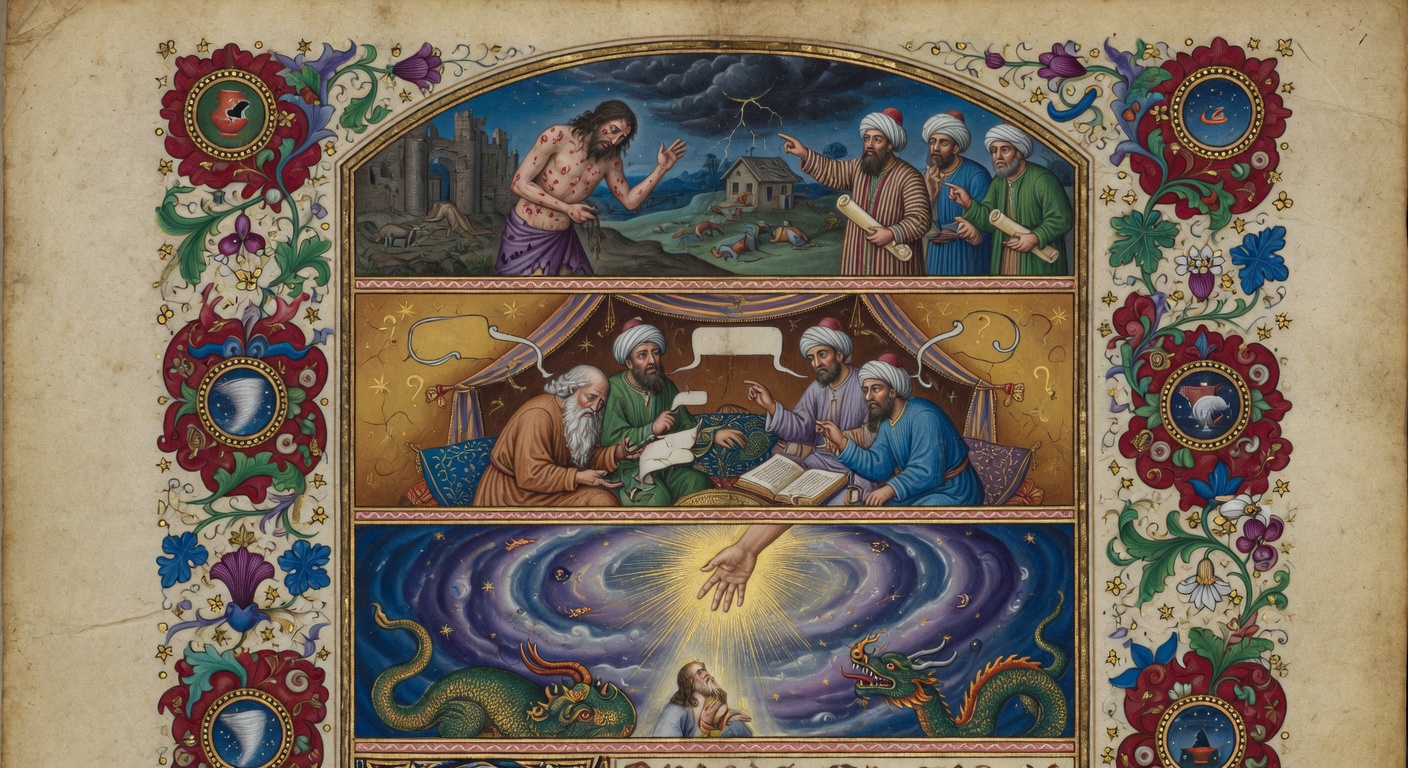
 1oreover Job continued his parable, and said,
2 Oh that I were as in months past, as in the days when God preserved me;
3 When his candle shined upon my head, and when by his light I walked through darkness;
4 As I was in the days of my youth, when the secret of God was upon my tabernacle;
5 When the Almighty was yet with me, when my children were about me;
6 When I washed my steps with butter, and the rock poured me out rivers of oil;
7 When I went out to the gate through the city, when I prepared my seat in the street!
8 The young men saw me, and hid themselves: and the aged arose, and stood up.
9 The princes refrained talking, and laid their hand on their mouth.
10 The nobles held their peace, and their tongue cleaved to the roof of their mouth.
11 When the ear heard me, then it blessed me; and when the eye saw me, it gave witness to me:
12 Because I delivered the poor that cried, and the fatherless, and him that had none to help him.
13 The blessing of him that was ready to perish came upon me: and I caused the widow’s heart to sing for joy.
14 I put on righteousness, and it clothed me: my judgment was as a robe and a diadem.
15 I was eyes to the blind, and feet was I to the lame.
16 I was a father to the poor: and the cause which I knew not I searched out.
17 And I brake the jaws of the wicked, and plucked the spoil out of his teeth.
18 Then I said, I shall die in my nest, and I shall multiply my days as the sand.
19 My root was spread out by the waters, and the dew lay all night upon my branch.
20 My glory was fresh in me, and my bow was renewed in my hand.
21 Unto me men gave ear, and waited, and kept silence at my counsel.
22 After my words they spake not again; and my speech dropped upon them.
23 And they waited for me as for the rain; and they opened their mouth wide as for the latter rain.
24 If I laughed on them, they believed it not; and the light of my countenance they cast not down.
25 I chose out their way, and sat chief, and dwelt as a king in the army, as one that comforteth the mourners.
← → arrow keys to navigate chapters · spacebar to play/pause audio
Did You Know?
Job's reference to 'the secret of God' upon his tabernacle (v.4) evokes the intimate divine counsel shared in ancient Near Eastern wisdom traditions, portraying his former life as one of privileged access to God's hidden purposes rather than mere material blessing.
The tree imagery of roots spread by waters and dew on branches (v.19) parallels cosmic tree motifs in Mesopotamian and Canaanite literature, symbolizing Job's former life as sustained by subterranean divine sources of vitality now severed.
Job's claim to have 'broken the jaws of the wicked' (v.17) employs forensic combat language drawn from ancient legal proceedings, casting his social justice work as physical intervention in disputes at the city gate rather than abstract charity.
The chapter's retrospective structure directly inverts the humiliations of chapter 30, forming a deliberate literary diptych that underscores the wisdom theme of sudden status reversal akin to Egyptian and Babylonian sufferer poems.
Job's description of young men hiding and princes refraining from speech (vv.8-10) reflects the ancient Israelite expectation that true authority derives from demonstrated righteousness at the gate, not inherited rank, inverting typical ANE hierarchies.