Job 31 KJV
Job's Final Defense
Job Chapter 31: Job's Final Defense
Job's 'covenant with mine eyes' (v.1) constitutes one of the earliest explicit biblical commitments to purity of thought rather than mere action, prefiguring later teachings on interior righteousness.
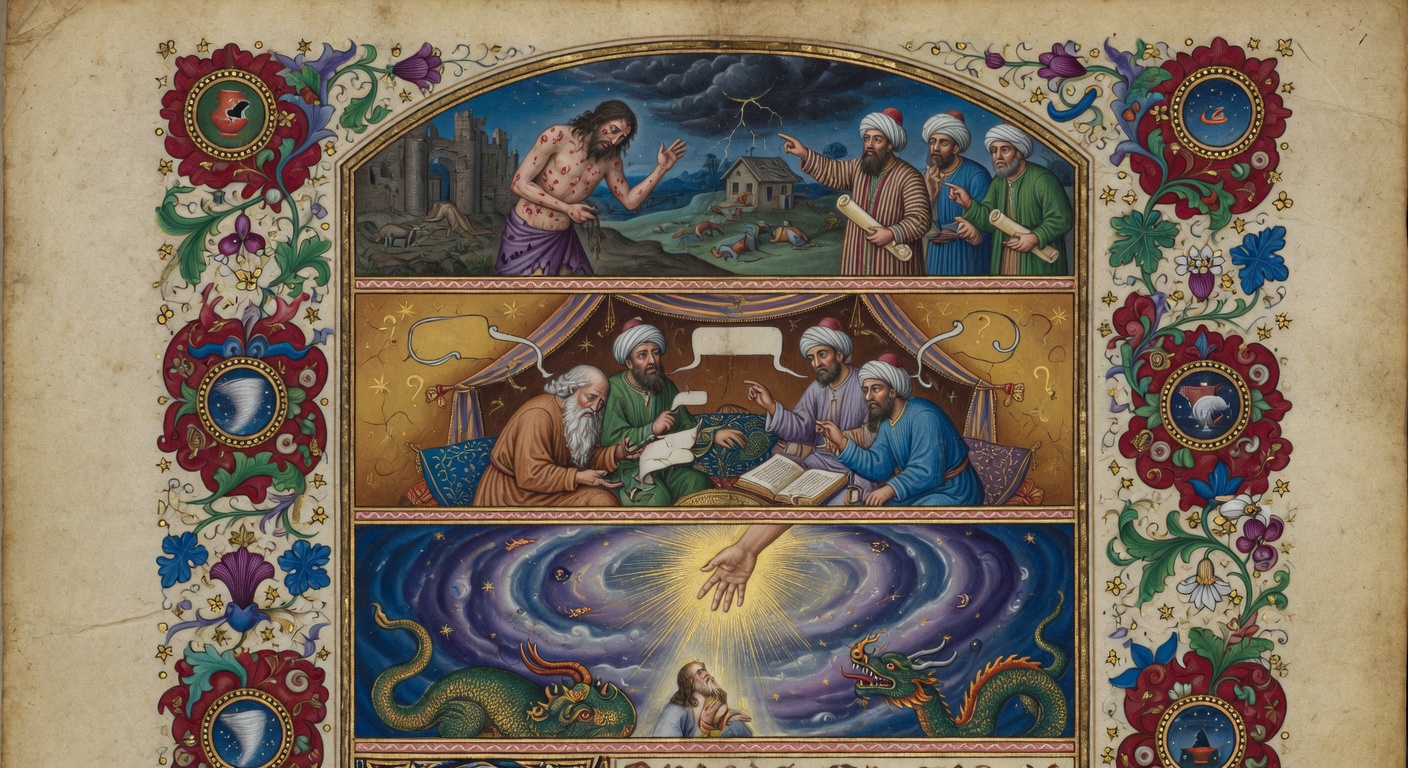
 1 made a covenant with mine eyes; why then should I think upon a maid?
2 For what portion of God is there from above? and what inheritance of the Almighty from on high?
3 Is not destruction to the wicked? and a strange punishment to the workers of iniquity?
4 Doth not he see my ways, and count all my steps?
5 If I have walked with vanity, or if my foot hath hasted to deceit;
6 Let me be weighed in an even balance that God may know mine integrity.
7 If my step hath turned out of the way, and mine heart walked after mine eyes, and if any blot hath cleaved to mine hands;
8 Then let me sow, and let another eat; yea, let my offspring be rooted out.
9 If mine heart have been deceived by a woman, or if I have laid wait at my neighbour’s door;
10 Then let my wife grind unto another, and let others bow down upon her.
11 For this is an heinous crime; yea, it is an iniquity to be punished by the judges.
12 For it is a fire that consumeth to destruction, and would root out all mine increase.
13 If I did despise the cause of my manservant or of my maidservant, when they contended with me;
14 What then shall I do when God riseth up? and when he visiteth, what shall I answer him?
15 Did not he that made me in the womb make him? and did not one fashion us in the womb?
16 If I have withheld the poor from their desire, or have caused the eyes of the widow to fail;
17 Or have eaten my morsel myself alone, and the fatherless hath not eaten thereof;
18 (For from my youth he was brought up with me, as with a father, and I have guided her from my mother’s womb;)
19 If I have seen any perish for want of clothing, or any poor without covering;
20 If his loins have not blessed me, and if he were not warmed with the fleece of my sheep;
21 If I have lifted up my hand against the fatherless, when I saw my help in the gate:
22 Then let mine arm fall from my shoulder blade, and mine arm be broken from the bone.
23 For destruction from God was a terror to me, and by reason of his highness I could not endure.
24 If I have made gold my hope, or have said to the fine gold, Thou art my confidence;
25 If I rejoiced because my wealth was great, and because mine hand had gotten much;
26 If I beheld the sun when it shined, or the moon walking in brightness;
27 And my heart hath been secretly enticed, or my mouth hath kissed my hand:
28 This also were an iniquity to be punished by the judge: for I should have denied the God that is above.
29 If I rejoiced at the destruction of him that hated me, or lifted up myself when evil found him:
30 Neither have I suffered my mouth to sin by wishing a curse to his soul.
31 If the men of my tabernacle said not, Oh that we had of his flesh! we cannot be satisfied.
32 The stranger did not lodge in the street: but I opened my doors to the traveller.
33 If I covered my transgressions as Adam, by hiding mine iniquity in my bosom:
34 Did I fear a great multitude, or did the contempt of families terrify me, that I kept silence, and went not out of the door?
35 Oh that one would hear me! behold, my desire is, that the Almighty would answer me, and that mine adversary had written a book.
36 Surely I would take it upon my shoulder, and bind it as a crown to me.
37 I would declare unto him the number of my steps; as a prince would I go near unto him.
38 If my land cry against me, or that the furrows likewise thereof complain;
39 If I have eaten the fruits thereof without money, or have caused the owners thereof to lose their life:
40 Let thistles grow instead of wheat, and cockle instead of barley. The words of Job are ended.
← → arrow keys to navigate chapters · spacebar to play/pause audio
Did You Know?
Job's 'covenant with mine eyes' (v.1) constitutes one of the earliest explicit biblical commitments to purity of thought rather than mere action, prefiguring later teachings on interior righteousness.
The chapter operates as a formal ancient Near Eastern oath of clearance, complete with self-imprecations, mirroring legal practices found in Hittite and Mesopotamian treaties where defendants invoked curses to affirm innocence.
Verses 13-15 ground social justice in shared creation by the same womb-maker, offering a theological argument for human equality that directly challenges ancient assumptions about inherent class or slave distinctions.
Job's reference to the land crying out (v.38) personifies the earth as a witness to economic injustice, echoing Genesis 4's blood crying from the ground and linking moral failure to environmental consequence.
The demand in v.35 for an 'adversary' to compose a written indictment frames the entire dialogue as a heavenly lawsuit, positioning God simultaneously as defendant, judge, and potential accuser in Job's quest for vindication.