Leviticus 9 KJV
Aaron's First Sacrifices
Leviticus Chapter 9: Aaron's First Sacrifices
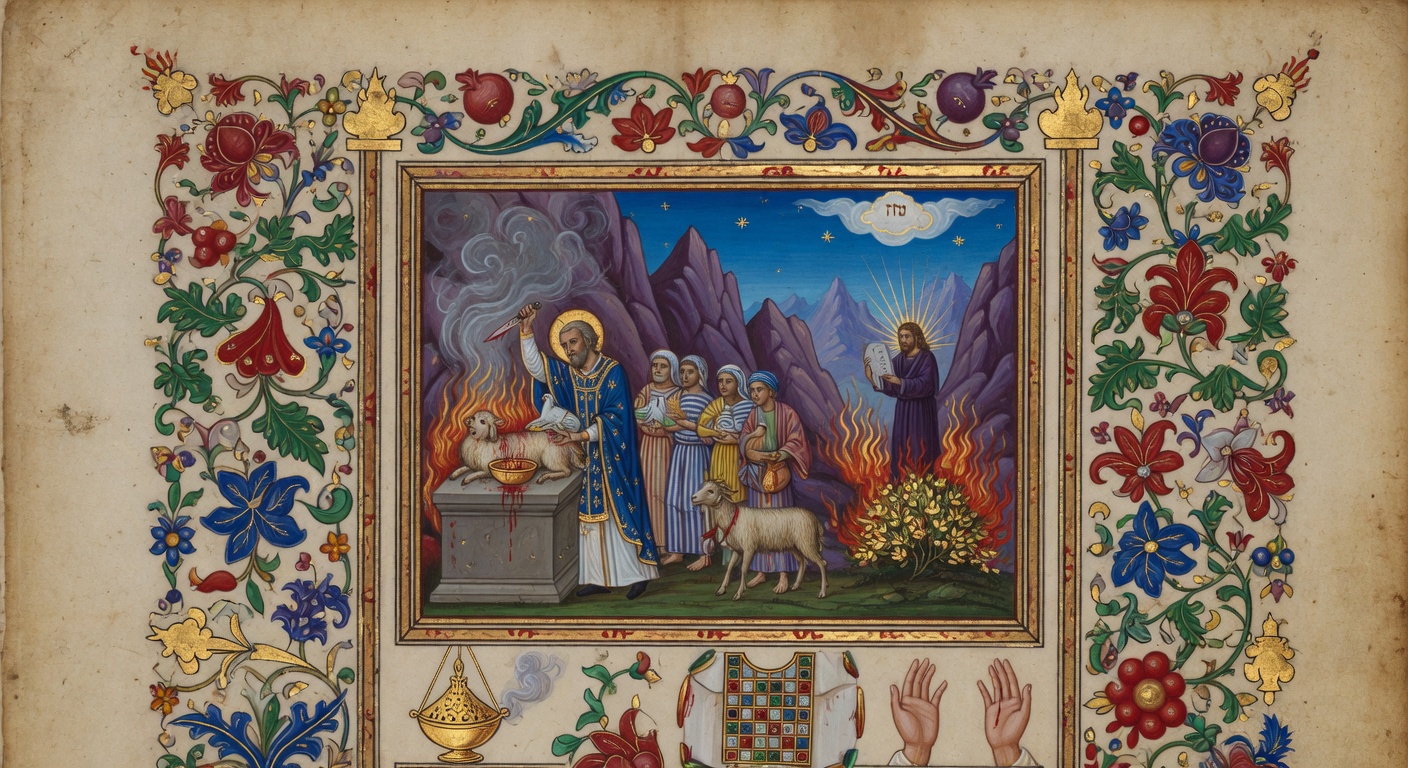
The divine fire consuming the offerings publicly validates Aaron's new role, shifting mediation from Moses alone to the Aaronic line in a way that echoes but domesticates the Sinai theophany.
 1nd it came to pass on the eighth day, that Moses called Aaron and his sons, and the elders of Israel;
2 And he said unto Aaron, Take thee a young calf for a sin offering, and a ram for a burnt offering, without blemish, and offer them before the LORD.
3 And unto the children of Israel thou shalt speak, saying, Take ye a kid of the goats for a sin offering; and a calf and a lamb, both of the first year, without blemish, for a burnt offering;
4 Also a bullock and a ram for peace offerings, to sacrifice before the LORD; and a meat offering mingled with oil: for to day the LORD will appear unto you.
5 And they brought that which Moses commanded before the tabernacle of the congregation: and all the congregation drew near and stood before the LORD.
6 And Moses said, This is the thing which the LORD commanded that ye should do: and the glory of the LORD shall appear unto you.
7 And Moses said unto Aaron, Go unto the altar, and offer thy sin offering, and thy burnt offering, and make an atonement for thyself, and for the people: and offer the offering of the people, and make an atonement for them; as the LORD commanded.
8 Aaron therefore went unto the altar, and slew the calf of the sin offering, which was for himself.
9 And the sons of Aaron brought the blood unto him: and he dipped his finger in the blood, and put it upon the horns of the altar, and poured out the blood at the bottom of the altar:
10 But the fat, and the kidneys, and the caul above the liver of the sin offering, he burnt upon the altar; as the LORD commanded Moses.
11 And the flesh and the hide he burnt with fire without the camp.
12 And he slew the burnt offering; and Aaron’s sons presented unto him the blood, which he sprinkled round about upon the altar.
13 And they presented the burnt offering unto him, with the pieces thereof, and the head: and he burnt them upon the altar.
14 And he did wash the inwards and the legs, and burnt them upon the burnt offering on the altar.
15 And he brought the people’s offering, and took the goat, which was the sin offering for the people, and slew it, and offered it for sin, as the first.
16 And he brought the burnt offering, and offered it according to the manner.
17 And he brought the meat offering, and took an handful thereof, and burnt it upon the altar, beside the burnt sacrifice of the morning.
18 He slew also the bullock and the ram for a sacrifice of peace offerings, which was for the people: and Aaron’s sons presented unto him the blood, which he sprinkled upon the altar round about,
19 And the fat of the bullock and of the ram, the rump, and that which covereth the inwards, and the kidneys, and the caul above the liver:
20 And they put the fat upon the breasts, and he burnt the fat upon the altar:
21 And the breasts and the right shoulder Aaron waved for a wave offering before the LORD; as Moses commanded.
22 And Aaron lifted up his hand toward the people, and blessed them, and came down from offering of the sin offering, and the burnt offering, and peace offerings.
23 And Moses and Aaron went into the tabernacle of the congregation, and came out, and blessed the people: and the glory of the LORD appeared unto all the people.
24 And there came a fire out from before the LORD, and consumed upon the altar the burnt offering and the fat: which when all the people saw, they shouted, and fell on their faces.
← → arrow keys to navigate chapters · spacebar to play/pause audio
Did You Know?
The divine fire consuming the offerings publicly validates Aaron's new role, shifting mediation from Moses alone to the Aaronic line in a way that echoes but domesticates the Sinai theophany.
Aaron's calf sin offering subtly atones for his earlier golden-calf failure, turning a symbol of idolatry into the first accepted priestly sacrifice.
The chapter's eighth-day timing completes the seven-day ordination cycle, marking the tabernacle's full inauguration as a new creation event.
Inclusion of peace offerings alongside sin and burnt offerings enacts a theological sequence from atonement to restored fellowship, prefiguring later covenant meals.
The people's shout and prostration directly parallels their response at Sinai and anticipates Solomon's temple dedication, framing the tabernacle as the mobile Sinai.
Commentary & Study Notes Jamieson-Fausset-Brown (1871) · Public Domain Moses called... Take thee a young calf for a sin offering — The directions in these sacred things were still given by Moses, the circumstances being extraordinary. But he was only…
Classic verse-by-verse commentary on Leviticus 9 from Jamieson, Fausset & Brown (1871). Covers: The priests' entry into office.
- 1-7
- Moses called... Take thee a young calf for a sin offering — The directions in these sacred things were still given by Moses, the circumstances being extraordinary. But he was only the medium of communicating the divine will to the newly made priests. The first of their official acts was the sacrifice of another sin offering to atone for the defects of the inauguration services; and yet that sacrifice did not consist of a bullock — the sacrifice appointed for some particular transgression, but of a calf, perhaps not without a significant reference to Aaron's sin in the golden calf [Ex 32:22-24]. Then followed a burnt offering, expressive of their voluntary and entire self-devotement to the divine service. The newly consecrated priests having done this on their own account, they were called to offer a sin offering and burnt offering for the people, ending the ceremonial by a peace offering, which was a sacred feast. This injunction, "to make atonement for himself and for the people" (Septuagint, "for thy family"), at the commencement of his sacred functions, furnishes a striking evidence of the divine origin of the Jewish system of worship. In all false or corrupt forms of religion, the studied policy has been to inspire the people with an idea of the sanctity of the priesthood as in point of purity and favor with the Divinity far above the level of other men. But among the Hebrews the priests were required to offer for the expiation of their own sins as well as the humblest of the people. This imperfection of Aaron's priesthood, however, does not extend to the gospel dispensation: for our great High Priest, who has entered for us into "the true tabernacle," "knew no sin" (Heb 10:10, 11).
- 8
- Aaron... went unto the altar, and slew the calf of the sin offering — Whether it had been enjoined the first time, or was unavoidable from the divisions of the priestly labor not being as yet completely arranged, Aaron, assisted by his sons, appears to have slain the victims with his own hands, as well as gone through all the prescribed ritual at the altar.
Read all 6 notes on Leviticus 9 →