Revelation 15 KJV
The Seven Angels with Seven Plagues
Revelation Chapter 15: The Seven Angels with Seven Plagues
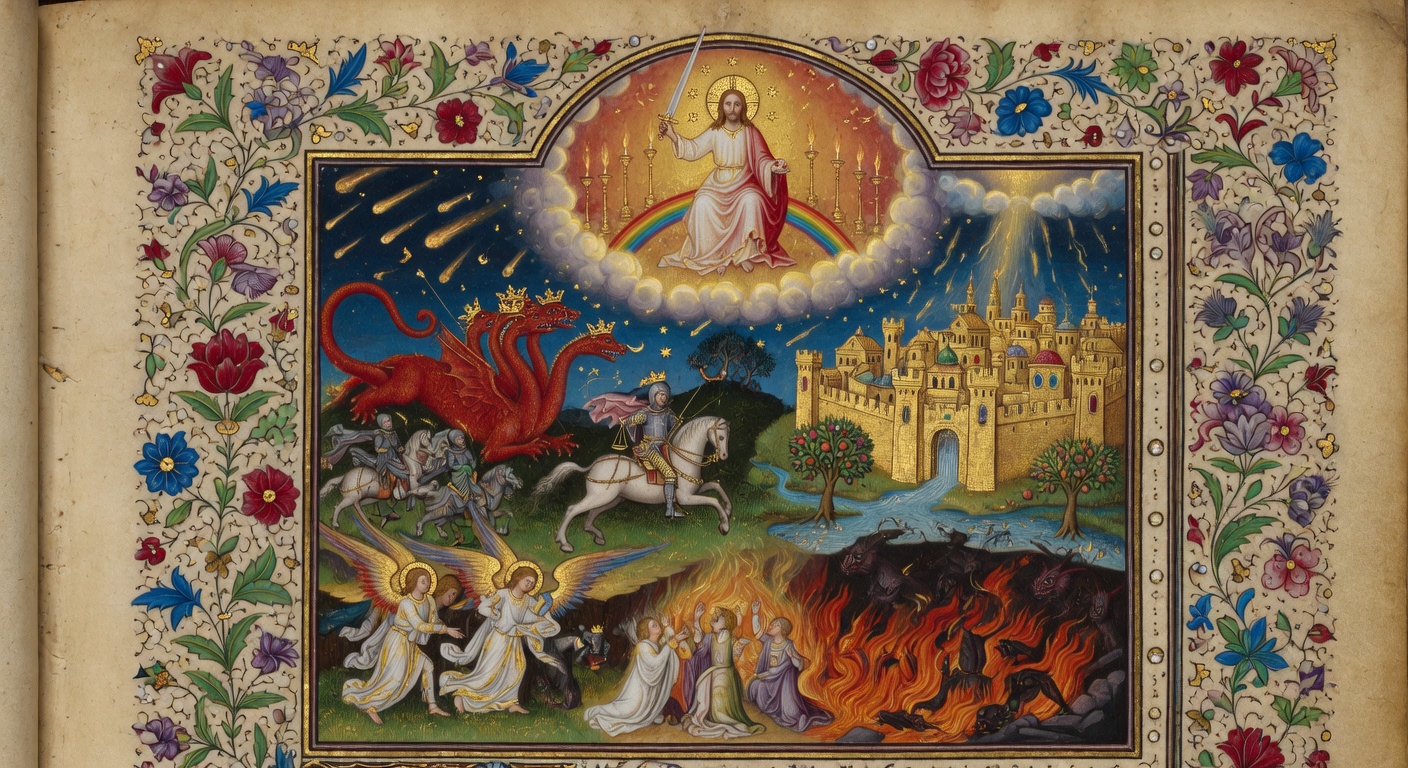
The victors' song is explicitly titled both the song of Moses and the song of the Lamb, forging a direct typological bridge between the Exodus plague narrative and the final outpouring of wrath, with the sea of glass mingled with fire evoking both the Red Sea crossing and the fiery furnace of Daniel.
 1nd I saw another sign in heaven, great and marvellous, seven angels having the seven last plagues; for in them is filled up the wrath of God.
2 And I saw as it were a sea of glass mingled with fire: and them that had gotten the victory over the beast, and over his image, and over his mark, and over the number of his name, stand on the sea of glass, having the harps of God.
3 And they sing the song of Moses the servant of God, and the song of the Lamb, saying, Great and marvellous are thy works, Lord God Almighty; just and true are thy ways, thou King of saints.
4 Who shall not fear thee, O Lord, and glorify thy name? for thou only art holy: for all nations shall come and worship before thee; for thy judgments are made manifest.
5 And after that I looked, and, behold, the temple of the tabernacle of the testimony in heaven was opened:
6 And the seven angels came out of the temple, having the seven plagues, clothed in pure and white linen, and having their breasts girded with golden girdles.
7 And one of the four beasts gave unto the seven angels seven golden vials full of the wrath of God, who liveth for ever and ever.
8 And the temple was filled with smoke from the glory of God, and from his power; and no man was able to enter into the temple, till the seven plagues of the seven angels were fulfilled.
← → arrow keys to navigate chapters · spacebar to play/pause audio
Did You Know?
The victors' song is explicitly titled both the song of Moses and the song of the Lamb, forging a direct typological bridge between the Exodus plague narrative and the final outpouring of wrath, with the sea of glass mingled with fire evoking both the Red Sea crossing and the fiery furnace of Daniel.
One of the four living creatures hands the golden vials to the angels, transferring the prerogative of executing wrath from the cherubim who guard the throne to ministering angels, a detail underscoring the creatures' ongoing administrative role in heavenly liturgy.
The temple is described as the 'tabernacle of the testimony,' deliberately echoing the wilderness sanctuary's ark of witness and implying that the plagues fulfill the covenant curses of Leviticus 26 and Deuteronomy 28 against persistent idolatry.
Smoke filling the temple so that no one can enter until the plagues finish mirrors the cloud that prevented Moses from entering the tabernacle (Exodus 40) and the priests from ministering at Solomon's temple dedication (1 Kings 8), but here signals irreversible judgment rather than temporary consecration.
The angels' attire of pure white linen with golden girdles deliberately recalls both the high priest's garments and Christ's own appearance in Revelation 1, casting the plague-bearers as priestly agents who mediate God's wrath in a final act of sanctuary cleansing.
Commentary & Study Notes Jamieson-Fausset-Brown (1871) · Public Domain the seven last plagues — Greek, "seven plagues which are the last." is filled up — literally, "was finished," or "consummated": the prophetical past for the future, the future bein…
Classic verse-by-verse commentary on Revelation 15 from Jamieson, Fausset & Brown (1871). Covers: The last seven vials of plagues: song of the victors over the beast.
- 1
- the seven last plagues — Greek, "seven plagues which are the last." is filled up — literally, "was finished," or "consummated": the prophetical past for the future, the future being to God as though it were past, so sure of accomplishment is His word. This verse is the summary of the vision that follows: the angels do not actually receive the vials till Re 15:7; but here, in Re 15:1, by anticipation they are spoken of as having them. There are no more plagues after these until the Lord's coming in judgment. The destruction of Babylon (Re 18:2) is the last: then in Re 19:11-16 He appears.
- 2
- sea of glass — Answering to the molten sea or great brazen laver before the mercy seat of the earthly temple, for the purification of the priests; typifying the baptism of water and the Spirit of all who are made kings and priests unto God. mingled with fire — answering to the baptism on earth with fire, that is, fiery trial, as well as with the Holy Ghost, which Christ's people undergo to purify them, as gold is purified of its dross in the furnace. them that had gotten the victory over — Greek, "those (coming) off from (the conflict with) the beast-conquerors." over the number of his name — A, B, C, Vulgate, Syriac, and Coptic omit the words in English Version, "over his mark." The mark, in fact, is the number of his name which the faithful refused to receive, and so were victorious over it. stand on the sea of glass — ALFORD and DE BURGH explain "on (the shore of) the sea": at the sea. So the preposition, Greek, "epi," with the accusative case, is used for at, Re 3:20. It has a pregnant sense: "standing" implies rest, Greek "epi" with the accusative case implies motion "towards." Thus the meaning is, Having come TO the sea, and now standing AT it. In Mt 14:26, where Christ walks on the sea, the Greek oldest manuscripts have the genitive, not the accusative as here. Allusion is made to the Israelites standing on the shore at the Red Sea, after having passed victoriously through it, and after the Lord had destroyed the Egyptian foe (type of Antichrist) in it. Moses and the Israelites' song of triumph (Ex 15:1) has its antitype in the saints' "song of Moses and the Lamb" (Re 15:3). Still English Version is consistent with good Greek, and the sense will then be: As the sea typifies the troubled state out of which the beast arose, and which is to be no more in the blessed world to come (Re 21:1), so the victorious saints stand on it, having it under their feet (as the woman had the moon, see on Re 12:1); but it is now no longer treacherous wherein the feet sink, but solid like glass, as it was under the feet of Christ, whose triumph and power the saints now share. Firmness of footing amidst apparent instability is thus represented. They can stand, not merely as victorious Israel at the Red Sea, and as John upon the sand of the shore, but upon the sea itself, now firm, and reflecting their glory as glass, their past conflict shedding the brighter luster on their present triumph. Their happiness is heightened by the retrospect of the dangers through which they have passed. Thus this corresponds to Re 7:14,
Read all 9 notes on Revelation 15 →