Zechariah 3 KJV
Clean Garments for the High Priest
Zechariah Chapter 3: Clean Garments for the High Priest
The vision's courtroom drama. With the Angel of the Lord as judge, Satan as accuser, and Joshua as defendant. Mirrors ancient Near Eastern legal procedures for priestly reinstatement, underscoring that post-exilic legitimacy derives from divine verdict rather than human lineage alone.
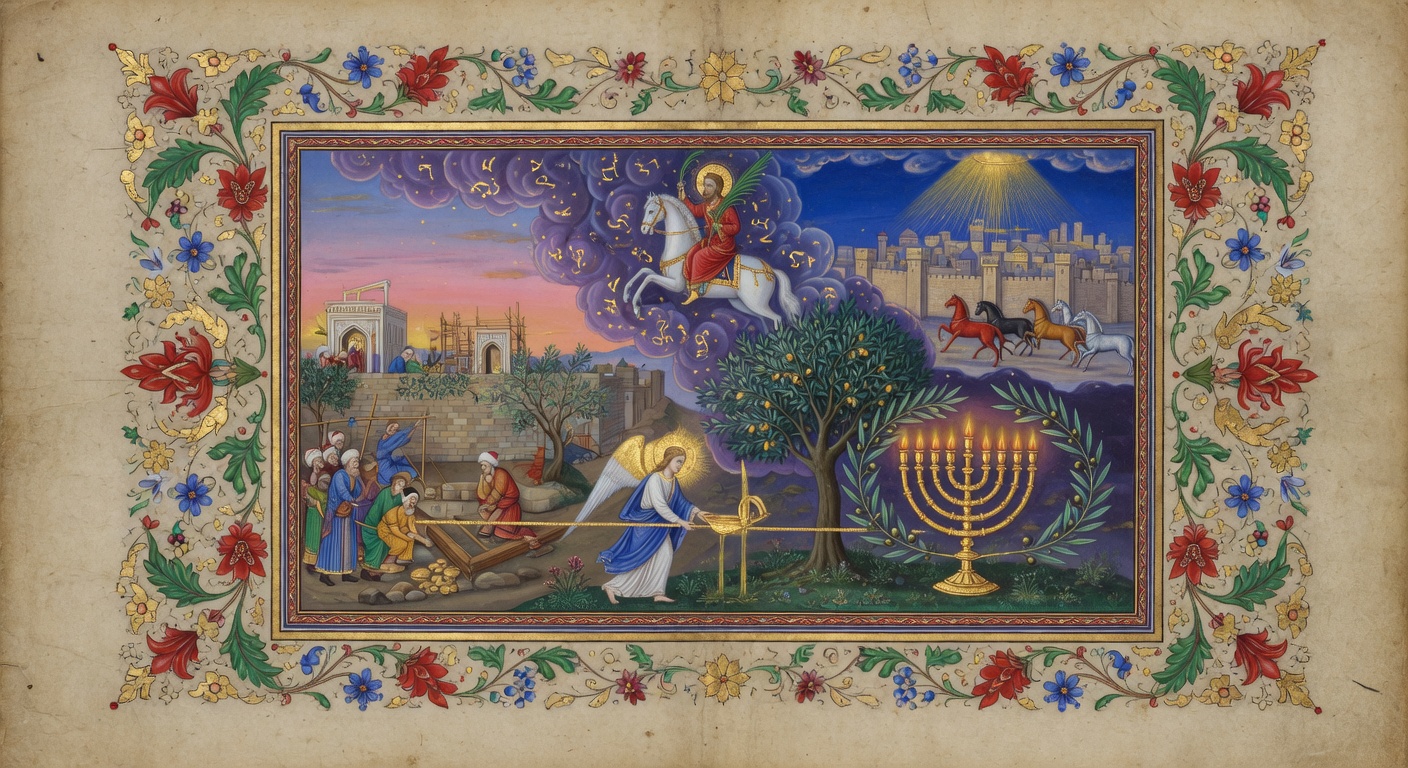
 1nd he shewed me Joshua the high priest standing before the angel of the LORD, and Satan standing at his right hand to resist him.
2 And the LORD said unto Satan, The LORD rebuke thee, O Satan; even the LORD that hath chosen Jerusalem rebuke thee: is not this a brand plucked out of the fire?
3 Now Joshua was clothed with filthy garments, and stood before the angel.
4 And he answered and spake unto those that stood before him, saying, Take away the filthy garments from him. And unto him he said, Behold, I have caused thine iniquity to pass from thee, and I will clothe thee with change of raiment.
5 And I said, Let them set a fair mitre upon his head. So they set a fair mitre upon his head, and clothed him with garments. And the angel of the LORD stood by.
6 And the angel of the LORD protested unto Joshua, saying,
7 Thus saith the LORD of hosts; If thou wilt walk in my ways, and if thou wilt keep my charge, then thou shalt also judge my house, and shalt also keep my courts, and I will give thee places to walk among these that stand by.
8 Hear now, O Joshua the high priest, thou, and thy fellows that sit before thee: for they are men wondered at: for, behold, I will bring forth my servant the BRANCH.
9 For behold the stone that I have laid before Joshua; upon one stone shall be seven eyes: behold, I will engrave the graving thereof, saith the LORD of hosts, and I will remove the iniquity of that land in one day.
10 In that day, saith the LORD of hosts, shall ye call every man his neighbour under the vine and under the fig tree.
← → arrow keys to navigate chapters · spacebar to play/pause audio
Did You Know?
The vision's courtroom drama. With the Angel of the Lord as judge, Satan as accuser, and Joshua as defendant. Mirrors ancient Near Eastern legal procedures for priestly reinstatement, underscoring that post-exilic legitimacy derives from divine verdict rather than human lineage alone.
By commanding removal of Joshua's filthy garments and declaring 'I have caused thine iniquity to pass from thee,' the text presents a direct divine act of atonement that anticipates the New Testament portrayal of Christ's high-priestly cleansing, distinct from the annual Yom Kippur ritual.
The 'stone' set before Joshua engraved with seven eyes fuses royal and priestly imagery; these eyes echo both the seven lamps of Zechariah's next vision and the all-seeing wheels of Ezekiel, symbolizing God's omniscient oversight of the rebuilt temple.
Naming the coming figure 'the Branch' deliberately merges the priestly line of Joshua with the Davidic royal title found in Isaiah and Jeremiah, signaling that the restored priesthood will ultimately be fulfilled in a messianic figure who unites kingship and priesthood.
The promise that iniquity will be removed 'in one day' alludes to a singular eschatological event rather than repeated sacrifices, a detail that later Jewish and Christian interpreters linked to the decisive work of the Messiah rather than the ongoing temple cult.
Commentary & Study Notes Jamieson-Fausset-Brown (1871) · Public Domain Joshua as high priest (Hag 1:1) represents "Jerusalem" (Zec 3:2), or the elect people, put on its trial, and "plucked" narrowly "out of the fire." His attitude, "standing before th…
Classic verse-by-verse commentary on Zechariah 3 from Jamieson, Fausset & Brown (1871). Covers: Fourth vision. Joshua the high priest before the angel of Jehovah; Accused by satan, but justified by Jehovah through messiah the coming branch.
- 1
- Joshua as high priest (Hag 1:1) represents "Jerusalem" (Zec 3:2), or the elect people, put on its trial, and "plucked" narrowly "out of the fire." His attitude, "standing before the Lord," is that of a high priest ministering before the altar erected previously to the building of the temple (Ezr 3:2, 3, 6; Ps 135:2). Yet, in this position, by reason of his own and his people's sins, he is represented as on his and their trial (Nu 35:12). he showed me — "He" is the interpreting angel. Jerusalem's (Joshua's) "filthy garments" (Zec 3:3) are its sins which had hitherto brought down God's judgments. The "change of raiment" implies its restoration to God's favor. Satan suggested to the Jews that so consciously polluted a priesthood and people could offer no acceptable sacrifice to God, and therefore they might as well desist from the building of the temple. Zechariah encourages them by showing that their demerit does not disqualify them for the work, as they are accepted in the righteousness of another, their great High Priest, the Branch (Zec 3:8), a scion of their own royal line of David (Isa 11:1). The full accomplishment of Israel's justification and of Satan the accuser's being "rebuked" finally, is yet future (Re 12:10). Compare Re 11:8, wherein "Jerusalem," as here, is shown to be meant primarily, though including the whole Church in general (compare Job 1:9). Satan — the Hebrew term meaning "adversary" in a law court: as devil is the Greek term, meaning accuser. Messiah, on the other hand, is "advocate" for His people in the court of heaven's justice (1Jo 2:1). standing at his right hand — the usual position of a prosecutor or accuser in court, as the left hand was the position of the defendant (Ps 109:6). The "angel of the Lord" took the same position just before another high priest was about to beget the forerunner of Messiah (Lu 1:11), who supplants Satan from his place as accuser. Some hence explain Jude 9 as referring to this passage: "the body of Moses" being thus the Jewish Church, for which Satan contended as his by reason of its sins; just as the "body of Christ" is the Christian Church. However, Jude 9 plainly speaks of the literal body of Moses, the resurrection of which at the transfiguration Satan seems to have opposed on the ground of Moses' error at Meribah; the same divine rebuke, "the Lord rebuke thee," checked Satan in contending for judgment against Moses' body, as checked him when demanding judgment against the Jewish Church, to which Moses' body corresponds.
- 2
- the Lord — JEHOVAH, hereby identified with the "angel of the Lord (Jehovah)" (Zec 3:1). rebuke thee — twice repeated to express the certainty of Satan's accusations and machinations against Jerusalem being frustrated. Instead of lengthened argument, Jehovah silences Satan by the one plea, namely, God's choice. chosen Jerusalem — (Ro 9:16; 11:5). The conclusive answer. If the issue rested on Jerusalem's merit or demerit, condemnation must be the award; but Jehovah's "choice" (Joh 15:16) rebuts Satan's charge against Jerusalem (Zec 1:17; 2:12; Ro 8:33, 34, 37), represented by Joshua (compare in the great atonement, Le 16:6-20, &c.), not that she may continue in sin, but be freed from it (Zec 3:7). brand plucked out of... fire — (Am 4:11; 1Pe 4:18; Jude 23). Herein God implies that His acquittal of Jerusalem is not that He does not recognize her sin (Zec 3:3, 4, 9), but that having punished her people for it with a seventy years' captivity, He on the ground of His electing love has delivered her from the fiery ordeal; and when once He has begun a deliverance, as in this case, He will perfect it (Ps 89:30-35; Php 1:6).
Read all 10 notes on Zechariah 3 →