Zechariah 6 KJV
The Crown for Joshua
Zechariah Chapter 6: The Crown for Joshua
The plural 'crowns' set upon Joshua's head in verse 11 deliberately merges priestly and royal authority in one figure, anticipating the dual office of the coming Branch who will sit as both priest and king on his throne.
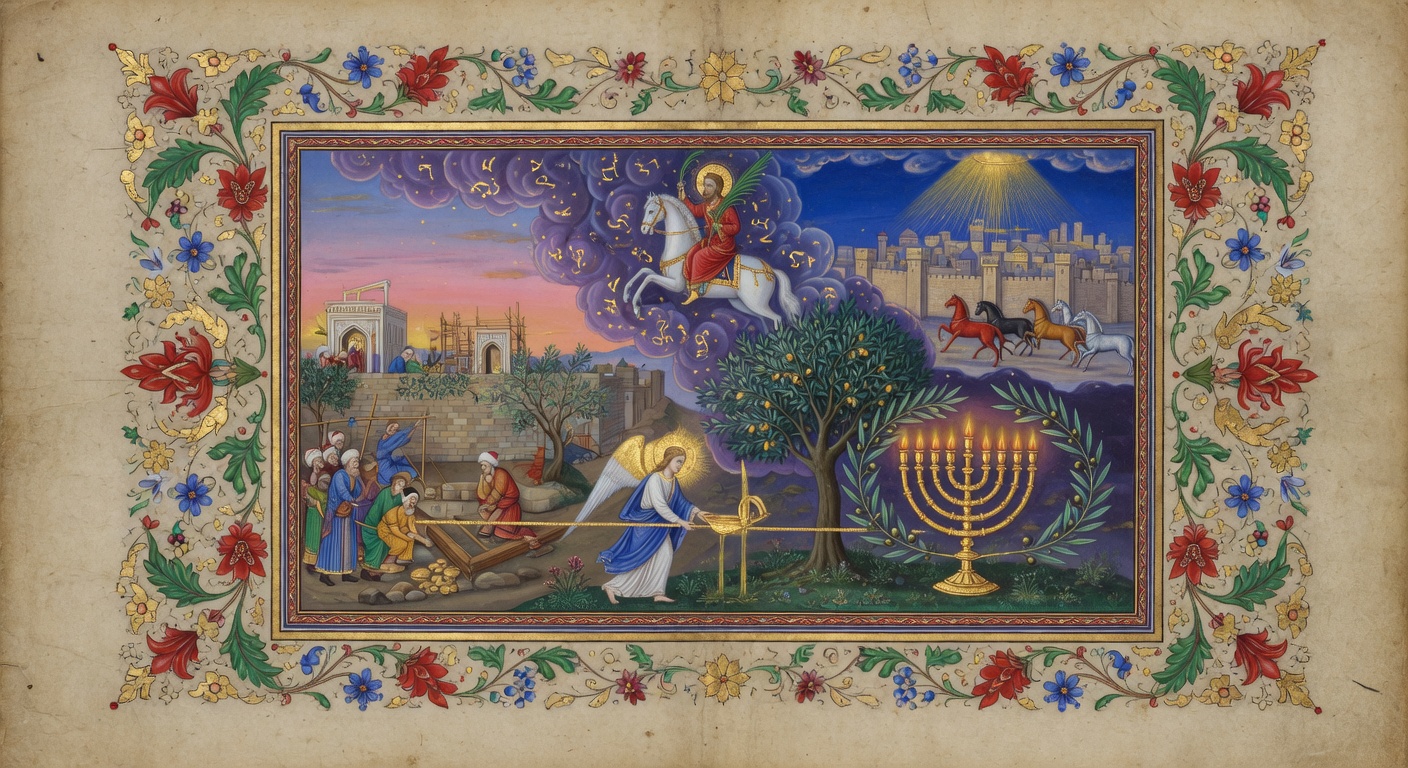
 1nd I turned, and lifted up mine eyes, and looked, and, behold, there came four chariots out from between two mountains; and the mountains were mountains of brass.
2 In the first chariot were red horses; and in the second chariot black horses;
3 And in the third chariot white horses; and in the fourth chariot grisled and bay horses.
4 Then I answered and said unto the angel that talked with me, What are these, my lord?
5 And the angel answered and said unto me, These are the four spirits of the heavens, which go forth from standing before the LORD of all the earth.
6 The black horses which are therein go forth into the north country; and the white go forth after them; and the grisled go forth toward the south country.
7 And the bay went forth, and sought to go that they might walk to and fro through the earth: and he said, Get you hence, walk to and fro through the earth. So they walked to and fro through the earth.
8 Then cried he upon me, and spake unto me, saying, Behold, these that go toward the north country have quieted my spirit in the north country.
9 And the word of the LORD came unto me, saying,
10 Take of them of the captivity, even of Heldai, of Tobijah, and of Jedaiah, which are come from Babylon, and come thou the same day, and go into the house of Josiah the son of Zephaniah;
11 Then take silver and gold, and make crowns, and set them upon the head of Joshua the son of Josedech, the high priest;
12 And speak unto him, saying, Thus speaketh the LORD of hosts, saying, Behold the man whose name is The BRANCH; and he shall grow up out of his place, and he shall build the temple of the LORD:
13 Even he shall build the temple of the LORD; and he shall bear the glory, and shall sit and rule upon his throne; and he shall be a priest upon his throne: and the counsel of peace shall be between them both.
14 And the crowns shall be to Helem, and to Tobijah, and to Jedaiah, and to Hen the son of Zephaniah, for a memorial in the temple of the LORD.
15 And they that are far off shall come and build in the temple of the LORD, and ye shall know that the LORD of hosts hath sent me unto you. And this shall come to pass, if ye will diligently obey the voice of the LORD your God.
← → arrow keys to navigate chapters · spacebar to play/pause audio
Did You Know?
The plural 'crowns' set upon Joshua's head in verse 11 deliberately merges priestly and royal authority in one figure, anticipating the dual office of the coming Branch who will sit as both priest and king on his throne.
The black horses' mission to the 'north country' followed by the white horses evokes the direction of Babylonian exile and its reversal, signaling divine judgment now turning toward restoration under Persian rule rather than mere reconnaissance.
Materials for the crowns are taken specifically from the returned exiles Heldai, Tobijah, and Jedaiah, transforming gifts once carried into captivity into symbols of temple honor and thereby enacting a literal reversal of Jeremiah's earlier prophecies of despoilment.
The 'two mountains of brass' framing the chariots' departure allude to the cosmic entrance of the divine council, a motif that reappears in later apocalyptic literature and suggests the patrols originate from God's heavenly presence rather than earthly locations.
Verse 14's command to place the crowns in the temple 'for a memorial' to the three donors creates an enduring physical witness inside the rebuilt sanctuary, linking the immediate post-exilic leadership of Joshua and Zerubbabel to the future fulfillment of the Branch prophecy.
Commentary & Study Notes Jamieson-Fausset-Brown (1871) · Public Domain four chariots — symbolizing the various dispensations of Providence towards the Gentile nations which had been more or less brought into contact with Judea; especially in punishing…
Classic verse-by-verse commentary on Zechariah 6 from Jamieson, Fausset & Brown (1871). Covers: Eighth vision. The four chariots; Ninth vision. The crowning of joshua.
- 1
- four chariots — symbolizing the various dispensations of Providence towards the Gentile nations which had been more or less brought into contact with Judea; especially in punishing Babylon. Compare Zec 6:8 ("the north country," that is, Babylon); Zec 1:15; 2:6. The number "four" is specified not merely in reference to the four quarters of the horizon (implying universal judgments), but in allusion to the four world kingdoms of Daniel. from between two mountains — the valley of Jehoshaphat, between Moriah and Mount Olivet [MOORE]; or the valley between Zion and Moriah, where the Lord is (Zec 2:10), and whence He sends forth His ministers of judgment on the heathen [MAURER]. The temple on Mount Moriah is the symbol of the theocracy; hence the nearest spot accessible to chariots in the valley below is the most suitable for a vision affecting Judah in relation to the Gentile world powers. The chariot is the symbol of war, and so of judgments. of brass — the metal among the ancients representing hard solidity; so the immovable and resistless firmness of God's people (compare Jer 1:18). CALVIN explains the "two mountains" thus: The secret purpose of God from eternity does not come forth to view before the execution, but is hidden and kept back irresistibly till the fit time, as it were between lofty mountains; the chariots are the various changes wrought in nations, which, as swift heralds, announce to us what before we knew not. The "two" may thus correspond to the number of the "olive trees" (Zec 4:3); the allusion to the "two mountains" near the temple is not necessarily excluded in this view. HENDERSON explains them to be the Medo-Persian kingdom, represented by the "two horns" (Da 8:3, 4), now employed to execute God's purpose in punishing the nations; but the prophecy reaches far beyond those times.
- 2
- red — implying carnage. black — representing sorrow; also famine (Re 6:5, 6; compare Zec 1:8).
Read all 14 notes on Zechariah 6 →