Hannah
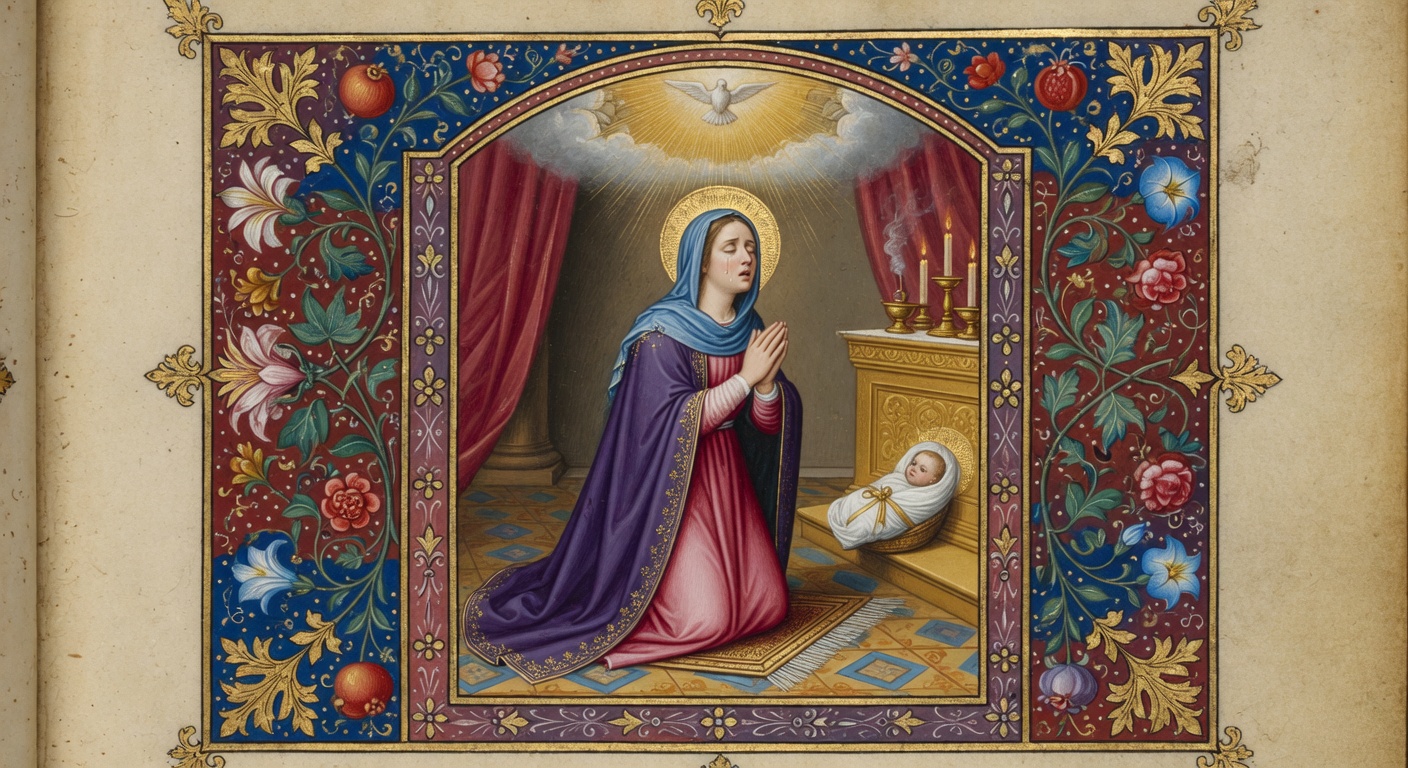
Hannah was the wife of Elkanah and one of two women in his household during the period of the judges, when she faced barrenness while her rival Peninnah had children. Deeply distressed by her condition and the social stigma it carried, she prayed fervently at the tabernacle in Shiloh, vowing that if God granted her a son she would dedicate him as a Nazirite to lifelong service. Her prayer was answered with the birth of Samuel, whom she presented to Eli the priest after weaning, allowing him to grow into Israel's last judge and the prophet who anointed the first two kings. Her account in 1 Samuel 1-2 illustrates the efficacy of persistent, heartfelt prayer and contains Hannah's song of thanksgiving, which models praise for God's reversal of fortunes and echoes later in Scripture.
Biography
- Tribe
- Ephraim
- Spouse
- Elkanah
- Children
- Samuel, and five others
- Era
- Judges / United Kingdom (c. 1100 BC)
- Nationality
- Israelite
Family
Did You Know?
Hannah's silent prayer at Shiloh, described with the rare Hebrew verb shaphak ("poured out"), was so unusual that priest Eli mistook her for a drunk woman, revealing that vocalized prayer was the expected norm at the sanctuary during the late Judges period.
Although Elkanah already had children through Peninnah, he consistently gave the childless Hannah a double sacrificial portion at the annual Shiloh feast, an act biblical scholars interpret as both an expression of affection and an attempt to compensate for her social shame in a polygamous culture.
Hannah alone among biblical mothers explicitly vowed her unborn son as a lifelong Nazirite, stipulating that "no razor shall touch his head," a detail Samuel fulfilled even though the more famous Nazirite Samson ultimately violated the same vow.
After weaning Samuel, Hannah brought him to Eli along with a three-year-old bull, an ephah of flour, and a skin of wine. Offerings whose combined value far exceeded typical female votive gifts, underscoring her determination to fulfill the vow in full public view.
Hannah's poetic thanksgiving in 1 Samuel 2 contains the earliest biblical use of the metaphor "horn of salvation," a phrase later echoed in the psalms and the Benedictus of Zechariah, demonstrating her influence on subsequent Israelite liturgical language.
Key Passages
Hannah's Prayer for a Son
1 Samuel 1:9-18
Hannah's desperate, silent prayer in the temple - mistaken for drunkenness by Eli - demonstrates that God hears the deepest cries of the heart even when no words are audible.
 9o Hannah rose up after they had eaten in Shiloh, and after they had drunk. Now Eli the priest sat upon a seat by a post of the temple of the LORD.
Hannah's Song of Praise
1 Samuel 2:1-10
Hannah's hymn of thanksgiving anticipates Mary's Magnificat, celebrating a God who reverses human fortunes - raising the barren, the poor, and the humble.
 1nd Hannah prayed, and said, My heart rejoiceth in the LORD, mine horn is exalted in the LORD: my mouth is enlarged over mine enemies; because I rejoice in thy salvation.
Hannah Dedicates Samuel
1 Samuel 1:24-28
Hannah fulfills her vow by giving her long-awaited son to God's service - modeling the principle that our greatest blessings are held in trust, not owned.
24nd when she had weaned him, she took him up with her, with three bullocks, and one ephah of flour, and a bottle of wine, and brought him unto the house of the LORD in Shiloh: and the child was young.
Commentary
Hannah: Patience in the Waiting
Hannah carried a longing so strong it hurt. She kept returning to God with broken, honest prayers.
Commentary by Bible Navigator.
This commentary is for inspirational and educational purposes only. It is not professional counseling, therapy, medical advice, or a substitute for professional help. If you are in crisis or need support, please reach out to a licensed professional or call 988 (Suicide & Crisis Lifeline).