Philippian Jailer
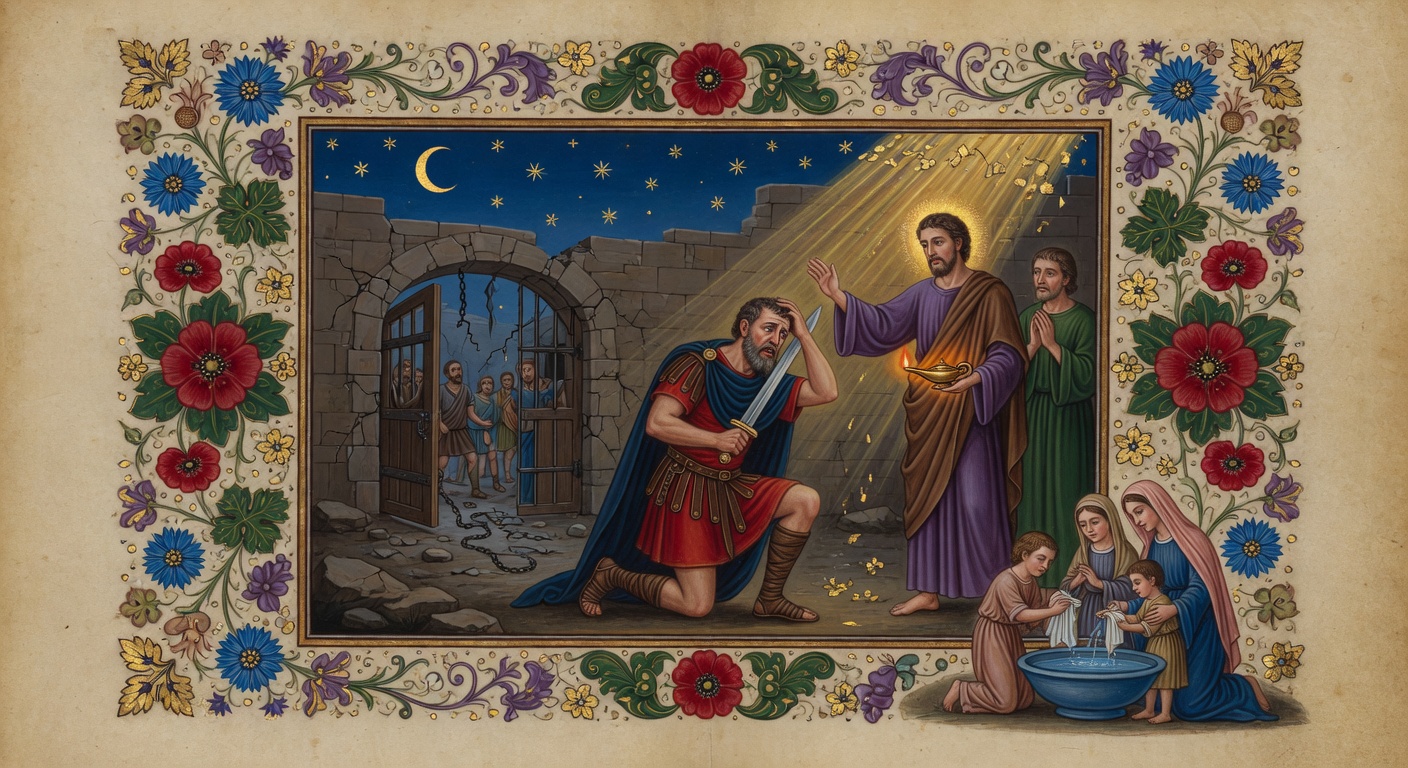
The Roman jailer in Philippi encountered the transforming power of the gospel amid an earthquake that opened the prison doors and freed the bonds of Paul and Silas. Prevented from taking his own life by the apostle's urgent call, he asked what he must do to be saved and received the answer to believe on the Lord Jesus Christ. His immediate care for their wounds, followed by the baptism of himself and his household after hearing the word, reveals how God's providence turns a moment of crisis into an opportunity for redemption and the spread of faith to an entire family.
Biography
- Era
- New Testament (c. AD 50)
Did You Know?
In the Roman Empire, prison guards like the one in Philippi were held personally responsible for any escaped prisoners and often faced execution, which accounts for his immediate suicide attempt upon seeing the open doors after the earthquake.
The jailer washed Paul and Silas's wounds before his own baptism, an act of repentance that reversed his earlier role in beating and imprisoning them as recorded in Acts 16.
Household baptisms in the first century typically included not only immediate family but also slaves and dependents, illustrating how entire social units converted together in early Christianity.
Philippi's status as a Roman colony meant its officials enforced strict military protocols, making the jailer's position carry the weight of a soldier's duty where failure often demanded suicide to preserve honor.
The conversion account notes the jailer bringing Paul and Silas into his home for a meal immediately after baptism, highlighting the rapid shift from custody to hospitality in the middle of the night.
Key Passages
What Must I Do to Be Saved?
Acts 16:25-34
This passage shows how faith in Jesus brings salvation and lasting joy even to the most unlikely people in desperate circumstances.
 25nd at midnight Paul and Silas prayed, and sang praises unto God: and the prisoners heard them.