1 Samuel 3 KJV
The Lord Calls Samuel
1 Samuel Chapter 3: The Lord Calls Samuel
The reference to the 'lamp of God' not yet gone out in the temple subtly evokes the tabernacle menorah and signals the fading of priestly mediation under Eli precisely at the moment divine speech resumes through a child.
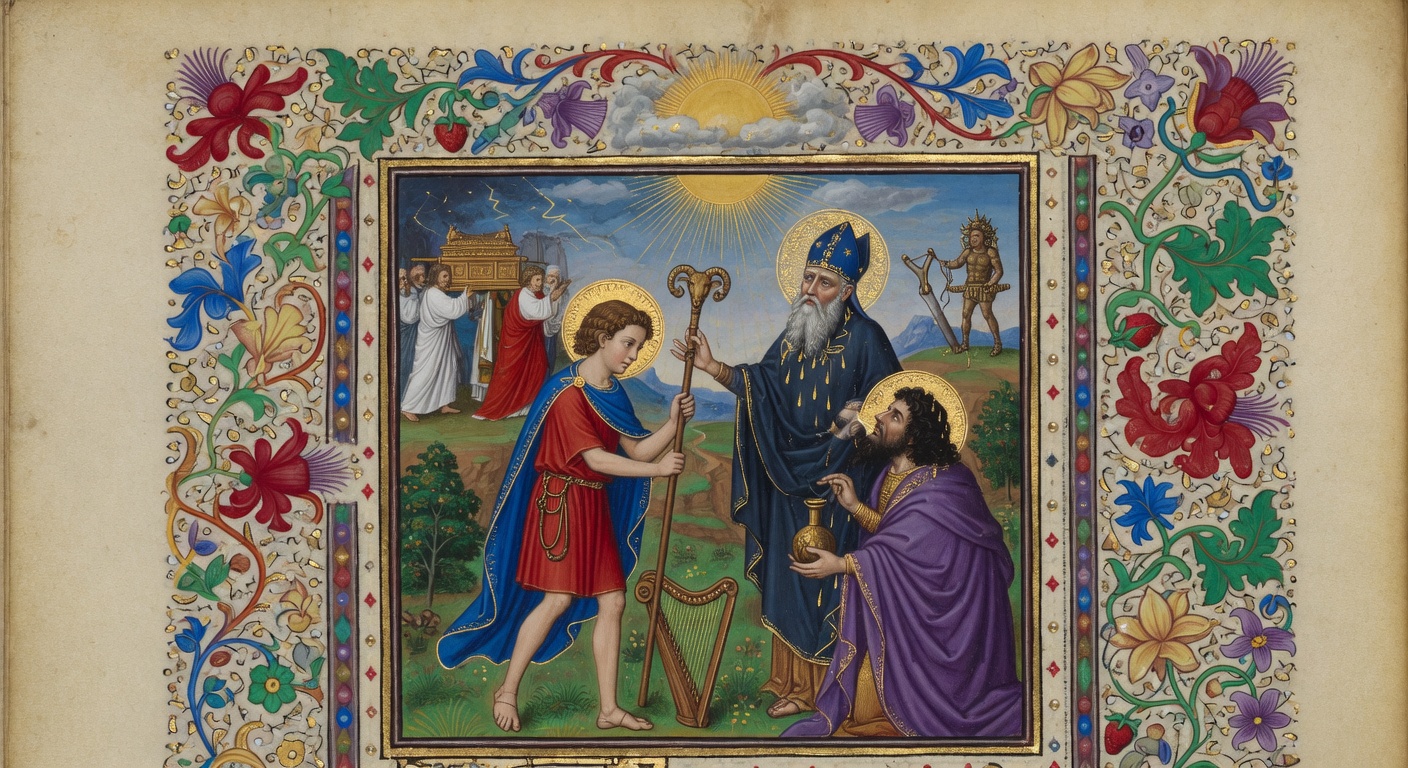
 1nd the child Samuel ministered unto the LORD before Eli. And the word of the LORD was precious in those days; there was no open vision.
2 And it came to pass at that time, when Eli was laid down in his place, and his eyes began to wax dim, that he could not see;
3 And ere the lamp of God went out in the temple of the LORD, where the ark of God was, and Samuel was laid down to sleep;
4 That the LORD called Samuel: and he answered, Here am I.
5 And he ran unto Eli, and said, Here am I; for thou calledst me. And he said, I called not; lie down again. And he went and lay down.
6 And the LORD called yet again, Samuel. And Samuel arose and went to Eli, and said, Here am I; for thou didst call me. And he answered, I called not, my son; lie down again.
7 Now Samuel did not yet know the LORD, neither was the word of the LORD yet revealed unto him.
8 And the LORD called Samuel again the third time. And he arose and went to Eli, and said, Here am I; for thou didst call me. And Eli perceived that the LORD had called the child.
9 Therefore Eli said unto Samuel, Go, lie down: and it shall be, if he call thee, that thou shalt say, Speak, LORD; for thy servant heareth. So Samuel went and lay down in his place.
10 And the LORD came, and stood, and called as at other times, Samuel, Samuel. Then Samuel answered, Speak; for thy servant heareth.
11 And the LORD said to Samuel, Behold, I will do a thing in Israel, at which both the ears of every one that heareth it shall tingle.
12 In that day I will perform against Eli all things which I have spoken concerning his house: when I begin, I will also make an end.
13 For I have told him that I will judge his house for ever for the iniquity which he knoweth; because his sons made themselves vile, and he restrained them not.
14 And therefore I have sworn unto the house of Eli, that the iniquity of Eli’s house shall not be purged with sacrifice nor offering for ever.
15 And Samuel lay until the morning, and opened the doors of the house of the LORD. And Samuel feared to shew Eli the vision.
16 Then Eli called Samuel, and said, Samuel, my son. And he answered, Here am I.
17 And he said, What is the thing that the LORD hath said unto thee? I pray thee hide it not from me: God do so to thee, and more also, if thou hide any thing from me of all the things that he said unto thee.
18 And Samuel told him every whit, and hid nothing from him. And he said, It is the LORD: let him do what seemeth him good.
19 And Samuel grew, and the LORD was with him, and did let none of his words fall to the ground.
20 And all Israel from Dan even to Beersheba knew that Samuel was established to be a prophet of the LORD.
21 And the LORD appeared again in Shiloh: for the LORD revealed himself to Samuel in Shiloh by the word of the LORD.
← → arrow keys to navigate chapters · spacebar to play/pause audio
Did You Know?
The reference to the 'lamp of God' not yet gone out in the temple subtly evokes the tabernacle menorah and signals the fading of priestly mediation under Eli precisely at the moment divine speech resumes through a child.
By disclosing the irrevocable judgment on Eli's house first to Samuel rather than the high priest, the narrative dramatizes the bypass of corrupt institutional authority and the direct conferral of prophetic insight outside hereditary lines.
Eli's demand that Samuel report the full vision despite its devastating content reveals his resigned acknowledgment of guilt, contrasting sharply with his earlier failure to restrain his sons and underscoring themes of belated accountability.
Samuel's threefold misidentification of the voice as Eli's mirrors yet inverts the recognition scenes in other call narratives (such as Moses), foregrounding the theme that authentic vocation requires external guidance to overcome spiritual deafness in a wordless age.
The detail that Samuel 'opened the doors of the house of the LORD' immediately after receiving the oracle of doom portrays his continued cultic service as an act of faithful endurance rather than withdrawal, modeling the prophet's dual role as both bearer of judgment and temple servant.
Commentary & Study Notes Jamieson-Fausset-Brown (1871) · Public Domain the child Samuel ministered unto the Lord before Eli — His ministry consisted, of course, of such duties in or about the sanctuary as were suited to his age, which is supposed now…
Classic verse-by-verse commentary on 1 Samuel 3 from Jamieson, Fausset & Brown (1871). Covers: The Lord appears to samuel in a vision.
- 1
- the child Samuel ministered unto the Lord before Eli — His ministry consisted, of course, of such duties in or about the sanctuary as were suited to his age, which is supposed now to have been about twelve years. Whether the office had been specially assigned him, or it arose from the interest inspired by the story of his birth, Eli kept him as his immediate attendant; and he resided not in the sanctuary, but in one of the tents or apartments around it, assigned for the accommodation of the priests and Levites, his being near to that of the high priest. the word of the Lord was precious in those days — It was very rarely known to the Israelites; and in point of fact only two prophets are mentioned as having appeared during the whole administration of the judges (Jud 4:4; 6:8). there was no open vision — no publicly recognized prophet whom the people could consult, and from whom they might learn the will of God. There must have been certain indubitable evidences by which a communication from heaven could be distinguished. Eli knew them, for he may have received them, though not so frequently as is implied in the idea of an "open vision."
- 3
- ere the lamp of God went out in the temple of the Lord — The "temple" seems to have become the established designation of the tabernacle, and the time indicated was towards the morning twilight, as the lamps were extinguished at sunrise (see Le 6:12, 13).
Read all 3 notes on 1 Samuel 3 →