1 Thessalonians 4 KJV
Living to Please God
1 Thessalonians Chapter 4: Living to Please God
This chapter explores themes of Sanctification, Second Coming. The unique Greek term 'theodidaktoi' (taught by God) in verse 9 appears nowhere else in the New Testament and underscores that brotherly love is directly imparted by divine instruction rather than human effort alone.
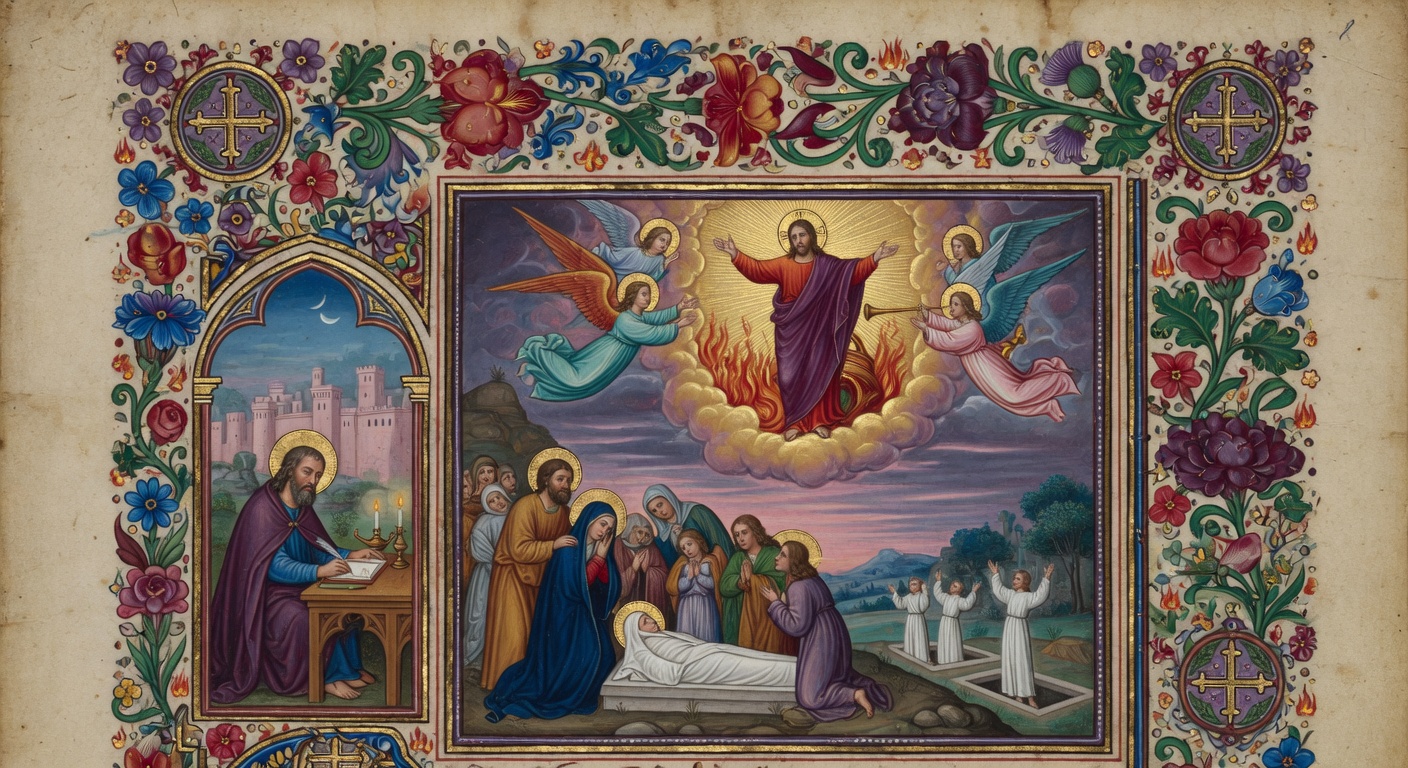
 1urthermore then we beseech you, brethren, and exhort you by the Lord Jesus, that as ye have received of us how ye ought to walk and to please God, so ye would abound more and more.
2 For ye know what commandments we gave you by the Lord Jesus.
3 For this is the will of God, even your sanctification, that ye should abstain from fornication:
4 That every one of you should know how to possess his vessel in sanctification and honour;
5 Not in the lust of concupiscence, even as the Gentiles which know not God:
6 That no man go beyond and defraud his brother in any matter: because that the Lord is the avenger of all such, as we also have forewarned you and testified.
7 For God hath not called us unto uncleanness, but unto holiness.
8 He therefore that despiseth, despiseth not man, but God, who hath also given unto us his holy Spirit.
9 But as touching brotherly love ye need not that I write unto you: for ye yourselves are taught of God to love one another.
10 And indeed ye do it toward all the brethren which are in all Macedonia: but we beseech you, brethren, that ye increase more and more;
11 And that ye study to be quiet, and to do your own business, and to work with your own hands, as we commanded you;
12 That ye may walk honestly toward them that are without, and that ye may have lack of nothing.
13 But I would not have you to be ignorant, brethren, concerning them which are asleep, that ye sorrow not, even as others which have no hope.
14 For if we believe that Jesus died and rose again, even so them also which sleep in Jesus will God bring with him.
15 For this we say unto you by the word of the Lord, that we which are alive and remain unto the coming of the Lord shall not prevent them which are asleep.
16 For the Lord himself shall descend from heaven with a shout, with the voice of the archangel, and with the trump of God: and the dead in Christ shall rise first:
17 Then we which are alive and remain shall be caught up together with them in the clouds, to meet the Lord in the air: and so shall we ever be with the Lord.
18 Wherefore comfort one another with these words.
← → arrow keys to navigate chapters · spacebar to play/pause audio
Did You Know?
The unique Greek term 'theodidaktoi' (taught by God) in verse 9 appears nowhere else in the New Testament and underscores that brotherly love is directly imparted by divine instruction rather than human effort alone.
Verse 6's warning against defrauding a brother in 'the matter' deliberately echoes the language of the Tenth Commandment, framing sexual misconduct as a form of theft that violates covenant community boundaries.
The 'word of the Lord' cited in verse 15 is unattested in any Gospel, suggesting Paul draws on an early oral tradition or prophetic revelation about the parousia not preserved elsewhere.
Paul's description of the Lord's descent with 'shout, voice of archangel, and trump of God' reappropriates Greco-Roman imperial arrival (parousia) imagery to present Christ as the true sovereign whose coming outstrips Caesar's.
The phrase 'sleep in Jesus' in verse 14 employs a distinctive genitive construction that ties the believer's death directly to union with Christ, transforming a common euphemism into a statement of participatory eschatology.
Commentary & Study Notes Jamieson-Fausset-Brown (1871) · Public Domain Furthermore — Greek, "As to what remains." Generally used towards the close of his Epistles (Eph 6:10; Php 4:8). then — with a view to the love and holiness (1Th 3:12, 13) which we…
Classic verse-by-verse commentary on 1 Thessalonians 4 from Jamieson, Fausset & Brown (1871). Covers: Exhortations to chastity; Brotherly love; Quiet industry; Abstinence from undue sorrow for departed friends, for at Christ's coming all his saints shall be glorified.
- 1
- Furthermore — Greek, "As to what remains." Generally used towards the close of his Epistles (Eph 6:10; Php 4:8). then — with a view to the love and holiness (1Th 3:12, 13) which we have just prayed for in your behalf, we now give you exhortation. beseech — "ask" as if it were a personal favor. by, &c. — rather as Greek, "IN the Lord Jesus"; in communion with the Lord Jesus, as Christian ministers dealing with Christian people [EDMUNDS]. as ye... received — when we were with you (1Th 2:13). how — Greek, the "how," that is, the manner. walk and... please God — that is, "and so please God," namely, by your walk; in contrast to the Jews who "please not God" (1Th 2:15). The oldest manuscripts add a clause here, "even as also ye do walk" (compare 1Th 4:10; 5:11). These words, which he was able to say of them with truth, conciliate a favorable hearing for the precepts which follow. Also the expression, "abound more and more," implies that there had gone before a recognition of their already in some measure walking so.
- 2
- by the Lord Jesus — by His authority and direction, not by our own. He uses the strong term, "commandments," in writing to this Church not long founded, knowing that they would take it in a right spirit, and feeling it desirable that they should understand he spake with divine authority. He seldom uses the term in writing subsequently, when his authority was established, to other churches. 1Co 7:10; 11:17; and 1Ti 1:5 (1Th 4:18, where the subject accounts for the strong expression) are the exceptions. "The Lord" marks His paramount authority, requiring implicit obedience.
Read all 18 notes on 1 Thessalonians 4 →