2 Corinthians 10 KJV
Paul Defends His Ministry
2 Corinthians Chapter 10: Paul Defends His Ministry
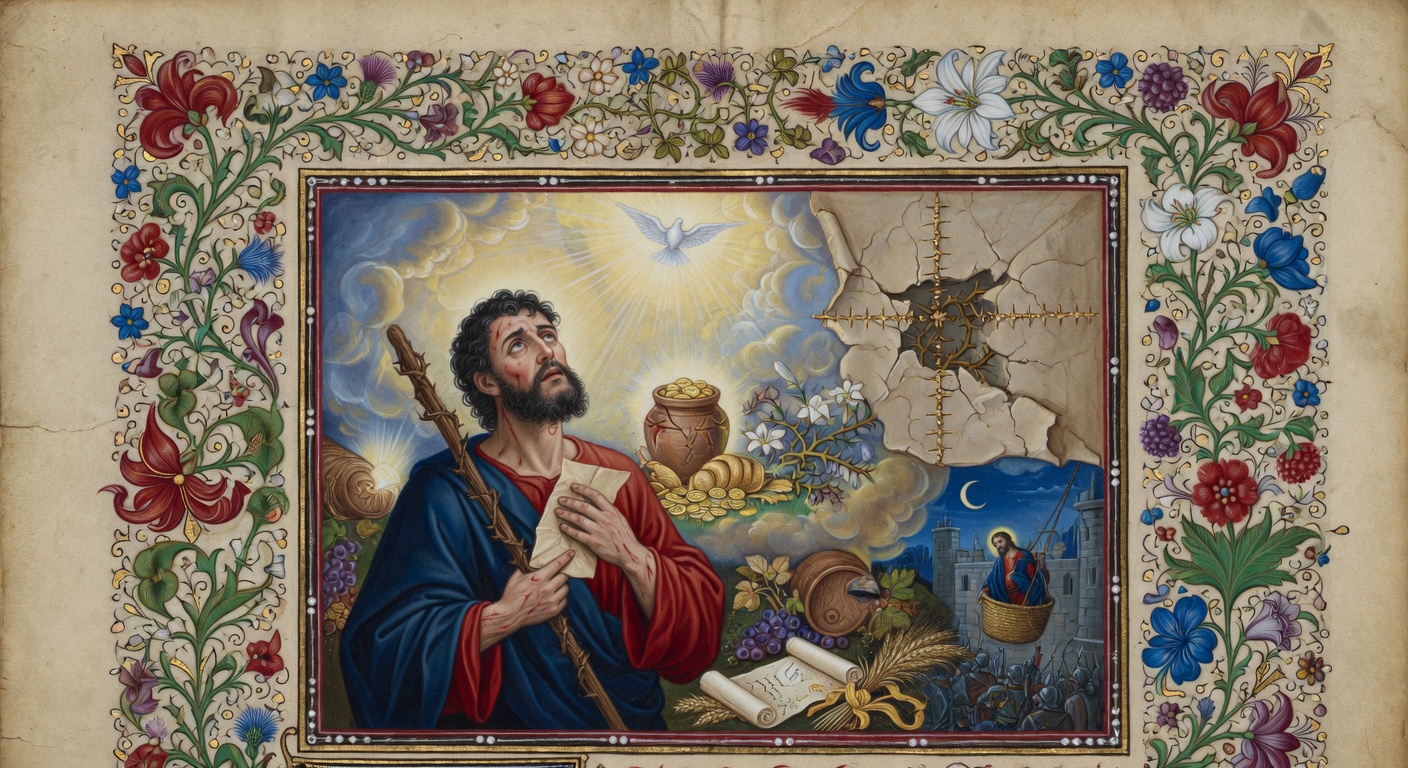
This chapter explores themes of Spiritual Warfare. Paul's use of 'strongholds' (ochyrōmata) in verse 5 specifically evokes Hellenistic military architecture and siege tactics, framing false teachings as ideological fortresses that require divine demolition rather than human persuasion.
 1ow I Paul myself beseech you by the meekness and gentleness of Christ, who in presence am base among you, but being absent am bold toward you:
2 But I beseech you, that I may not be bold when I am present with that confidence, wherewith I think to be bold against some, which think of us as if we walked according to the flesh.
3 For though we walk in the flesh, we do not war after the flesh:
4 (For the weapons of our warfare are not carnal, but mighty through God to the pulling down of strong holds;)
5 Casting down imaginations, and every high thing that exalteth itself against the knowledge of God, and bringing into captivity every thought to the obedience of Christ;
6 And having in a readiness to revenge all disobedience, when your obedience is fulfilled.
7 Do ye look on things after the outward appearance? If any man trust to himself that he is Christ’s, let him of himself think this again, that, as he is Christ’s, even so are we Christ’s.
8 For though I should boast somewhat more of our authority, which the Lord hath given us for edification, and not for your destruction, I should not be ashamed:
9 That I may not seem as if I would terrify you by letters.
10 For his letters, say they, are weighty and powerful; but his bodily presence is weak, and his speech contemptible.
11 Let such an one think this, that, such as we are in word by letters when we are absent, such will we be also in deed when we are present.
12 For we dare not make ourselves of the number, or compare ourselves with some that commend themselves: but they measuring themselves by themselves, and comparing themselves among themselves, are not wise.
13 But we will not boast of things without our measure, but according to the measure of the rule which God hath distributed to us, a measure to reach even unto you.
14 For we stretch not ourselves beyond our measure, as though we reached not unto you: for we are come as far as to you also in preaching the gospel of Christ:
15 Not boasting of things without our measure, that is, of other men’s labours; but having hope, when your faith is increased, that we shall be enlarged by you according to our rule abundantly,
16 To preach the gospel in the regions beyond you, and not to boast in another man’s line of things made ready to our hand.
17 But he that glorieth, let him glory in the Lord.
18 For not he that commendeth himself is approved, but whom the Lord commendeth.
← → arrow keys to navigate chapters · spacebar to play/pause audio
Did You Know?
Paul's use of 'strongholds' (ochyrōmata) in verse 5 specifically evokes Hellenistic military architecture and siege tactics, framing false teachings as ideological fortresses that require divine demolition rather than human persuasion.
The 'measure of the rule' (metron tou kanonos) in verses 13-16 alludes to ancient land-surveying practices used in Roman colonial allotments, positioning Paul's apostolic jurisdiction as a divinely assigned territory akin to tribal inheritances in Joshua.
Verse 17's quotation of Jeremiah 9:24 creates an intertextual link between Paul's self-defense and the prophetic critique of boasting in wisdom or strength, redirecting glory exclusively to the Lord amid Corinthian factionalism.
The contrast between Paul's 'weighty' letters and 'weak' bodily presence in verse 10 engages Greco-Roman rhetorical theory on ethos, where critics like those in Corinth applied standards from sophistic performance to dismiss his apostolic authority.
Verses 3-6's extended warfare metaphor repurposes Old Testament holy war language (e.g., from Deuteronomy) into a spiritual battle against 'imaginations' (logismous), countering both pagan philosophy and Judaizing influences without physical violence.
Commentary & Study Notes Jamieson-Fausset-Brown (1871) · Public Domain I Paul myself — no longer "we," "us," "our" (2Co 9:11): I who am represented by depreciators as "base," I, the same Paul, of my own accord "beseech you"; or rather "entreat," "exho…
Classic verse-by-verse commentary on 2 Corinthians 10 from Jamieson, Fausset & Brown (1871). Covers: He vindicates his apostolic authority against those who depreciated him for his personal appearance. He will make his power felt when he comes. He boasts not, as they, beyond his measure.
- 1
- I Paul myself — no longer "we," "us," "our" (2Co 9:11): I who am represented by depreciators as "base," I, the same Paul, of my own accord "beseech you"; or rather "entreat," "exhort" you for your sake. As "I beseech you" (a distinct Greek verb, 2Co 10:2) for my sake. by the meekness and gentleness of Christ — He mentions these graces of Christ especially (Ps 18:35; Mt 11:29), as on account of his imitation of them in particular he was despised [GROTIUS]. He entreats them by these, in order to show that though he must have recourse to more severe measures, he is naturally inclined to gentle ones after Christ's example [MENOCHIUS]. "Meekness" is more in the mind internally; "gentleness" in the external behavior, and in relation to others; for instance, the condescending yieldingness of a superior to an inferior, the former not insisting on his strict rights [TRENCH]. BENGEL explains it, "By the meekness and gentleness derived by me from Christ," not from my own nature: he objects to understanding it of Christ's meekness and gentleness, since nowhere else is "gentleness" attributed to Him. But though the exact Greek word is not applied to Him, the idea expressed by it is (compare Isa 40:11; Mt 12:19, 20). in presence — in personal appearance when present with you. base — Greek, "lowly"; timid, humbly diffident: opposed to "bold." "Am" stands here by ironical concession for "am reputed to be" (compare 2Co 10:10).
- 2
- I beseech you — Intimating that, as he can beseech in letters, so he can be severe in their presence. that I may not be — that I may not have to be bold, &c. with that confidence — that authoritative sternness. I think — I am minded to be. as if we walked according to the flesh — His Corinthian detractors judged of him by themselves, as if he were influenced by fleshly motives, the desire of favor or fear of giving offense, so as not to exercise his authority when present.
Read all 20 notes on 2 Corinthians 10 →