2 Corinthians 6 KJV
Paul's Hardships
2 Corinthians Chapter 6: Paul's Hardships
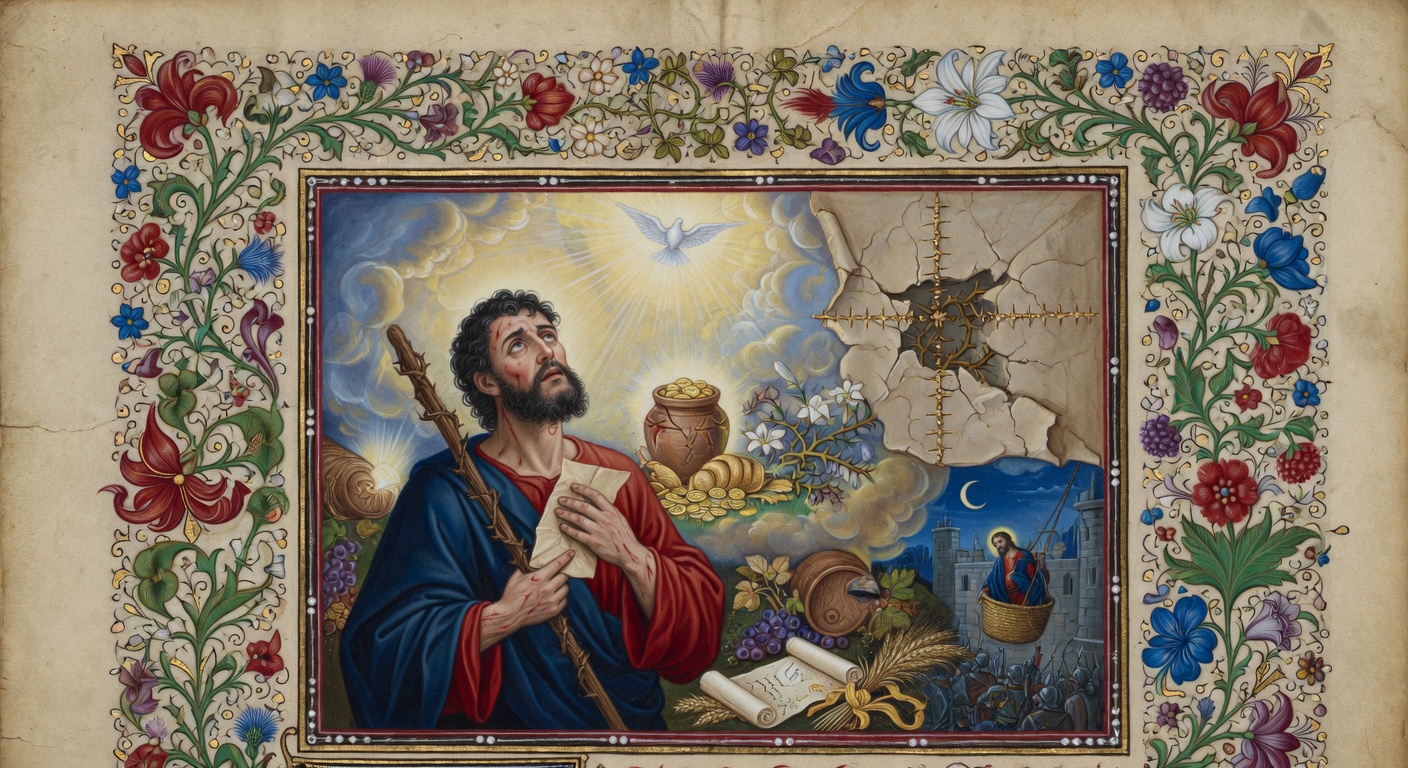
The hardships catalogue in verses 4-10 mirrors Greco-Roman peristasis lists used by Cynic and Stoic philosophers to authenticate their calling through suffering, but Paul Christianizes it by framing endurance as participation in Christ's paradoxical power.
 1e then, as workers together with him, beseech you also that ye receive not the grace of God in vain.
2 (For he saith, I have heard thee in a time accepted, and in the day of salvation have I succoured thee: behold, now is the accepted time; behold, now is the day of salvation.)
3 Giving no offence in any thing, that the ministry be not blamed:
4 But in all things approving ourselves as the ministers of God, in much patience, in afflictions, in necessities, in distresses,
5 In stripes, in imprisonments, in tumults, in labours, in watchings, in fastings;
6 By pureness, by knowledge, by longsuffering, by kindness, by the Holy Ghost, by love unfeigned,
7 By the word of truth, by the power of God, by the armour of righteousness on the right hand and on the left,
8 By honour and dishonour, by evil report and good report: as deceivers, and yet true;
9 As unknown, and yet well known; as dying, and, behold, we live; as chastened, and not killed;
10 As sorrowful, yet alway rejoicing; as poor, yet making many rich; as having nothing, and yet possessing all things.
11 O ye Corinthians, our mouth is open unto you, our heart is enlarged.
12 Ye are not straitened in us, but ye are straitened in your own bowels.
13 Now for a recompence in the same, (I speak as unto my children,) be ye also enlarged.
14 Be ye not unequally yoked together with unbelievers: for what fellowship hath righteousness with unrighteousness? and what communion hath light with darkness?
15 And what concord hath Christ with Belial? or what part hath he that believeth with an infidel?
16 And what agreement hath the temple of God with idols? for ye are the temple of the living God; as God hath said, I will dwell in them, and walk in them; and I will be their God, and they shall be my people.
17 Wherefore come out from among them, and be ye separate, saith the Lord, and touch not the unclean thing; and I will receive you,
18 And will be a Father unto you, and ye shall be my sons and daughters, saith the Lord Almighty.
← → arrow keys to navigate chapters · spacebar to play/pause audio
Did You Know?
The hardships catalogue in verses 4-10 mirrors Greco-Roman peristasis lists used by Cynic and Stoic philosophers to authenticate their calling through suffering, but Paul Christianizes it by framing endurance as participation in Christ's paradoxical power.
Verse 2's quotation of Isaiah 49:8 applies the Servant Song's 'day of salvation' directly to Paul's present apostolic ministry, signaling an inaugurated eschatology where the promised restoration is already underway amid affliction.
The 'unequally yoked' metaphor in verse 14 extends the agricultural prohibition of Deuteronomy 22:10 (ox and donkey) into a theological principle against spiritual syncretism, echoing Jewish concerns over intermarriage and idolatry in the Second Temple period.
Verses 16-18 weave a catena of Old Testament texts (Leviticus 26:11-12, Isaiah 52:11, Ezekiel 20:34, 2 Samuel 7:14) that collectively redefines the Corinthian community as the renewed temple and eschatological people of God.
Paul's emotional appeal in verses 11-13, with its imagery of an 'enlarged heart,' draws on ancient Mediterranean understandings of the heart as the organ of both intellect and affection, positioning apostolic suffering as the basis for relational openness rather than restriction.