Acts 28 KJV
Paul in Rome
Acts Chapter 28: Paul in Rome
The viper incident on Malta echoes Jesus' promise in Luke 10:19 that nothing shall by any means hurt the disciples, framing Paul's survival as a sign that the authority given to the Seventy continues in the apostolic mission to the ends of the earth.
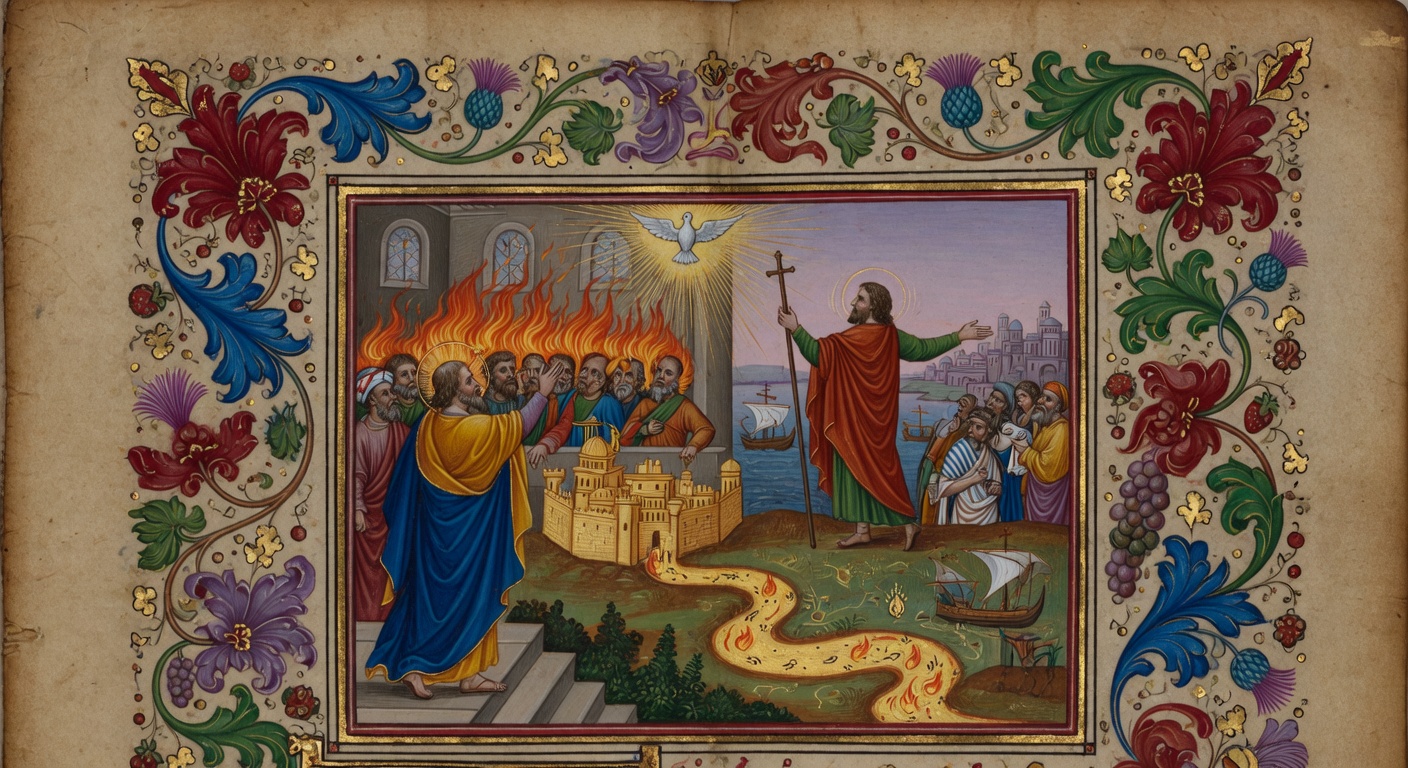
 1nd when they were escaped, then they knew that the island was called Melita.
2 And the barbarous people shewed us no little kindness: for they kindled a fire, and received us every one, because of the present rain, and because of the cold.
3 And when Paul had gathered a bundle of sticks, and laid them on the fire, there came a viper out of the heat, and fastened on his hand.
4 And when the barbarians saw the venomous beast hang on his hand, they said among themselves, No doubt this man is a murderer, whom, though he hath escaped the sea, yet vengeance suffereth not to live.
5 And he shook off the beast into the fire, and felt no harm.
6 Howbeit they looked when he should have swollen, or fallen down dead suddenly: but after they had looked a great while, and saw no harm come to him, they changed their minds, and said that he was a god.
7 In the same quarters were possessions of the chief man of the island, whose name was Publius; who received us, and lodged us three days courteously.
8 And it came to pass, that the father of Publius lay sick of a fever and of a bloody flux: to whom Paul entered in, and prayed, and laid his hands on him, and healed him.
9 So when this was done, others also, which had diseases in the island, came, and were healed:
10 Who also honoured us with many honours; and when we departed, they laded us with such things as were necessary.
11 And after three months we departed in a ship of Alexandria, which had wintered in the isle, whose sign was Castor and Pollux.
12 And landing at Syracuse, we tarried there three days.
13 And from thence we fetched a compass, and came to Rhegium: and after one day the south wind blew, and we came the next day to Puteoli:
14 Where we found brethren, and were desired to tarry with them seven days: and so we went toward Rome.
15 And from thence, when the brethren heard of us, they came to meet us as far as Appii forum, and The three taverns: whom when Paul saw, he thanked God, and took courage.
16 And when we came to Rome, the centurion delivered the prisoners to the captain of the guard: but Paul was suffered to dwell by himself with a soldier that kept him.
17 And it came to pass, that after three days Paul called the chief of the Jews together: and when they were come together, he said unto them, Men and brethren, though I have committed nothing against the people, or customs of our fathers, yet was I delivered prisoner from Jerusalem into the hands of the Romans.
18 Who, when they had examined me, would have let me go, because there was no cause of death in me.
19 But when the Jews spake against it, I was constrained to appeal unto Caesar; not that I had ought to accuse my nation of.
20 For this cause therefore have I called for you, to see you, and to speak with you: because that for the hope of Israel I am bound with this chain.
21 And they said unto him, We neither received letters out of Judaea concerning thee, neither any of the brethren that came shewed or spake any harm of thee.
22 But we desire to hear of thee what thou thinkest: for as concerning this sect, we know that every where it is spoken against.
23 And when they had appointed him a day, there came many to him into his lodging; to whom he expounded and testified the kingdom of God, persuading them concerning Jesus, both out of the law of Moses, and out of the prophets, from morning till evening.
24 And some believed the things which were spoken, and some believed not.
25 And when they agreed not among themselves, they departed, after that Paul had spoken one word, Well spake the Holy Ghost by Esaias the prophet unto our fathers,
26 Saying, Go unto this people, and say, Hearing ye shall hear, and shall not understand; and seeing ye shall see, and not perceive:
27 For the heart of this people is waxed gross, and their ears are dull of hearing, and their eyes have they closed; lest they should see with their eyes, and hear with their ears, and understand with their heart, and should be converted, and I should heal them.
28 Be it known therefore unto you, that the salvation of God is sent unto the Gentiles, and that they will hear it.
29 And when he had said these words, the Jews departed, and had great reasoning among themselves.
30 And Paul dwelt two whole years in his own hired house, and received all that came in unto him,
31 Preaching the kingdom of God, and teaching those things which concern the Lord Jesus Christ, with all confidence, no man forbidding him.
← → arrow keys to navigate chapters · spacebar to play/pause audio
Did You Know?
The viper incident on Malta echoes Jesus' promise in Luke 10:19 that nothing shall by any means hurt the disciples, framing Paul's survival as a sign that the authority given to the Seventy continues in the apostolic mission to the ends of the earth.
Paul's quotation of Isaiah 6:9-10 at the chapter's climax deliberately repeats the same text used by Jesus in Luke 8:10 and by Paul earlier in Acts 13, creating a literary inclusio that presents Jewish rejection of the gospel as the consistent scriptural pattern authorizing the Gentile mission.
The detail that the Maltese 'barbaroi' showed 'no little kindness' subverts the classical Greco-Roman stereotype of island savages, presenting instead an ironic reversal in which pagans treat the apostle more hospitably than the Jerusalem authorities had done.
The two-year house arrest in Rome, during which Paul 'received all that came in unto him,' functions as an implicit contrast to the temple cult: the true locus of Israel's hope has shifted from the Jerusalem sanctuary to an unhindered proclamation centered on the risen Christ.
By ending without narrating Paul's trial outcome or death, Luke leaves the narrative open at the geographical goal of Acts 1:8, implying that the 'kingdom of God' and 'those things which concern the Lord Jesus Christ' continue beyond the text into the reader's own time.
Commentary & Study Notes Jamieson-Fausset-Brown (1871) · Public Domain knew the island was called Melita — (See on Ac 27:39). The opinion that this island was not Malta to the south of Sicily, but Meleda in the Gulf of Venice — which till lately had r…
Classic verse-by-verse commentary on Acts 28 from Jamieson, Fausset & Brown (1871). Covers: The wintering at malta, and notable occurrences there--prosecution of the voyage to italy as far as puteoli, and land journey thence to rome--summary of the apostle's labors there for the two following years.
- 1
- knew the island was called Melita — (See on Ac 27:39). The opinion that this island was not Malta to the south of Sicily, but Meleda in the Gulf of Venice — which till lately had respectable support among Competent judges — is now all but exploded; examination of all the places on the spot, and of all writings and principles bearing on the question, by gentlemen of the highest qualification, particularly SMITH (see on Ac 27:41), having set the question, it may now be affirmed, at rest.
- 2
- the barbarous people — so called merely as speaking neither the Greek nor the Latin language. They were originally Phnician colonists. showed us no little — "no ordinary" kindness, for they kindled a fire, and received us every one, because of the present rain — "the rain that was on us" — not now first falling, but then falling heavily. and because of the cold — welcomed us all, drenched and shivering, to these most seasonable marks of friendship. In this these "barbarians" contrast favorably with many since bearing the Christian name. The lifelike style of the narrative here and in the following verses gives it a great charm.
Read all 29 notes on Acts 28 →