Isaiah 32 KJV
The Kingdom of Righteousness
Isaiah Chapter 32: The Kingdom of Righteousness
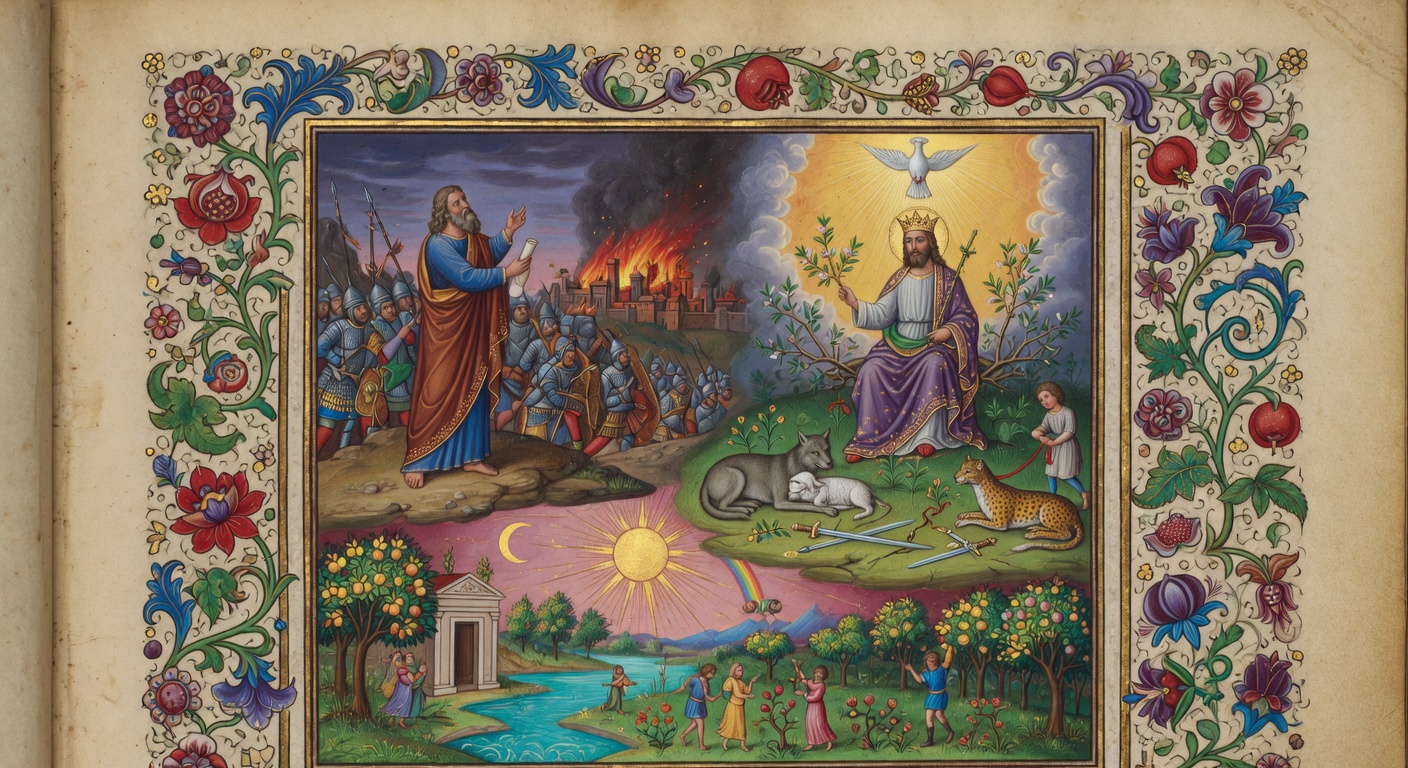
The chapter frames the messianic king's protection in verse 2 with the rare triple metaphor of 'hiding place from the wind,' 'covert from the tempest,' and 'rivers of water in a dry place,' evoking both Exodus wilderness imagery and ancient Near Eastern storm-god motifs repurposed for a human ruler.
 1ehold, a king shall reign in righteousness, and princes shall rule in judgment.
2 And a man shall be as an hiding place from the wind, and a covert from the tempest; as rivers of water in a dry place, as the shadow of a great rock in a weary land.
3 And the eyes of them that see shall not be dim, and the ears of them that hear shall hearken.
4 The heart also of the rash shall understand knowledge, and the tongue of the stammerers shall be ready to speak plainly.
5 The vile person shall be no more called liberal, nor the churl said to be bountiful.
6 For the vile person will speak villany, and his heart will work iniquity, to practise hypocrisy, and to utter error against the LORD, to make empty the soul of the hungry, and he will cause the drink of the thirsty to fail.
7 The instruments also of the churl are evil: he deviseth wicked devices to destroy the poor with lying words, even when the needy speaketh right.
8 But the liberal deviseth liberal things; and by liberal things shall he stand.
9 Rise up, ye women that are at ease; hear my voice, ye careless daughters; give ear unto my speech.
10 Many days and years shall ye be troubled, ye careless women: for the vintage shall fail, the gathering shall not come.
11 Tremble, ye women that are at ease; be troubled, ye careless ones: strip you, and make you bare, and gird sackcloth upon your loins.
12 They shall lament for the teats, for the pleasant fields, for the fruitful vine.
13 Upon the land of my people shall come up thorns and briers; yea, upon all the houses of joy in the joyous city:
14 Because the palaces shall be forsaken; the multitude of the city shall be left; the forts and towers shall be for dens for ever, a joy of wild asses, a pasture of flocks;
15 Until the spirit be poured upon us from on high, and the wilderness be a fruitful field, and the fruitful field be counted for a forest.
16 Then judgment shall dwell in the wilderness, and righteousness remain in the fruitful field.
17 And the work of righteousness shall be peace; and the effect of righteousness quietness and assurance for ever.
18 And my people shall dwell in a peaceable habitation, and in sure dwellings, and in quiet resting places;
19 When it shall hail, coming down on the forest; and the city shall be low in a low place.
20 Blessed are ye that sow beside all waters, that send forth thither the feet of the ox and the ass.
← → arrow keys to navigate chapters · spacebar to play/pause audio
Did You Know?
The chapter frames the messianic king's protection in verse 2 with the rare triple metaphor of 'hiding place from the wind,' 'covert from the tempest,' and 'rivers of water in a dry place,' evoking both Exodus wilderness imagery and ancient Near Eastern storm-god motifs repurposed for a human ruler.
Verses 9-14 address the 'women that are at ease' and 'careless daughters' in language that deliberately echoes the taunt-song against the 'daughters of Zion' in Isaiah 3, yet shifts the indictment from adornment to agricultural complacency, linking moral indifference directly to crop failure.
The outpouring of the Spirit in verse 15 is the only place in Isaiah where ruach is said to be poured 'from on high' upon 'us,' creating a corporate rather than individual endowment that anticipates Joel 2 while grounding social justice in pneumatic effusion rather than royal decree alone.
Verse 17's chiasm ('work of righteousness... peace... effect of righteousness quietness and assurance') presents peace not as the absence of war but as the active 'effect' or 'service' of mishpat, a theological claim that inverts Assyrian propaganda equating peace with imperial tribute.
The final verse's benediction on those who 'sow beside all waters' and 'send forth the feet of the ox and the ass' subtly reverses the curse of Deuteronomy 28:30-31 by restoring agricultural freedom under a righteous order, transforming forced labor into voluntary fruitfulness.
Commentary & Study Notes Jamieson-Fausset-Brown (1871) · Public Domain king — not Hezekiah, who was already on the throne, whereas a future time is contemplated. If he be meant at all, it can only be as a type of Messiah the King, to whom alone the la…
Classic verse-by-verse commentary on Isaiah 32 from Jamieson, Fausset & Brown (1871). Covers: Messiah's kingdom; Desolations, to be succeeded by lasting peace, the spirit having been poured out.
- 1
- king — not Hezekiah, who was already on the throne, whereas a future time is contemplated. If he be meant at all, it can only be as a type of Messiah the King, to whom alone the language is fully applicable (Ho 3:5; Zec 9:9; see on Isa 11:3-5). The kingdom shall be transferred from the world kings, who have exercised their power against God, instead of for God, to the rightful King of kings (Eze 21:27; Da 7:13, 14). princes — subordinate; referring to all in authority under Christ in the coming kingdom on earth, for example, the apostles, &c. (Lu 22:30; 1Co 6:2; 2Ti 2:12; Re 2:26, 27; 3:21).
- 2
- a man — rather, the man Christ [LOWTH]; it is as "the Son of man" He is to reign, as it was as Son of man He suffered (Mt 26:64; Joh 5:27; 19:5). Not as MAURER explains, "every one of the princes shall be," &c. rivers — as refreshing as water and the cool shade are to the heated traveller (Isa 35:6, 7; 41:18).
Read all 20 notes on Isaiah 32 →