Job 25 KJV
Bildad's Third Speech
Job Chapter 25: Bildad's Third Speech
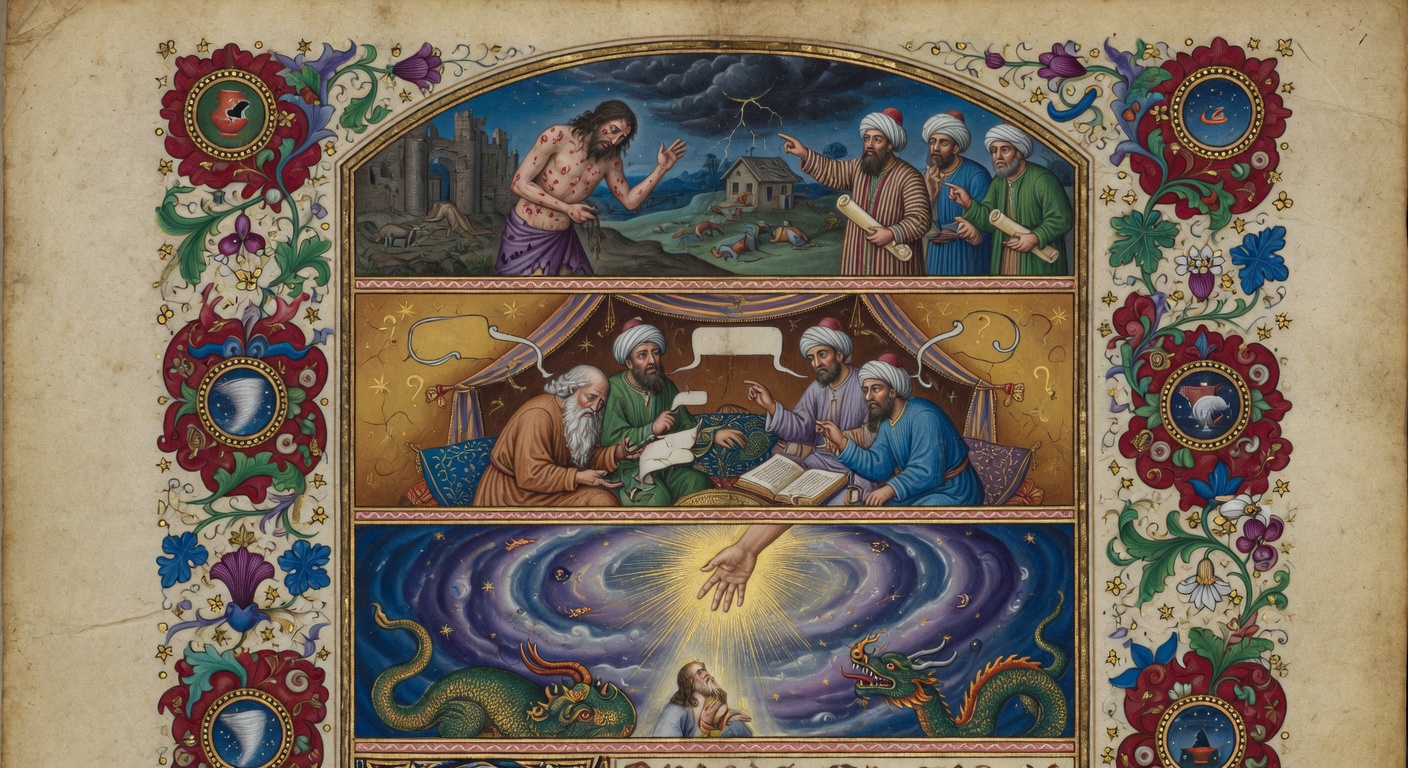
Bildad's reference to God making 'peace in his high places' echoes ancient Near Eastern motifs of divine subjugation of chaotic heavenly powers, reframing cosmic order as an act of pacification rather than mere creation.
 1hen answered Bildad the Shuhite, and said,
2 Dominion and fear are with him, he maketh peace in his high places.
3 Is there any number of his armies? and upon whom doth not his light arise?
4 How then can man be justified with God? or how can he be clean that is born of a woman?
5 Behold even to the moon, and it shineth not; yea, the stars are not pure in his sight.
6 How much less man, that is a worm? and the son of man, which is a worm?
← → arrow keys to navigate chapters · spacebar to play/pause audio
Did You Know?
Bildad's reference to God making 'peace in his high places' echoes ancient Near Eastern motifs of divine subjugation of chaotic heavenly powers, reframing cosmic order as an act of pacification rather than mere creation.
The assertion that even the moon and stars are not pure in God's sight draws on a distinctive wisdom tradition of celestial imperfection, paralleling but intensifying similar imagery in Job 15:15 to argue for an ontological gulf between Creator and creation.
Unlike earlier speeches that mix theology with direct accusations, chapter 25 avoids naming Job or his sins entirely, illustrating the friends' rhetorical collapse into abstract dogma as dialogue breaks down.
The 'worm' metaphor for humanity (Job 25:6) inverts royal or priestly exaltation language found elsewhere in the Hebrew Bible, positioning humans not as vice-regents but as creatures lower than the already-impure luminaries.
As the final speech from the three friends, the chapter functions as a truncated coda that restates retributive logic without engaging Job's oath of innocence, marking the transition from human debate to divine theophany.