Job 26 KJV
Job's Reply: God's Majesty
Job Chapter 26: Job's Reply: God's Majesty
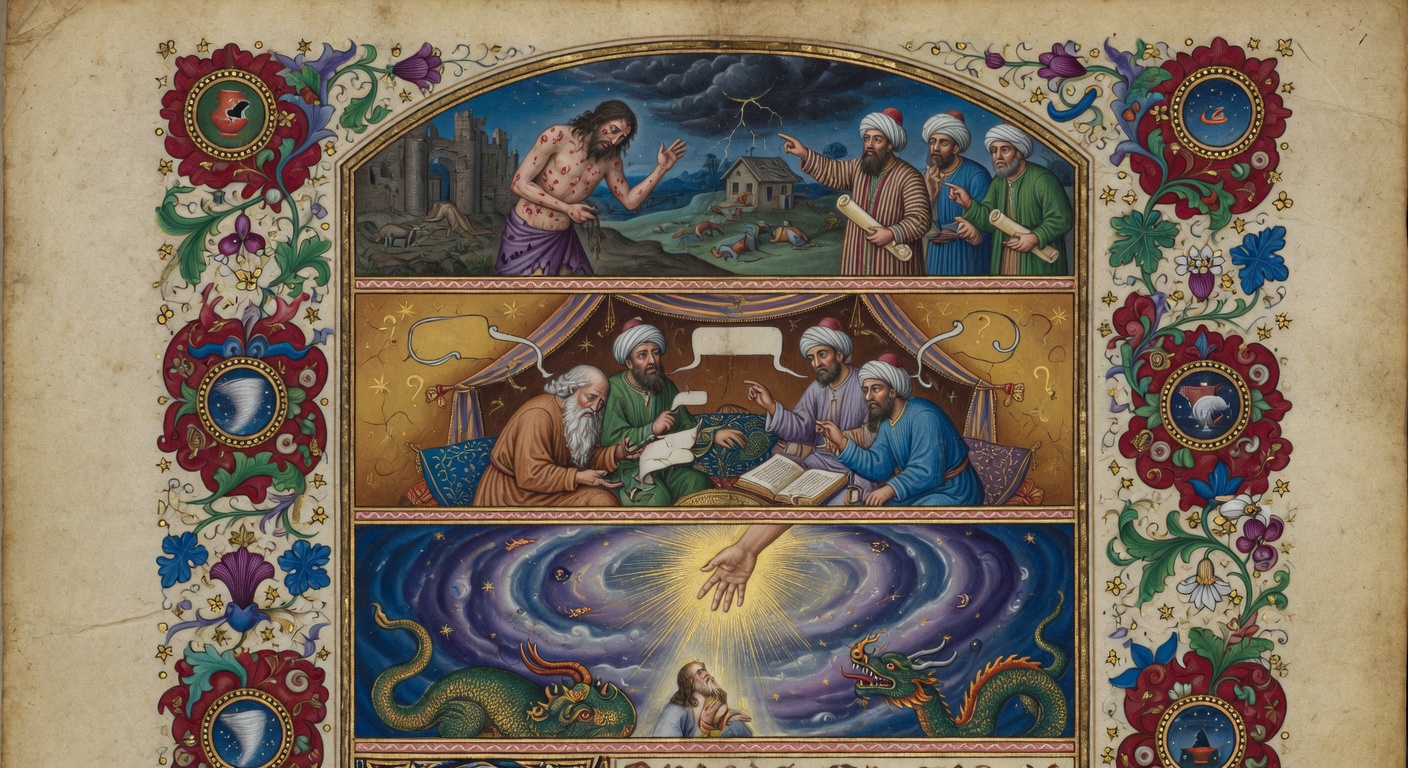
Job 26:7's claim that God 'hangeth the earth upon nothing' stands out against ancient Near Eastern cosmologies that typically depict the world resting on a giant or cosmic mountain, offering an unusually abstract ancient portrayal of suspended creation.
 1ut Job answered and said,
2 How hast thou helped him that is without power? how savest thou the arm that hath no strength?
3 How hast thou counselled him that hath no wisdom? and how hast thou plentifully declared the thing as it is?
4 To whom hast thou uttered words? and whose spirit came from thee?
5 Dead things are formed from under the waters, and the inhabitants thereof.
6 Hell is naked before him, and destruction hath no covering.
7 He stretcheth out the north over the empty place, and hangeth the earth upon nothing.
8 He bindeth up the waters in his thick clouds; and the cloud is not rent under them.
9 He holdeth back the face of his throne, and spreadeth his cloud upon it.
10 He hath compassed the waters with bounds, until the day and night come to an end.
11 The pillars of heaven tremble and are astonished at his reproof.
12 He divideth the sea with his power, and by his understanding he smiteth through the proud.
13 By his spirit he hath garnished the heavens; his hand hath formed the crooked serpent.
14 Lo, these are parts of his ways: but how little a portion is heard of him? but the thunder of his power who can understand?
← → arrow keys to navigate chapters · spacebar to play/pause audio
Did You Know?
Job 26:7's claim that God 'hangeth the earth upon nothing' stands out against ancient Near Eastern cosmologies that typically depict the world resting on a giant or cosmic mountain, offering an unusually abstract ancient portrayal of suspended creation.
The chapter's reference to Rahab in verse 12 reworks Canaanite storm-god imagery by having Yahweh 'smite' the chaos monster rather than battle it ongoing, signaling a theological move toward absolute divine sovereignty over primordial forces.
Job locates the realm of the dead (Sheol and Abaddon) beneath the cosmic waters with no covering (v. 5-6), inverting typical protective enclosure motifs and underscoring God's unmediated gaze even into hidden underworld depths.
The trembling 'pillars of heaven' at God's rebuke (v. 11) draws on architectural language shared with Mesopotamian and Ugaritic texts, yet here the pillars react in fear rather than providing stable support, subverting expectations of cosmic order.
Verse 14's phrase 'the outskirts of his ways' employs the Hebrew qəṣōt to frame all prior descriptions as mere fringes, reinforcing the book's wisdom theme that even accurate theology captures only peripheral echoes of divine reality.