Gideon
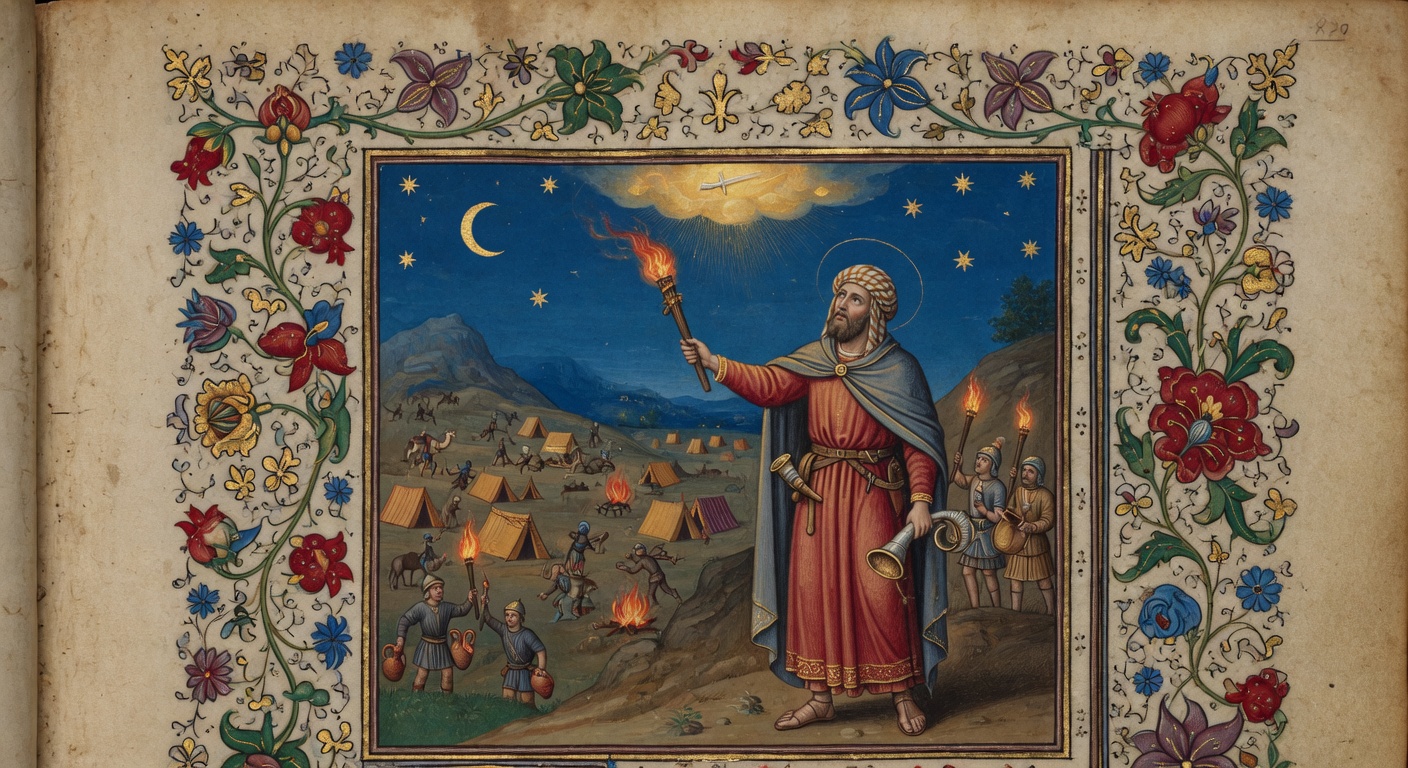
Gideon was a judge raised up by God during a time when the Israelites were oppressed by the Midianites due to their disobedience. Initially hesitant, he obeyed God's command to lead an army against the invaders, but God reduced his forces from thousands to just 300 men to ensure that the victory would be attributed to divine power rather than human might. With torches, trumpets, and clay jars, Gideon's small band routed the much larger Midianite army, bringing peace to the land for forty years. This account in the Book of Judges illustrates the biblical principle that God often works through human weakness to display His strength and faithfulness to His people.
Biography
- Occupation
- Judge, Warrior
- Tribe
- Manasseh
- Father
- Joash
- Spouse
- Many wives
- Children
- Seventy sons, including Abimelech
- Era
- Judges (c. 1162-1122 BC)
- Nationality
- Israelite
- Also Known As
- Jerubbaal
Family
Did You Know?
Gideon first appears in the biblical narrative while secretly threshing wheat inside a winepress to evade Midianite raiders, an act that underscores the extreme economic oppression Israel faced during this period of the Judges.
Before his military campaign, Gideon earned the name Jerubbaal by destroying his father's Baal altar and Asherah pole at night, provoking a local crisis that highlighted the syncretistic religious practices common among Israelite families in the twelfth century BC.
Gideon twice tested God's promise using a wool fleece, first requesting dew only on the fleece while the ground stayed dry, then reversing the sign, demonstrating a rare biblical example of prolonged divine accommodation to human doubt.
The selection of Gideon's 300 warriors relied on an ancient drinking test at the spring of Harod, where men who lapped water from their hands like dogs were chosen over those who knelt, reflecting tactical concerns about readiness and stealth in ancient Near Eastern warfare.
After the victory Gideon collected gold earrings from the defeated Midianites to fashion an ephod that later became an idolatrous object in Ophrah, illustrating how even successful leaders could inadvertently introduce cultic stumbling blocks for Israel.
Key Passages
Gideon's Call
Judges 6:11-24
God addresses a fearful man hiding from enemies as 'mighty warrior' - seeing not what Gideon is, but what he will become through divine empowerment.
 11nd there came an angel of the LORD, and sat under an oak which was in Ophrah, that pertained unto Joash the Abiezrite: and his son Gideon threshed wheat by the winepress, to hide it from the Midianites.
The Fleece
Judges 6:36-40
Gideon's request for signs reveals both human weakness and God's patience. God graciously accommodates doubt while calling His servant toward greater faith.
36nd Gideon said unto God, If thou wilt save Israel by mine hand, as thou hast said,
Victory with 300 Men
Judges 7:15-25
God deliberately reduces Gideon's army from 32,000 to 300 so that Israel cannot claim credit for the victory - establishing that God's power is displayed through human weakness.
15nd it was so, when Gideon heard the telling of the dream, and the interpretation thereof, that he worshipped, and returned into the host of Israel, and said, Arise; for the LORD hath delivered into your hand the host of Midian.