Boaz's Kinsman Redeemer
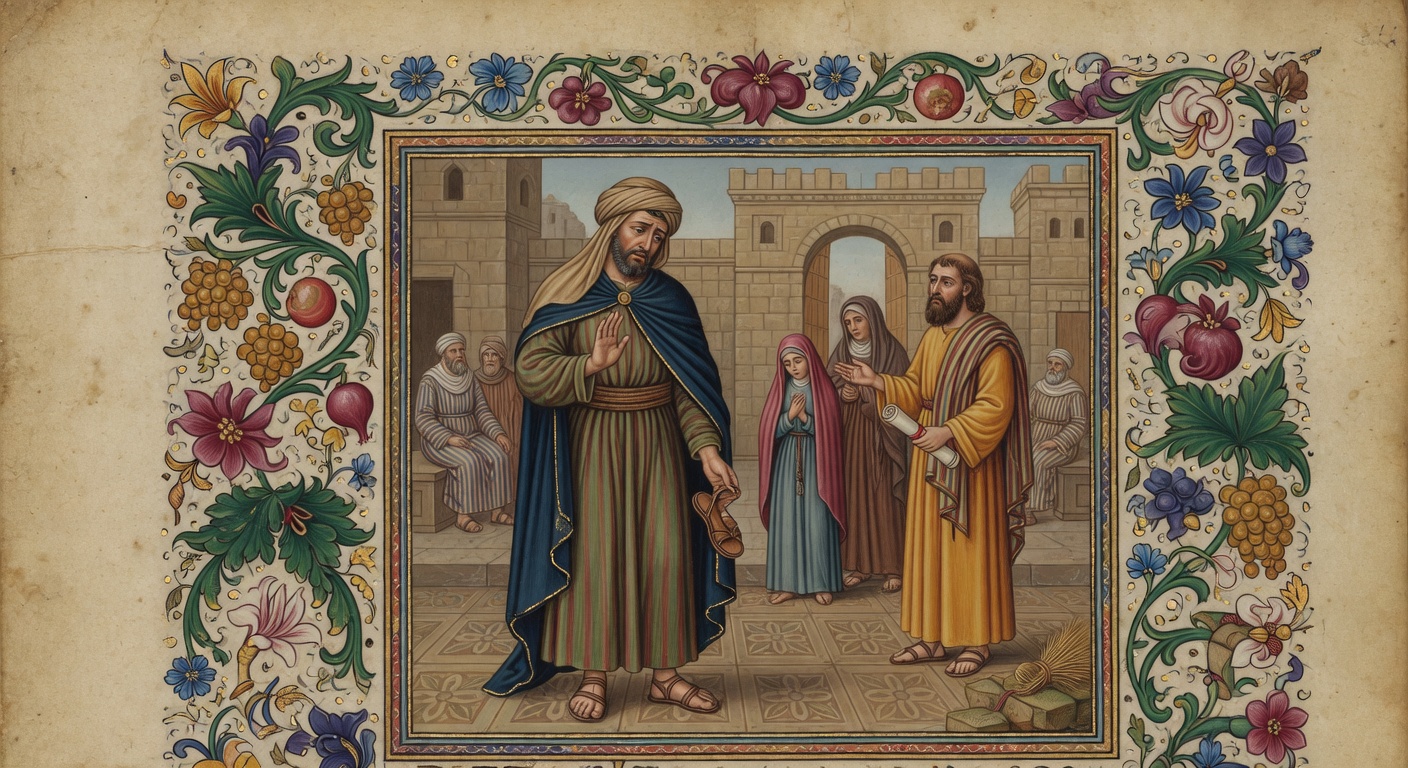
In the Book of Ruth, the unnamed nearer kinsman held the primary legal right under Israelite custom to redeem the land of Elimelech, Naomi's deceased husband, and to marry Ruth in order to preserve the family name and inheritance. When Boaz presented this obligation at the city gate, the kinsman initially agreed to buy the land but withdrew upon realizing that marriage to Ruth would require him to share or risk his own estate with any offspring from that union. His refusal cleared the way for Boaz to fulfill the role of redeemer, resulting in the marriage to Ruth and the birth of their son Obed, who became the grandfather of King David. This episode underscores the biblical themes of redemption and divine providence in maintaining the lineage leading to the Messiah.
Biography
- Tribe
- Judah
- Era
- Judges (c. 1100 BC)
- Nationality
- Israelite
Did You Know?
The nearer kinsman's refusal arose because any son born to Ruth would be legally reckoned as Elimelech's heir, forcing the redeemer to expend his own funds on land that would ultimately enlarge another man's lineage instead of his direct descendants' holdings under Iron Age Israelite inheritance rules.
The sandal-removal ceremony performed at Bethlehem's city gate before ten elders transferred redemption rights to Boaz and invoked a Deuteronomic legal symbol that publicly marked the kinsman's renunciation, a ritual otherwise sparsely attested outside levirate contexts.
During the late Judges period, redemption transactions like this one combined land restoration with marriage duties to prevent family estates from permanently leaving the clan, yet the nearer relative's economic calculation shows how personal risk could override customary obligation in village society.
The kinsman's anonymity in the narrative functions as deliberate literary contrast, underscoring Boaz's hesed while erasing the closer relative from both the text and the genealogy that leads to David, an outcome the man sought to avoid by declining.
City-gate assemblies served as the primary venue for validating such deals because they allowed communal memory to substitute for written contracts, ensuring disputed fields and lineage claims remained traceable across generations in a largely non-literate culture.
Key Passages
The Nearer Kinsman Declines
Ruth 4:1-8
This passage shows how God clears the path for willing redemption, reminding us that true love often requires sacrificial commitment to bless future generations.
 1hen went Boaz up to the gate, and sat him down there: and, behold, the kinsman of whom Boaz spake came by; unto whom he said, Ho, such a one! turn aside, sit down here. And he turned aside, and sat down.