Boaz
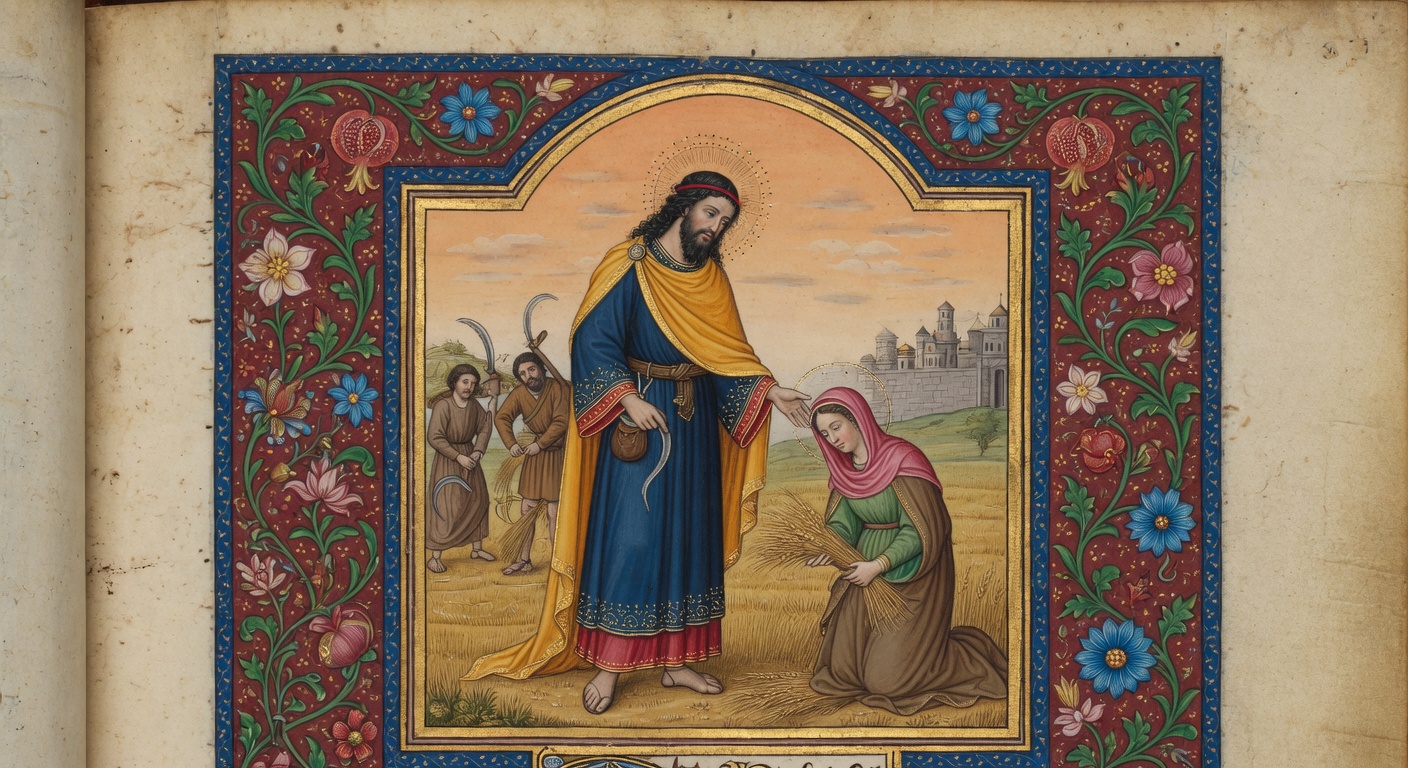
Boaz was a wealthy and respected landowner in Bethlehem during the period of the judges, recognized for his faithfulness to Israelite law and customs. When the Moabite widow Ruth arrived with her mother-in-law Naomi, Boaz acted as her kinsman-redeemer by permitting her to glean in his fields, protecting her, and ultimately marrying her after the nearer relative declined the duty, thereby redeeming the family property and securing Ruth's future. Their marriage produced a son named Obed, who became the father of Jesse and grandfather of King David, directly linking Boaz to the royal lineage of Israel. This account in the Book of Ruth illustrates God's providence in using acts of loyalty and redemption to preserve the messianic line despite foreign origins and social marginalization.
Biography
- Occupation
- Landowner, Farmer
- Tribe
- Judah
- Father
- Salmon
- Mother
- Rahab
- Spouse
- Ruth
- Children
- Obed
- Era
- Judges (c. 1100 BC)
- Nationality
- Israelite
Family
Did You Know?
Boaz is identified in Ruth 2:1 as a "worthy man" (ish gibbor chayil), a phrase also used of military leaders like Gideon, underscoring his high social status and protective role in a lawless era of the Judges.
According to the genealogy in Matthew 1:5, Boaz was the son of Salmon and Rahab of Jericho, linking the Moabite outsider Ruth to an earlier Canaanite convert and illustrating unexpected Gentile inclusion in Israel's royal line.
Boaz invoked the rare custom of the kinsman-redeemer (goel) from Leviticus 25 by purchasing Elimelech's land and marrying Ruth at the city gate, a public legal transaction witnessed by ten elders that preserved both property and lineage.
At the threshing floor, Ruth's bold nighttime proposal invoked the levirate duty (Deuteronomy 25), yet Boaz insisted on first offering the redemption right to a nearer relative, revealing precise adherence to Israelite inheritance law over personal desire.
Boaz's six measures of barley given to Ruth (Ruth 3:15) symbolized both generous provision and a legal pledge, a detail that casual readers overlook but which signaled his intent to complete the redemption before the harvest ended.
Key Passages
Boaz Notices Ruth
Ruth 2:4-16
This passage shows how compassionate integrity welcomes the outsider and becomes a channel of God's generous care.
 4nd, behold, Boaz came from Bethlehem, and said unto the reapers, The LORD be with you. And they answered him, The LORD bless thee.
Boaz at the Threshing Floor
Ruth 3:7-15
This passage shows Boaz's integrity and kindness as he steps forward to redeem and protect Ruth, modeling God's caring provision.
7nd when Boaz had eaten and drunk, and his heart was merry, he went to lie down at the end of the heap of corn: and she came softly, and uncovered his feet, and laid her down.
Boaz Redeems Ruth
Ruth 4:9-17
This passage reveals how God's redeeming love restores the broken and weaves ordinary lives into his greater story of hope.
9nd Boaz said unto the elders, and unto all the people, Ye are witnesses this day, that I have bought all that was Elimelech’s, and all that was Chilion’s and Mahlon’s, of the hand of Naomi.