2 Corinthians 5 KJV
The Ministry of Reconciliation
2 Corinthians Chapter 5: The Ministry of Reconciliation
This chapter explores themes of Heaven. The tent/tabernacle imagery for the body (v.1) subtly positions Paul’s apostolic afflictions within Israel’s wilderness tradition, where God’s presence dwelled in a portable sanctuary rather than a fixed temple.
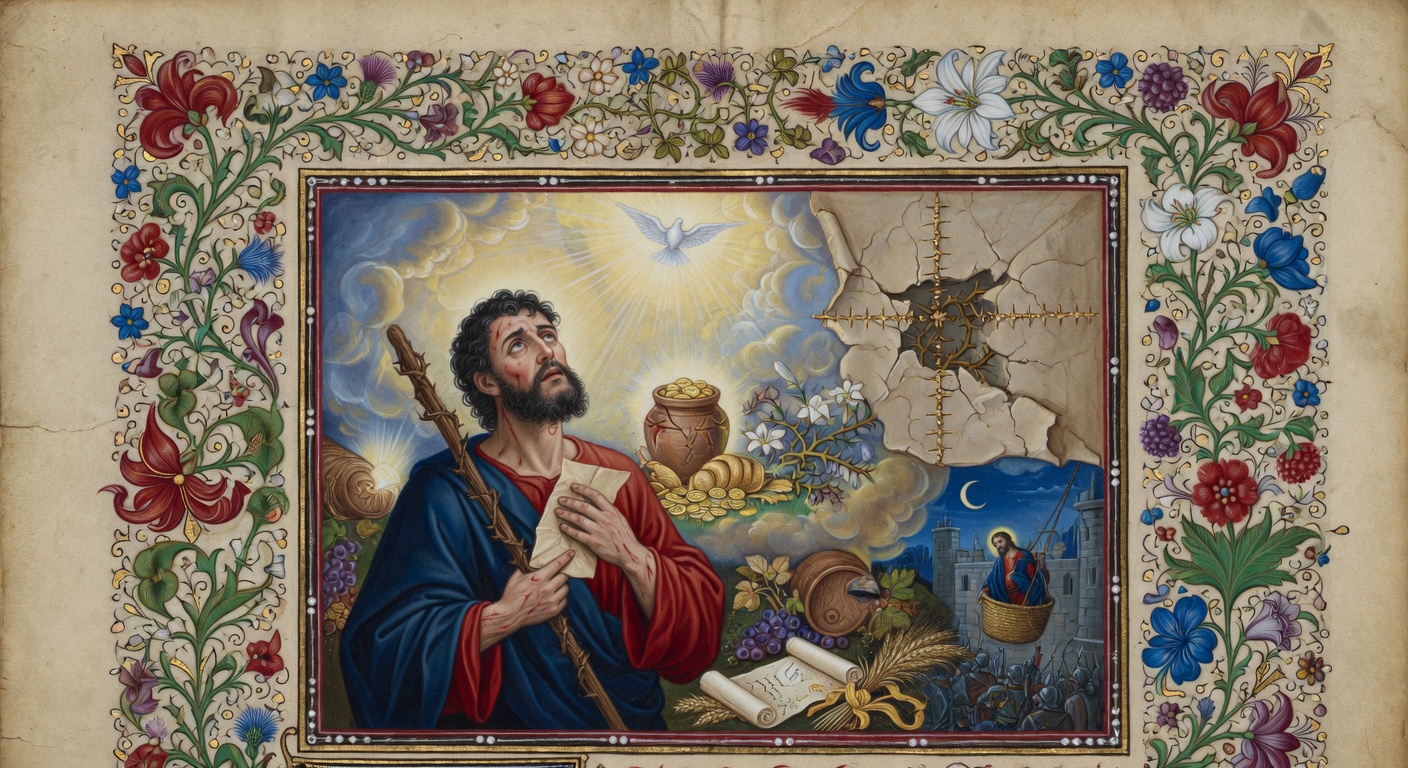
 1or we know that if our earthly house of this tabernacle were dissolved, we have a building of God, an house not made with hands, eternal in the heavens.
2 For in this we groan, earnestly desiring to be clothed upon with our house which is from heaven:
3 If so be that being clothed we shall not be found naked.
4 For we that are in this tabernacle do groan, being burdened: not for that we would be unclothed, but clothed upon, that mortality might be swallowed up of life.
5 Now he that hath wrought us for the selfsame thing is God, who also hath given unto us the earnest of the Spirit.
6 Therefore we are always confident, knowing that, whilst we are at home in the body, we are absent from the Lord:
7 (For we walk by faith, not by sight:)
8 We are confident, I say, and willing rather to be absent from the body, and to be present with the Lord.
9 Wherefore we labour, that, whether present or absent, we may be accepted of him.
10 For we must all appear before the judgment seat of Christ; that every one may receive the things done in his body, according to that he hath done, whether it be good or bad.
11 Knowing therefore the terror of the Lord, we persuade men; but we are made manifest unto God; and I trust also are made manifest in your consciences.
12 For we commend not ourselves again unto you, but give you occasion to glory on our behalf, that ye may have somewhat to answer them which glory in appearance, and not in heart.
13 For whether we be beside ourselves, it is to God: or whether we be sober, it is for your cause.
14 For the love of Christ constraineth us; because we thus judge, that if one died for all, then were all dead:
15 And that he died for all, that they which live should not henceforth live unto themselves, but unto him which died for them, and rose again.
16 Wherefore henceforth know we no man after the flesh: yea, though we have known Christ after the flesh, yet now henceforth know we him no more.
17 Therefore if any man be in Christ, he is a new creature: old things are passed away; behold, all things are become new.
18 And all things are of God, who hath reconciled us to himself by Jesus Christ, and hath given to us the ministry of reconciliation;
19 To wit, that God was in Christ, reconciling the world unto himself, not imputing their trespasses unto them; and hath committed unto us the word of reconciliation.
20 Now then we are ambassadors for Christ, as though God did beseech you by us: we pray you in Christ’s stead, be ye reconciled to God.
21 For he hath made him to be sin for us, who knew no sin; that we might be made the righteousness of God in him.
← → arrow keys to navigate chapters · spacebar to play/pause audio
Did You Know?
The tent/tabernacle imagery for the body (v.1) subtly positions Paul’s apostolic afflictions within Israel’s wilderness tradition, where God’s presence dwelled in a portable sanctuary rather than a fixed temple.
Verse 3’s warning against being found “naked” draws on ancient Jewish apocalyptic traditions about post-mortem shame and the need for a heavenly garment, distinguishing Christian hope from both Greek soul-immortality and simple resuscitation.
The declaration that believers become “the righteousness of God” (v.21) applies a divine attribute to the community, an astonishing transfer that echoes yet surpasses the servant songs of Isaiah where righteousness is imputed to the many.
Paul’s claim to be Christ’s ambassador (v.20) borrows the language of Roman legates who spoke with the emperor’s authority, recasting imperial diplomacy as the announcement of a crucified king’s peace treaty with the world.
The “ministry of reconciliation” (v.18) is framed as God’s own initiative that precedes human response, reversing the normal ancient pattern in which the offending party sought terms; here the offended deity dispatches emissaries first.
Commentary & Study Notes Jamieson-Fausset-Brown (1871) · Public Domain For — Assigning the reason for the statement (2Co 4:17), that affliction leads to exceeding glory. we know — assuredly (2Co 4:14; Job 19:25). if — For all shall not die; many shall…
Classic verse-by-verse commentary on 2 Corinthians 5 from Jamieson, Fausset & Brown (1871). Covers: The hope (2co 4:17, 18) of eternal glory in the resurrection body.
- 1
- For — Assigning the reason for the statement (2Co 4:17), that affliction leads to exceeding glory. we know — assuredly (2Co 4:14; Job 19:25). if — For all shall not die; many shall be "changed" without "dissolution" (1Co 15:51-53). If this daily delivering unto death (2Co 3:11) should end in actual death. earthly — not the same as earthy (1Co 15:47). It stands in contrast to "in the heavens." house of this tabernacle — rather, "house of the tabernacle." "House" expresses more permanency than belongs to the body; therefore the qualification, "of the tabernacle" (implying that it is shifting, not stationary), is added (compare Job 4:19; 2Pe 1:13, 14). It thus answers to the tabernacle in the wilderness. Its wooden frame and curtains wore out in course of time when Israel dwelt in Canaan, and a fixed temple was substituted for it. The temple and the tabernacle in all essentials were one; there was the same ark, the same cloud of glory. Such is the relation between the "earthly" body and the resurrection body. The Holy Spirit is enshrined in the believer's body as in a sanctuary (1Co 3:16). As the ark went first in taking down the wilderness tabernacle, so the soul (which like the ark is sprinkled with blood of atonement, and is the sacred deposit in the inmost shrine, 2Ti 1:12) in the dissolution of the body; next the coverings were removed, answering to the flesh; lastly, the framework and boards, answering to the bones, which are last to give way (Nu 4:1-49). Paul, as a tent-maker, uses an image taken from his trade (Ac 18:3). dissolved — a mild word for death, in the case of believers. we have — in assured prospect of possession, as certain as if it were in our hands, laid up "in the heavens" for us. The tense is present (compare Joh 3:36; 6:47, "hath"). a building of God — rather "from God." A solid building, not a temporary tabernacle or tent. "Our" body stands in contrast to "from God." For though our present body be also from God, yet it is not fresh and perfect from His hands, as our resurrection body shall be. not made with hands — contrasted with houses erected by man's hands (1Co 15:44-49). So Christ's body is designated, as contrasted with the tabernacle reared by Moses (Mr 14:58; Heb 9:11). This "house" can only be the resurrection body, in contrast to the "earthly house of the tabernacle," our present body. The intermediate state is not directly taken into account. A comma should separate "eternal," and "in the heavens."
- 2
- For in this — Greek, "For also in this"; "herein" (2Co 8:10). ALFORD takes it, "in this" tabernacle. 2Co 5:4, which seems parallel, favors this. But the parallelism is sufficiently exact by making "in this we groan" refer generally to what was just said (2Co 5:1), namely, that we cannot obtain our "house in the heavens" except our "earthly tabernacle" be first dissolved by death. we groan — (Ro 8:23) under the body's weaknesses now and liability to death. earnestly desiring to be clothed upon — translate, "earnestly longing to have ourselves clothed upon," &c., namely, by being found alive at Christ's coming, and so to escape dissolution by death (2Co 5:1, 4), and to have our heavenly body put on over the earthly. The groans of the saints prove the existence of the longing desire for the heavenly glory, a desire which cannot be planted by God within us in vain, as doomed to disappointment. our house — different Greek from that in 2Co 5:1; translate, "our habitation," "our domicile"; it has a more distinct reference to the inhabitant than the general term "house" (2Co 5:1) [BENGEL]. from heaven — This domicile is "from heaven" in its origin, and is to be brought to us by the Lord at His coming again "from heaven" (1Th 4:16). Therefore this "habitation" or "domicile" is not heaven itself.
Read all 22 notes on 2 Corinthians 5 →