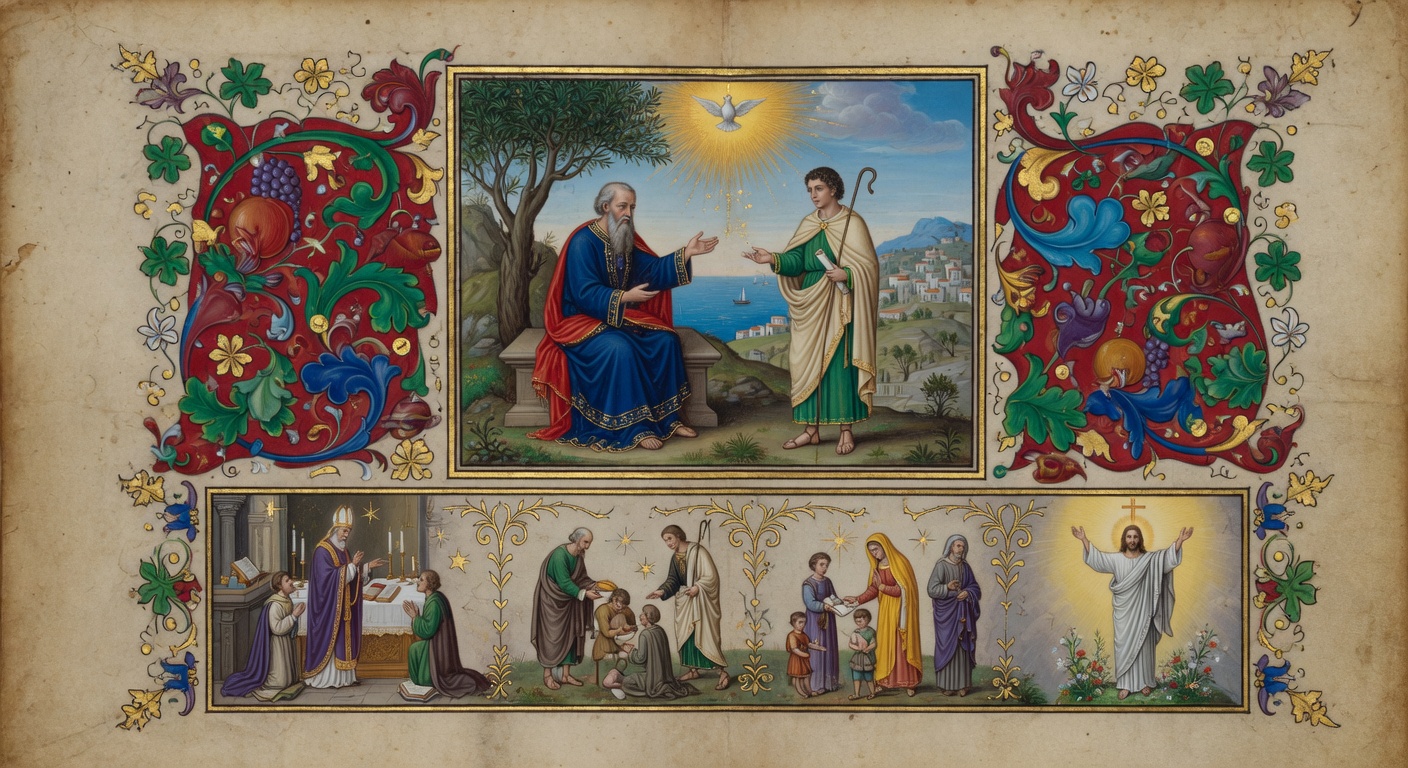
Titus 1 KJV
Appointing Elders in Crete
Titus Chapter 1: Appointing Elders in Crete
The quotation labeling Cretans as 'always liars' draws from Epimenides and targets the island's specific claim to house Zeus's tomb, a tradition that contradicted pagan notions of divine immortality and allowed Paul to subvert local mythology against false teachers.
 1aul, a servant of God, and an apostle of Jesus Christ, according to the faith of God’s elect, and the acknowledging of the truth which is after godliness;
2 In hope of eternal life, which God, that cannot lie, promised before the world began;
3 But hath in due times manifested his word through preaching, which is committed unto me according to the commandment of God our Saviour;
4 To Titus, mine own son after the common faith: Grace, mercy, and peace, from God the Father and the Lord Jesus Christ our Saviour.
5 For this cause left I thee in Crete, that thou shouldest set in order the things that are wanting, and ordain elders in every city, as I had appointed thee:
6 If any be blameless, the husband of one wife, having faithful children not accused of riot or unruly.
7 For a bishop must be blameless, as the steward of God; not selfwilled, not soon angry, not given to wine, no striker, not given to filthy lucre;
8 But a lover of hospitality, a lover of good men, sober, just, holy, temperate;
9 Holding fast the faithful word as he hath been taught, that he may be able by sound doctrine both to exhort and to convince the gainsayers.
10 For there are many unruly and vain talkers and deceivers, specially they of the circumcision:
11 Whose mouths must be stopped, who subvert whole houses, teaching things which they ought not, for filthy lucre’s sake.
12 One of themselves, even a prophet of their own, said, The Cretians are alway liars, evil beasts, slow bellies.
13 This witness is true. Wherefore rebuke them sharply, that they may be sound in the faith;
14 Not giving heed to Jewish fables, and commandments of men, that turn from the truth.
15 Unto the pure all things are pure: but unto them that are defiled and unbelieving is nothing pure; but even their mind and conscience is defiled.
16 They profess that they know God; but in works they deny him, being abominable, and disobedient, and unto every good work reprobate.
← → arrow keys to navigate chapters · spacebar to play/pause audio
Did You Know?
The quotation labeling Cretans as 'always liars' draws from Epimenides and targets the island's specific claim to house Zeus's tomb, a tradition that contradicted pagan notions of divine immortality and allowed Paul to subvert local mythology against false teachers.
Paul's omission of deacons from the leadership qualifications, unlike the parallel instructions in 1 Timothy, suggests a Crete-specific strategy where a single tier of elders was prioritized amid the island's decentralized villages and weak civic structures.
The requirement that elders' children be 'faithful' and not 'unruly' confronts Crete's documented practices of institutionalized pederasty and child exposure, issues noted by ancient writers like Strabo as endemic to the culture.
The declaration that 'unto the pure all things are pure' functions as a direct theological rebuttal to lingering Jewish purity laws or emerging ascetic sects, reframing ritual defilement as a matter of inner disposition rather than external observance.
Describing opponents as motivated by 'filthy lucre' while belonging to 'the circumcision' points to a localized exploitation of the Jewish temple tax system or patronage networks, blending ethnic identity with economic predation in a commercial hub like Crete.