Esther
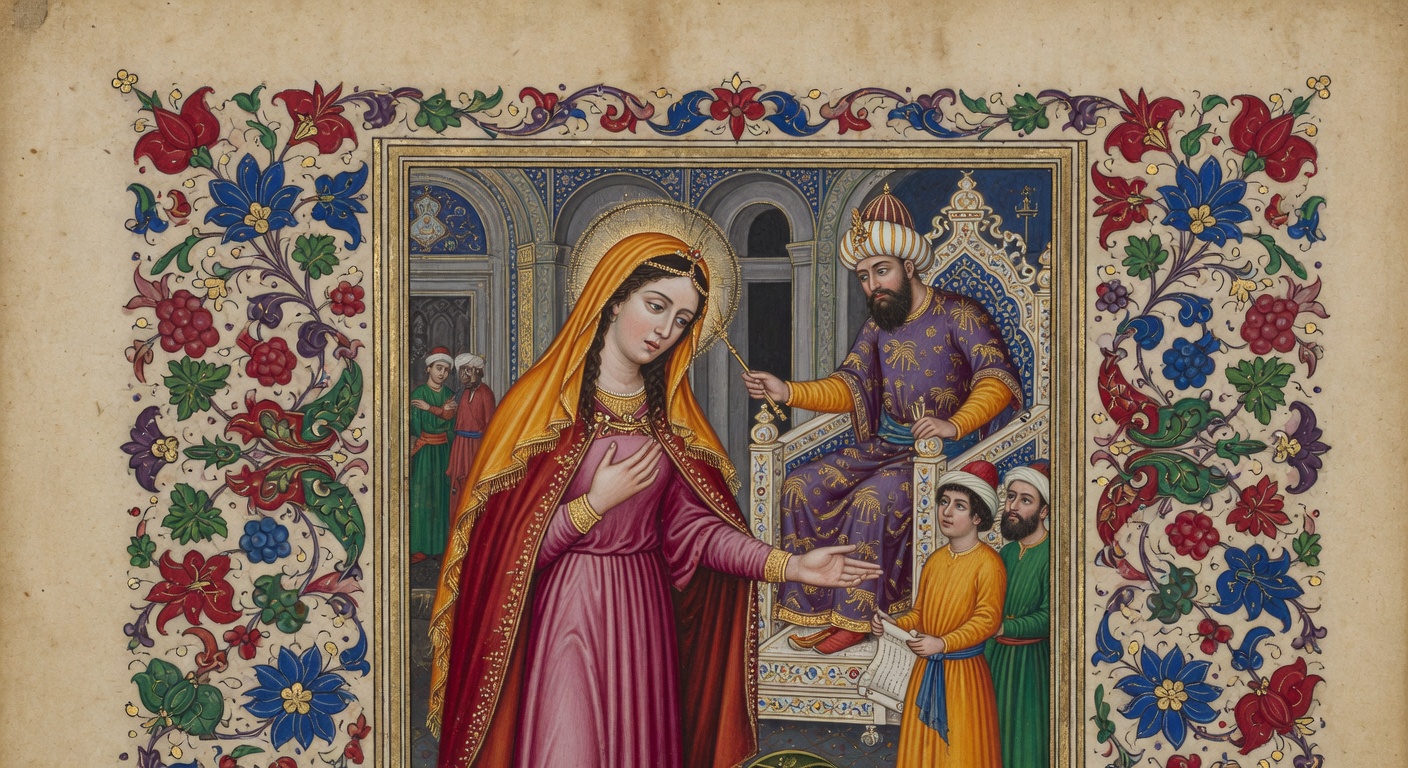
Esther was a Jewish orphan raised by her cousin Mordecai who became queen of Persia after King Ahasuerus selected her from among many candidates. When the king's advisor Haman secured a royal decree to destroy all Jews throughout the empire, Esther risked execution by entering the king's presence without invitation to plead for her people. Her intervention led to the reversal of the decree, the defeat of Haman's plot, and the deliverance of the Jewish nation. The account appears in the Old Testament book of Esther, illustrating God's providential care and establishing the annual festival of Purim.
Biography
- Occupation
- Queen of Persia
- Tribe
- Benjamin
- Father
- Abihail
- Spouse
- King Ahasuerus (Xerxes I)
- Era
- Post-Exile (c. 479 BC)
- Nationality
- Jewish/Persian
- Also Known As
- Hadassah
Family
Did You Know?
Esther's original Hebrew name Hadassah appears only once in the text, identifying her as an orphan raised by her cousin Mordecai in the Persian citadel of Susa after the Babylonian exile.
The Book of Esther is the sole canonical book that never mentions God, yet its narrative structure relies on precise chronological coincidences such as the king's insomnia prompting the reading of Mordecai's loyalty record.
Candidates for queen, including Esther, underwent a mandatory twelve-month regimen of myrrh oil and cosmetic treatments before entering the king's presence, illustrating Achaemenid court protocols for royal consorts.
Esther's uninvited approach to the throne room carried an automatic death penalty under Persian law, yet she invoked a three-day communal fast among the Jews of Susa before the risky act.
The festival of Purim, established directly by the events in Esther, requires the public reading of the entire scroll twice on the fourteenth of Adar and mandates sending food gifts to neighbors and charity to the poor, practices still observed in Jewish communities today.
Key Passages
Esther Becomes Queen
Esther 2:15-18
God's name never appears in this book, yet His providence is everywhere - positioning a Jewish orphan as queen of Persia precisely when her people will need a deliverer.
 15ow when the turn of Esther, the daughter of Abihail the uncle of Mordecai, who had taken her for his daughter, was come to go in unto the king, she required nothing but what Hegai the king’s chamberlain, the keeper of the women, appointed. And Esther obtained favour in the sight of all them that looked upon her.
For Such a Time as This
Esther 4:10-17
Mordecai's challenge to Esther - 'who knows whether you have come to the kingdom for such a time as this?' - reveals that God places people in positions of influence for redemptive purposes.
 10gain Esther spake unto Hatach, and gave him commandment unto Mordecai;
Esther's Plea to the King
Esther 7:1-10
Esther risks death to approach the king uninvited, choosing to identify with her condemned people rather than preserve her own safety - a model of courageous intercession.
 1o the king and Haman came to banquet with Esther the queen.