Psalms 125 KJV
The Security of God's People
About This Psalm
Those who trust in the LORD are like Mount Zion - unmovable. Security and stability through faith.
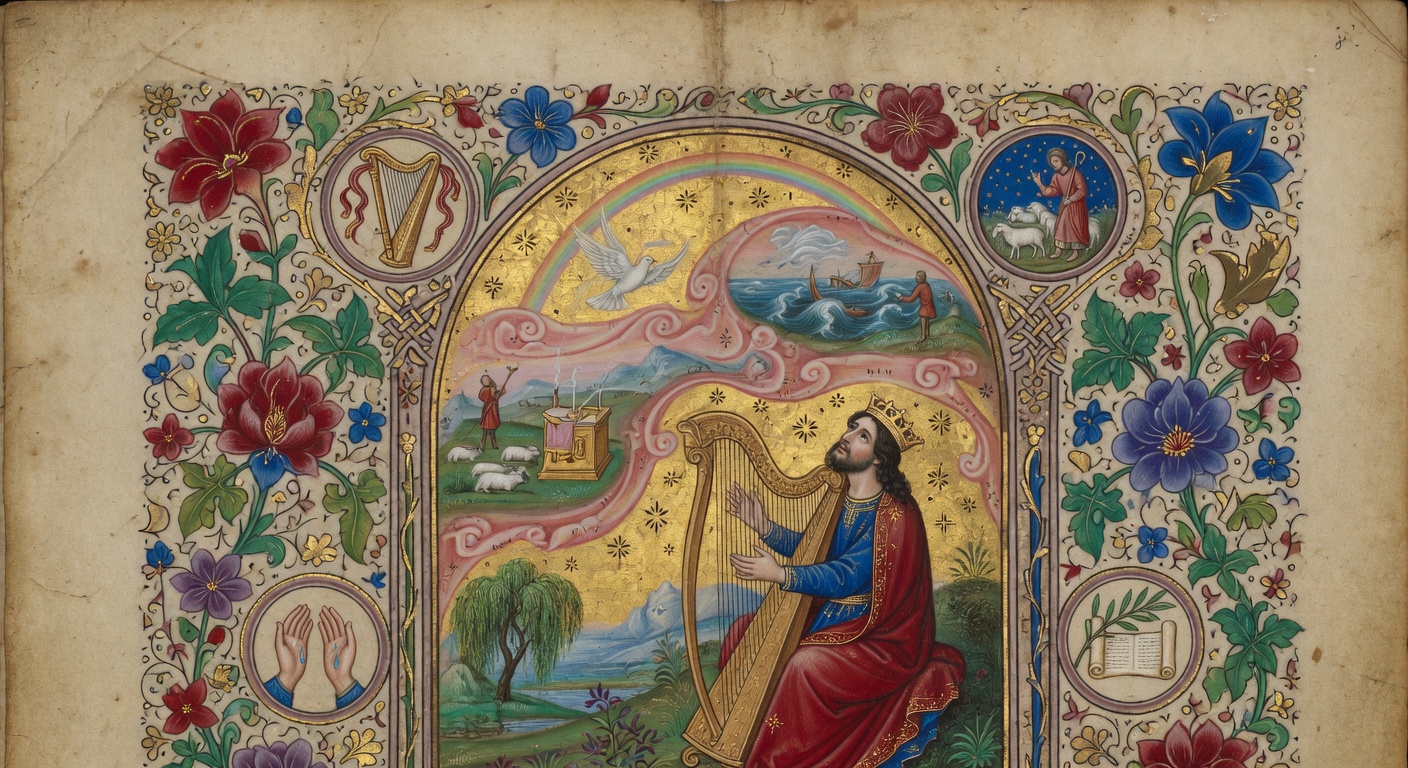
 1hey that trust in the LORD shall be as mount Zion, which cannot be removed, but abideth for ever.
2 As the mountains are round about Jerusalem, so the LORD is round about his people from henceforth even for ever.
3 For the rod of the wicked shall not rest upon the lot of the righteous; lest the righteous put forth their hands unto iniquity.
4 Do good, O LORD, unto those that be good, and to them that are upright in their hearts.
5 As for such as turn aside unto their crooked ways, the LORD shall lead them forth with the workers of iniquity: but peace shall be upon Israel.
← → arrow keys to navigate chapters · spacebar to play/pause audio
Did You Know?
As a Song of Ascents, the psalm repurposes Jerusalem's actual topography of encircling hills into a covenantal guarantee that the faithful themselves become immovable like Zion, shifting sacred-mountain ideology from pagan deities to Yahweh's people.
Verse 3's 'rod of the wicked' likely evokes the temporary Persian or Seleucid scepters that threatened post-exilic Judea, framing foreign rule as a transient affliction that will not permanently 'rest' on Israel's allotted inheritance.
The abrupt shift in verse 5 from communal security to the fate of those who 'turn aside unto their crooked ways' mirrors Deuteronomic covenant curses, implying internal apostasy poses a greater threat than external enemies.
The closing petition 'do good unto those that be good' functions as a liturgical boundary marker, possibly recited at the temple gates to distinguish true pilgrims from insincere participants in the ascent festivals.
Theologically the psalm subverts ancient Near Eastern notions of divine protection tied to a physical temple by locating Zion's stability in the trust of the righteous rather than in the city's walls or cultic apparatus.
Commentary & Study Notes Jamieson-Fausset-Brown (1871) · Public Domain Mount Zion — as an emblem of permanence, and locality of Jerusalem as one of security, represent the firm and protected condition of God's people (compare Ps 46:5), supported not o…
Classic verse-by-verse commentary on Psalms 125 from Jamieson, Fausset & Brown (1871). Covers: God honors the confidence of his people, by protection and deliverance, and leaves hypocrites to the doom of the wicked.
- 1,2
- Mount Zion — as an emblem of permanence, and locality of Jerusalem as one of security, represent the firm and protected condition of God's people (compare Ps 46:5), supported not only by Providence, but by covenant promise. Even the mountains shall depart, and the hills be removed, but God's kindness shall not depart, nor His covenant of peace be removed (Isa 54:10). They that trust — are "His people," (Ps 125:2).
- 3
- Though God may leave them for a time under the "rod," or power (Ps 2:9), and oppression of the wicked for a time, as a chastisement, He will not suffer them to be tempted so as to fall into sin (1Co 10:13). The wicked shall only prove a correcting rod to them, not a destroying sword; even this rod shall not remain ("rest") on them, lest they be tempted to despair and apostasy (Ps 73:13, 14). God may even try His people to the uttermost: when nothing is before our eyes but pure despair, then He delivers us and gives life in death, and makes us blessed in the curse (2Co 1:8, 9) [LUTHER]. the lot — the possession, literally, "Canaan," spiritually, the heavenly inheritance of holiness and bliss which is appointed to the righteous. Sin's dominion shall not permanently come between the believer and his inheritance.
Read all 4 notes on Psalms 125 →