Psalms 144 KJV
A Prayer for Victory and Prosperity
About This Psalm
Blessed be the LORD my rock, who trains my hands for war. A warrior's prayer combining strength and tenderness.
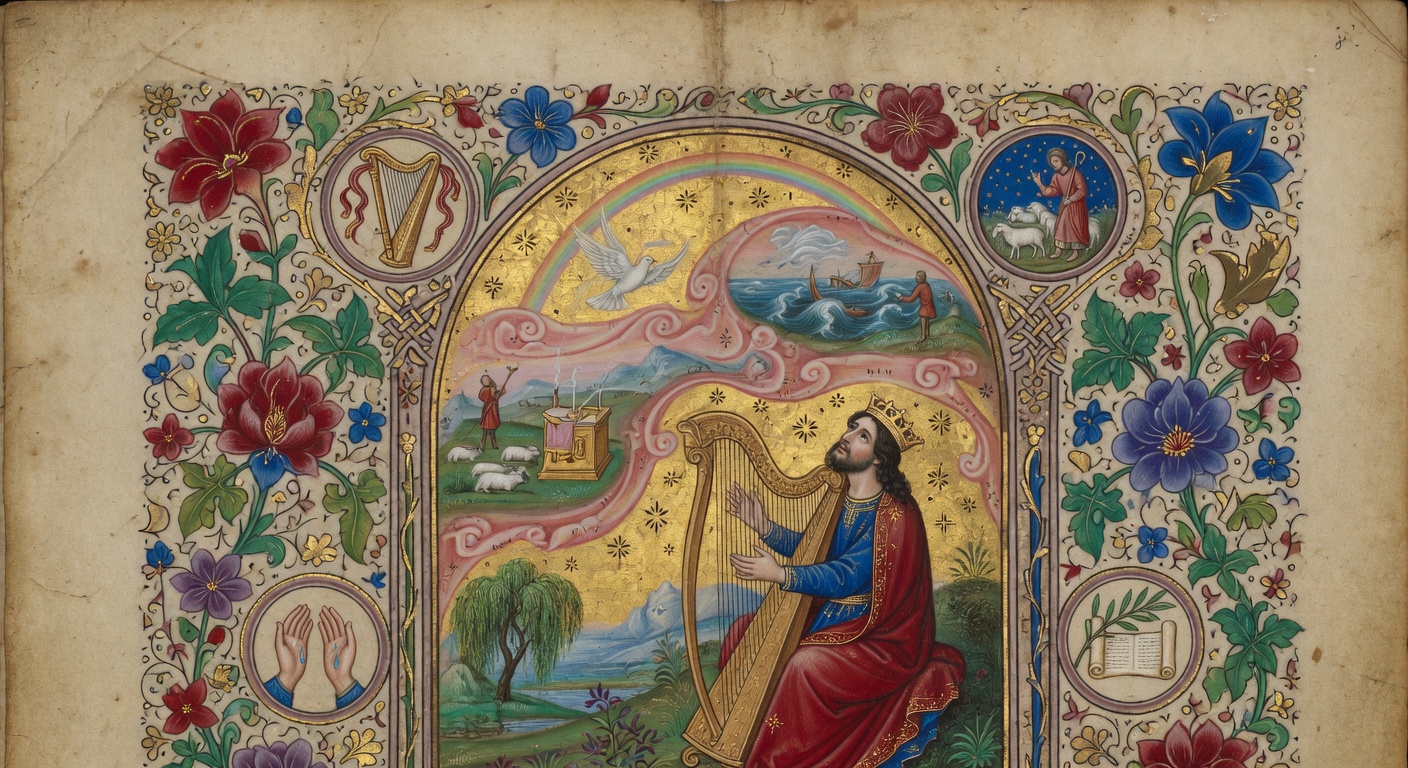
 1lessed be the LORD my strength, which teacheth my hands to war, and my fingers to fight:
2 My goodness, and my fortress; my high tower, and my deliverer; my shield, and he in whom I trust; who subdueth my people under me.
3 LORD, what is man, that thou takest knowledge of him! or the son of man, that thou makest account of him!
4 Man is like to vanity: his days are as a shadow that passeth away.
5 Bow thy heavens, O LORD, and come down: touch the mountains, and they shall smoke.
6 Cast forth lightning, and scatter them: shoot out thine arrows, and destroy them.
7 Send thine hand from above; rid me, and deliver me out of great waters, from the hand of strange children;
8 Whose mouth speaketh vanity, and their right hand is a right hand of falsehood.
9 I will sing a new song unto thee, O God: upon a psaltery and an instrument of ten strings will I sing praises unto thee.
10 It is he that giveth salvation unto kings: who delivereth David his servant from the hurtful sword.
11 Rid me, and deliver me from the hand of strange children, whose mouth speaketh vanity, and their right hand is a right hand of falsehood:
12 That our sons may be as plants grown up in their youth; that our daughters may be as corner stones, polished after the similitude of a palace:
13 That our garners may be full, affording all manner of store: that our sheep may bring forth thousands and ten thousands in our streets:
14 That our oxen may be strong to labour; that there be no breaking in, nor going out; that there be no complaining in our streets.
15 Happy is that people, that is in such a case: yea, happy is that people, whose God is the LORD.
← → arrow keys to navigate chapters · spacebar to play/pause audio
Did You Know?
Psalm 144 reworks material from Psalm 18 so extensively that verses 1-2 function as a condensed theological précis of the earlier victory hymn, shifting its focus from retrospective thanksgiving to present petition.
The question in verse 3 is a near-verbatim reuse of Psalm 8:4, yet here it occurs inside a warrior's prayer rather than a creation hymn, reframing human insignificance as the very ground for requesting divine military intervention.
Verses 12-15 form a self-contained "prosperity coda" whose imagery of sons as plants and daughters as cornerstones deliberately echoes temple and fertility motifs found in ancient Near Eastern royal blessings, not typical psalmic language.
The phrase "strange children" (v. 7, 11) is a rare pejorative plural that elsewhere in the Hebrew Bible denotes either foreign deities or culturally alien offspring, suggesting the enemies are being portrayed as both political and cultic threats.
The final beatitude (v. 15) uses the otherwise unattested construction "happy is the people whose God is the Lord," inverting the more common Deuteronomic formula and thereby making covenant relationship itself the culminating sign of national shalom.