Psalms 22 KJV
My God, Why Have You Forsaken Me?
About This Psalm
Begins with Jesus' words on the cross: 'My God, why hast thou forsaken me?' Written 1,000 years before crucifixion, it describes it in detail.
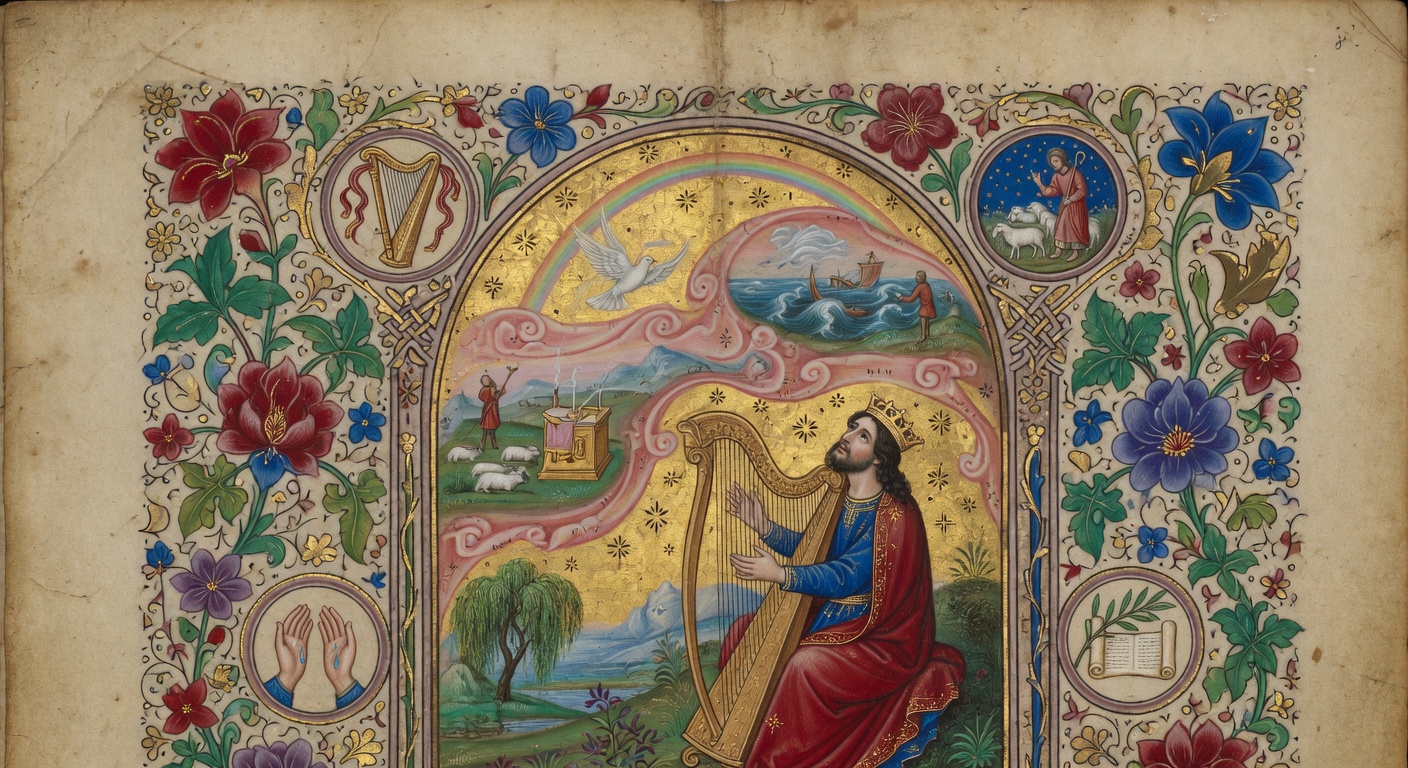
 1y God, my God, why hast thou forsaken me? why art thou so far from helping me, and from the words of my roaring?
2 O my God, I cry in the day time, but thou hearest not; and in the night season, and am not silent.
3 But thou art holy, O thou that inhabitest the praises of Israel.
4 Our fathers trusted in thee: they trusted, and thou didst deliver them.
5 They cried unto thee, and were delivered: they trusted in thee, and were not confounded.
6 But I am a worm, and no man; a reproach of men, and despised of the people.
7 All they that see me laugh me to scorn: they shoot out the lip, they shake the head, saying,
8 He trusted on the LORD that he would deliver him: let him deliver him, seeing he delighted in him.
9 But thou art he that took me out of the womb: thou didst make me hope when I was upon my mother’s breasts.
10 I was cast upon thee from the womb: thou art my God from my mother’s belly.
11 Be not far from me; for trouble is near; for there is none to help.
12 Many bulls have compassed me: strong bulls of Bashan have beset me round.
13 They gaped upon me with their mouths, as a ravening and a roaring lion.
14 I am poured out like water, and all my bones are out of joint: my heart is like wax; it is melted in the midst of my bowels.
15 My strength is dried up like a potsherd; and my tongue cleaveth to my jaws; and thou hast brought me into the dust of death.
16 For dogs have compassed me: the assembly of the wicked have inclosed me: they pierced my hands and my feet.
17 I may tell all my bones: they look and stare upon me.
18 They part my garments among them, and cast lots upon my vesture.
19 But be not thou far from me, O LORD: O my strength, haste thee to help me.
20 Deliver my soul from the sword; my darling from the power of the dog.
21 Save me from the lion’s mouth: for thou hast heard me from the horns of the unicorns.
22 I will declare thy name unto my brethren: in the midst of the congregation will I praise thee.
23 Ye that fear the LORD, praise him; all ye the seed of Jacob, glorify him; and fear him, all ye the seed of Israel.
24 For he hath not despised nor abhorred the affliction of the afflicted; neither hath he hid his face from him; but when he cried unto him, he heard.
25 My praise shall be of thee in the great congregation: I will pay my vows before them that fear him.
26 The meek shall eat and be satisfied: they shall praise the LORD that seek him: your heart shall live for ever.
27 All the ends of the world shall remember and turn unto the LORD: and all the kindreds of the nations shall worship before thee.
28 For the kingdom is the LORD’s: and he is the governor among the nations.
29 All they that be fat upon earth shall eat and worship: all they that go down to the dust shall bow before him: and none can keep alive his own soul.
30 A seed shall serve him; it shall be accounted to the Lord for a generation.
31 They shall come, and shall declare his righteousness unto a people that shall be born, that he hath done this.
← → arrow keys to navigate chapters · spacebar to play/pause audio
Did You Know?
The superscription 'Aijeleth Shahar' (hind of the dawn) likely names an ancient melody yet also evokes the image of a vulnerable deer pursued at first light, framing the psalm's movement from nocturnal terror to anticipated deliverance.
Verses 12-18 deploy a cluster of animal metaphors (Bashan bulls, ravening lions, dogs) drawn from Canaanite chaos imagery, portraying enemies as cosmic forces rather than mere human foes and thereby elevating the sufferer's plight to a mythic scale.
Verse 16's reference to hands and feet being 'pierced' predates Roman crucifixion by centuries, yet its precise anatomical details later supplied early Christian writers with language for interpreting the cross as the fulfillment of Davidic suffering.
The abrupt transition at verse 22 from isolated lament to communal praise enacts a liturgical pattern in which the psalmist's personal rescue becomes the seed for worldwide testimony, culminating in the declaration that 'all the ends of the world shall remember.'
Verse 28's assertion that 'the kingdom is the LORD'S' functions as a political counter-claim within an otherwise intimate complaint, asserting Yahweh's rule over gentile nations even while the speaker remains surrounded by hostile 'dogs' and 'unicorns.'
Commentary & Study Notes Jamieson-Fausset-Brown (1871) · Public Domain A summary of the complaint. Desertion by God, when overwhelmed by distress, is the climax of the sufferer's misery. words of my roaring — shows that the complaint is expressed inte…
Classic verse-by-verse commentary on Psalms 22 from Jamieson, Fausset & Brown (1871). Covers: The obscure words aijeleth shahar in this title have various explanations. Most interpreters agree in translating them by "hind of the morning." but great difference exists as to the meaning of these words. By some they are supposed (compare ps 9:1) to be the name of the tune to which the words of the psalm were set; By others, the name of a musical instrument. Perhaps the best view is to regard the phrase as enigmatically expressive of the subject--the sufferer being likened to a hind pursued by hunters in the early morning (literally, "the dawn of day")--or that, while hind suggests the idea of a meek, innocent sufferer, the addition of morning denotes relief obtained. The feelings of a pious sufferer in sorrow and deliverance are vividly portrayed. He earnestly pleads for divine aid on the ground of his relation to God, whose past goodness to his people encourages hope, and then on account of the imminent danger by which he is threatened. The language of complaint is turned to that of rejoicing in the assured prospect of relief from suffering and triumph over his enemies. The use of the words of the first clause of ps 22:1 by our saviour on the cross, and the quotation of ps 22:18 by john (joh 19:24), and of ps 22:22 by paul (heb 2:12), as fulfilled in his history, clearly intimate the prophetical and messianic purport of the psalm. The intensity of the grief, and the completeness and glory of the deliverance and triumph, alike appear to be unsuitable representations of the fortunes of any less personage. In a general and modified sense (see on ps 16:1), the experience here detailed may be adapted to the case of all christians suffering from spiritual foes, and delivered by divine aid, inasmuch as Christ in his human nature was their head and representative.
- 1
- A summary of the complaint. Desertion by God, when overwhelmed by distress, is the climax of the sufferer's misery. words of my roaring — shows that the complaint is expressed intelligently, though the term "roaring" is figurative, taken from the conduct of irrational creatures in pain.
- 2
- The long distress is evinced by — am not silent — literally, "not silence to me," either meaning, I continually cry; or, corresponding with "thou hearest not," or answerest not, it may mean, there is no rest or quiet to me.
Read all 23 notes on Psalms 22 →