Psalms 8 KJV
The Majesty of God in Creation
About This Psalm
Looking at the night sky and marveling that the God who made galaxies cares about humans. The original 'pale blue dot' moment.
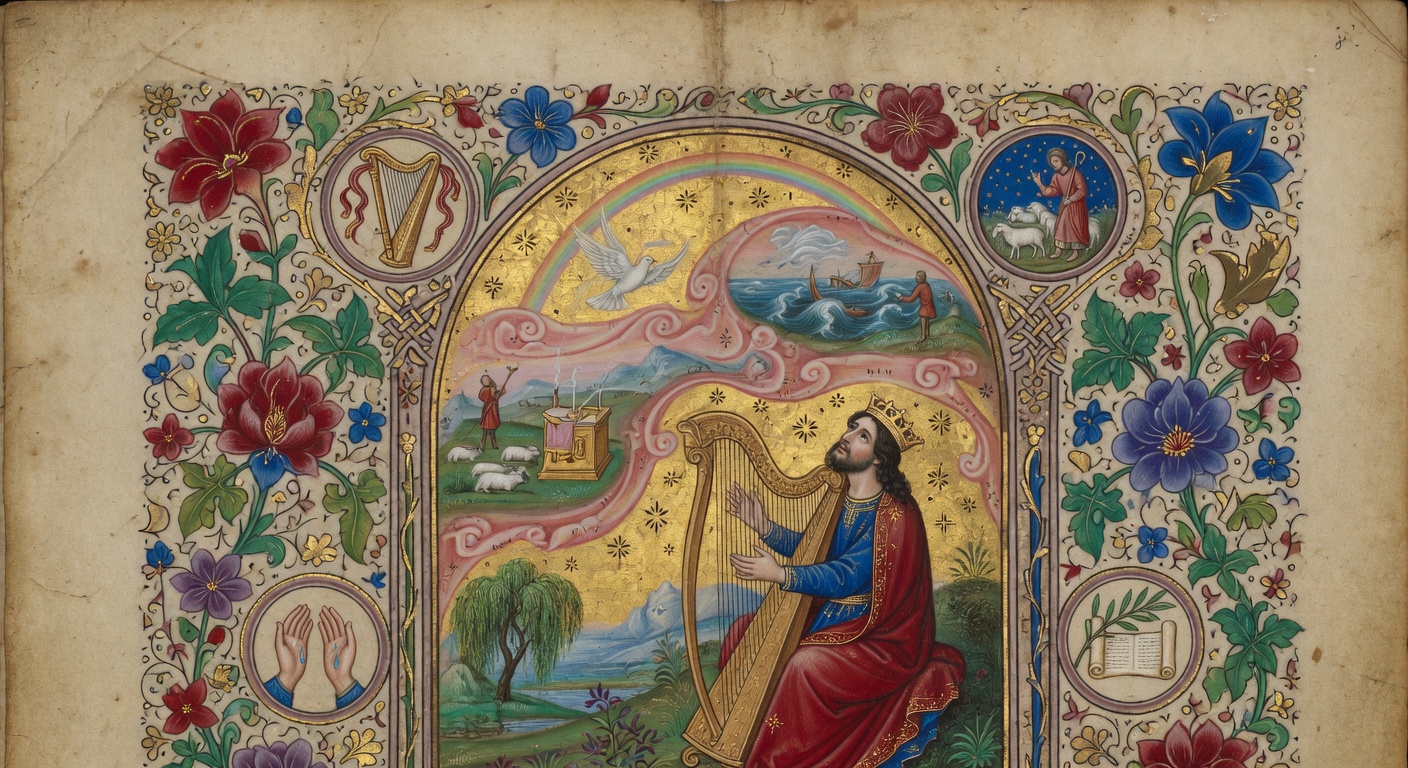
 1 LORD, our Lord, how excellent is thy name in all the earth! who hast set thy glory above the heavens.
2 Out of the mouth of babes and sucklings hast thou ordained strength because of thine enemies, that thou mightest still the enemy and the avenger.
3 When I consider thy heavens, the work of thy fingers, the moon and the stars, which thou hast ordained;
4 What is man, that thou art mindful of him? and the son of man, that thou visitest him?
5 For thou hast made him a little lower than the angels, and hast crowned him with glory and honour.
6 Thou madest him to have dominion over the works of thy hands; thou hast put all things under his feet:
7 All sheep and oxen, yea, and the beasts of the field;
8 The fowl of the air, and the fish of the sea, and whatsoever passeth through the paths of the seas.
9 O LORD our Lord, how excellent is thy name in all the earth!
← → arrow keys to navigate chapters · spacebar to play/pause audio
Did You Know?
The superscription 'upon Gittith' ties the psalm to a Philistine musical form or instrument from Gath, ironically placing a song of cosmic dominion on the lips of David while he lived among Israel's enemies.
Verse 2's image of perfected praise from infants is the only Old Testament text Jesus explicitly cites to justify children's shouts during his triumphal entry (Matthew 21:16), transforming a creation hymn into a defense of messianic recognition.
The phrase 'son of man' in verse 4 uses the ordinary Hebrew 'ben adam' yet becomes the seed for the apocalyptic title later applied to the Messiah in Daniel 7 and the Gospels, linking creational anthropology directly to eschatological kingship.
By listing domesticated animals (sheep, oxen) alongside untamed creatures (beasts of the field, fowl, fish) under human feet, the psalm quietly subverts ancient Near Eastern royal ideology that reserved such dominion exclusively for kings or gods.
The double divine name 'O LORD our Lord' (Yahweh Adonenu) at the psalm's opening and close forms an inclusio that moves from transcendent creator to covenantal ruler, a rhetorical move unique among the creation psalms.