Ezekiel
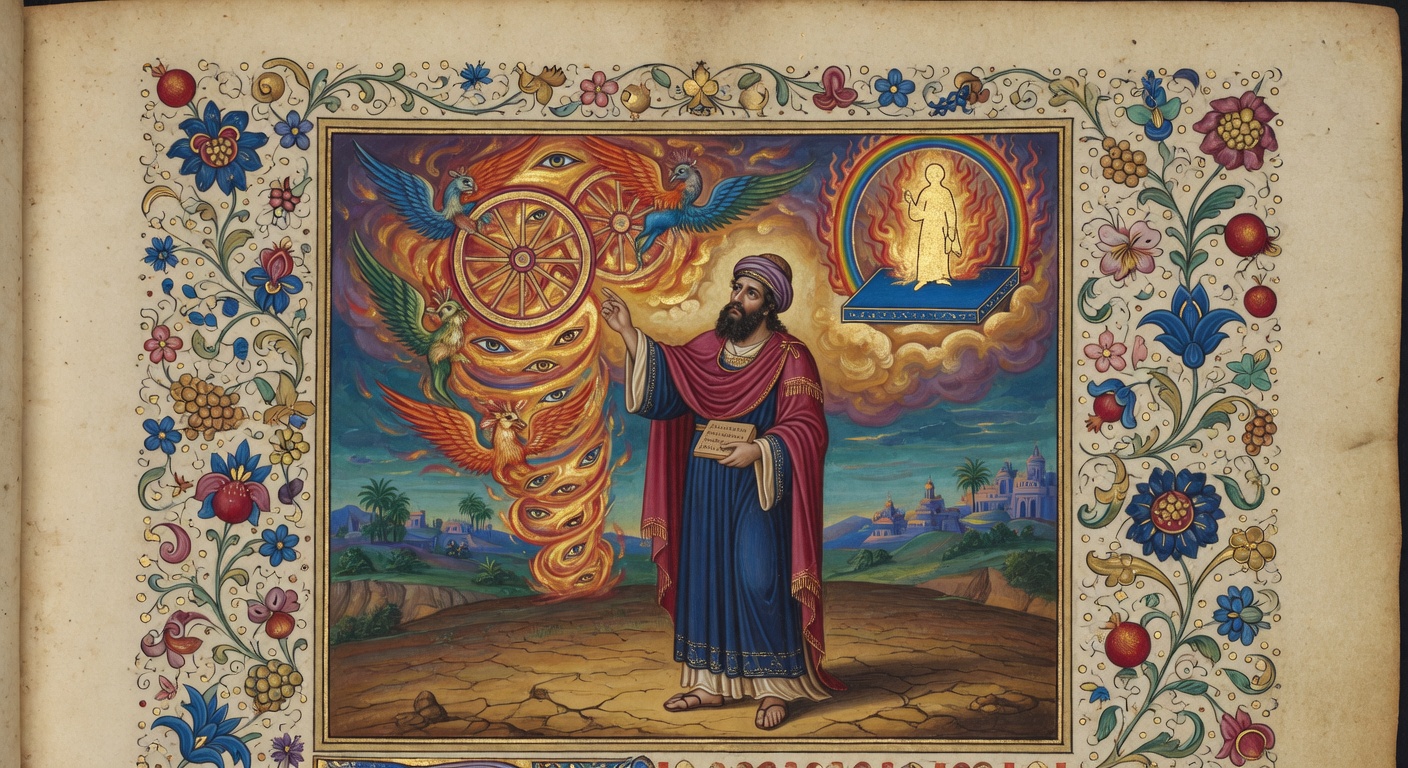
Ezekiel served as a prophet and priest among the Jewish exiles in Babylon following the first deportation from Judah in 597 BC. He conveyed God's messages through vivid visions, such as the chariot throne of God and the valley of dry bones, as well as through unusual symbolic actions that illustrated impending judgment and eventual restoration. His prophecies addressed both the immediate crisis of Jerusalem's destruction and the long-term hope of Israel's renewal under a new covenant. This book holds significance in Scripture for its emphasis on personal accountability, the transcendence of God's glory, and the promise of spiritual revival for God's people.
Biography
- Born
- c. 622 BC, Jerusalem
- Occupation
- Prophet, Priest
- Tribe
- Levi (priestly family)
- Father
- Buzi
- Spouse
- Unnamed wife (died during ministry)
- Era
- Exile (c. 593-571 BC)
- Nationality
- Judean
Family
Did You Know?
Ezekiel was commanded to lie on his left side for 390 days and his right side for 40 days while bound with ropes, symbolically bearing the iniquity of Israel and Judah respectively during the Babylonian exile period.
After God struck Ezekiel mute except when delivering divine messages, the prophet remained silent for extended periods and only regained speech upon learning of Jerusalem's fall in 586 BC, as recorded in chapters 3 and 33.
Ezekiel performed a public symbolic act by shaving his head and beard with a sword, then dividing the hair into three portions to be burned, struck, and scattered, illustrating the fates awaiting Jerusalem's inhabitants.
While physically among the exiles at the Chebar canal in Babylon, Ezekiel described visionary transport to Jerusalem's temple where he witnessed elders worshiping idols and women mourning Tammuz, blending his priestly concerns with apocalyptic imagery.
Ezekiel's wife died suddenly as a divine sign, yet he was forbidden to mourn or perform customary funeral rites, serving as a living parable for the exiles' stunned response to the temple's destruction.
Key Passages
Ezekiel's Vision of God's Glory
Ezekiel 1:1-14
Ezekiel's overwhelming vision of God's throne-chariot reveals divine majesty that transcends human comprehension - establishing his authority as a prophet who has seen the Lord.
 1ow it came to pass in the thirtieth year, in the fourth month, in the fifth day of the month, as I was among the captives by the river of Chebar, that the heavens were opened, and I saw visions of God.
Ezekiel's Call
Ezekiel 2:1-10
God commissions Ezekiel to speak to a rebellious people whether they listen or not - defining prophetic faithfulness as obedience to the message regardless of the audience's response.
 1nd he said unto me, Son of man, stand upon thy feet, and I will speak unto thee.
Valley of Dry Bones
Ezekiel 37:1-14
God shows Ezekiel a valley of dead bones and asks 'Can these bones live?' - then resurrects them as a vast army, promising national and spiritual restoration to hopeless exiles.
 1he hand of the LORD was upon me, and carried me out in the spirit of the LORD, and set me down in the midst of the valley which was full of bones,