Esther 6 KJV
Mordecai Honored
Esther Chapter 6: Mordecai Honored
The king's insomnia prompts a reading from the royal chronicles that lands precisely on Mordecai's unrewarded act of foiling an assassination plot two chapters earlier, creating a chain of events driven by apparent coincidence rather than explicit divine intervention.
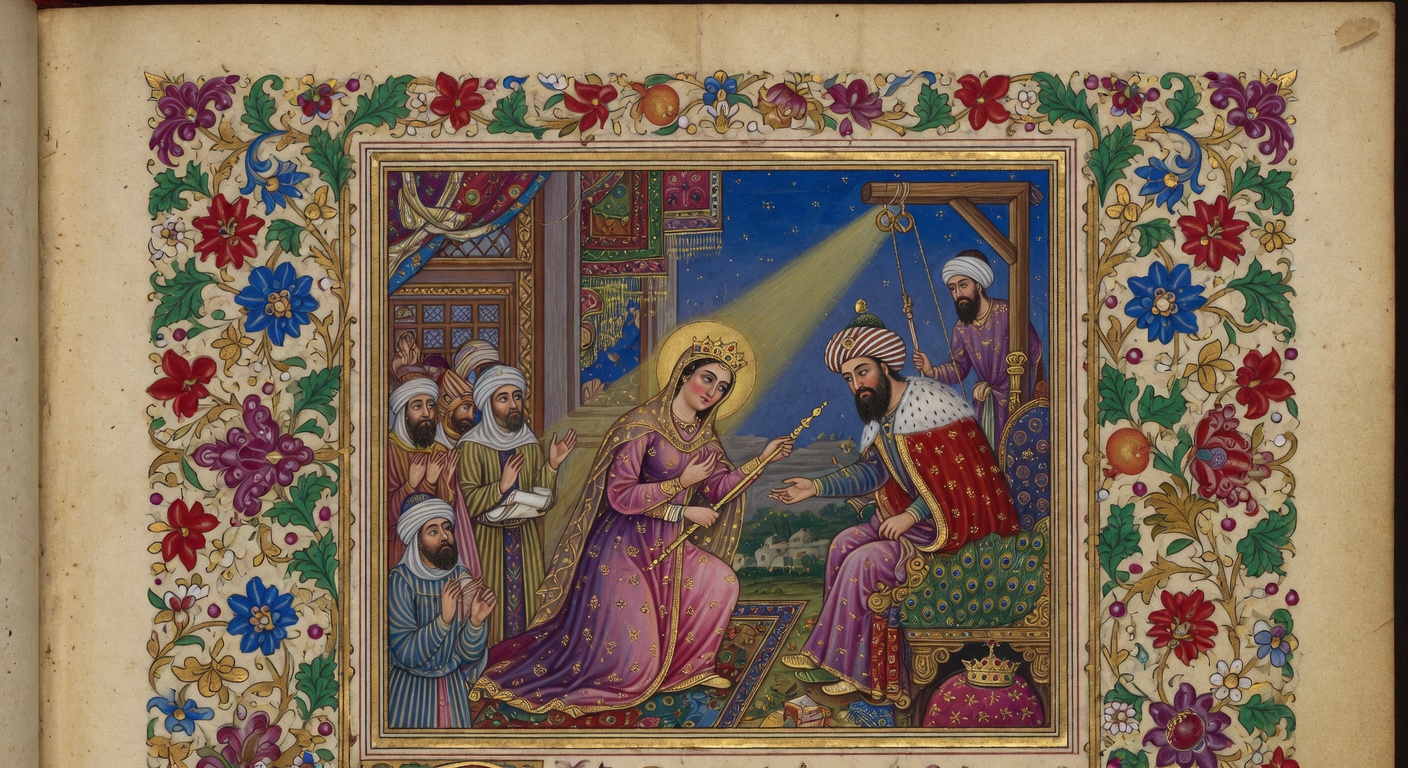
 1n that night could not the king sleep, and he commanded to bring the book of records of the chronicles; and they were read before the king.
2 And it was found written, that Mordecai had told of Bigthana and Teresh, two of the king’s chamberlains, the keepers of the door, who sought to lay hand on the king Ahasuerus.
3 And the king said, What honour and dignity hath been done to Mordecai for this? Then said the king’s servants that ministered unto him, There is nothing done for him.
4 And the king said, Who is in the court? Now Haman was come into the outward court of the king’s house, to speak unto the king to hang Mordecai on the gallows that he had prepared for him.
5 And the king’s servants said unto him, Behold, Haman standeth in the court. And the king said, Let him come in.
6 So Haman came in. And the king said unto him, What shall be done unto the man whom the king delighteth to honour? Now Haman thought in his heart, To whom would the king delight to do honour more than to myself?
7 And Haman answered the king, For the man whom the king delighteth to honour,
8 Let the royal apparel be brought which the king useth to wear, and the horse that the king rideth upon, and the crown royal which is set upon his head:
9 And let this apparel and horse be delivered to the hand of one of the king’s most noble princes, that they may array the man withal whom the king delighteth to honour, and bring him on horseback through the street of the city, and proclaim before him, Thus shall it be done to the man whom the king delighteth to honour.
10 Then the king said to Haman, Make haste, and take the apparel and the horse, as thou hast said, and do even so to Mordecai the Jew, that sitteth at the king’s gate: let nothing fail of all that thou hast spoken.
11 Then took Haman the apparel and the horse, and arrayed Mordecai, and brought him on horseback through the street of the city, and proclaimed before him, Thus shall it be done unto the man whom the king delighteth to honour.
12 And Mordecai came again to the king’s gate. But Haman hasted to his house mourning, and having his head covered.
13 And Haman told Zeresh his wife and all his friends every thing that had befallen him. Then said his wise men and Zeresh his wife unto him, If Mordecai be of the seed of the Jews, before whom thou hast begun to fall, thou shalt not prevail against him, but shalt surely fall before him.
14 And while they were yet talking with him, came the king’s chamberlains, and hasted to bring Haman unto the banquet that Esther had prepared.
← → arrow keys to navigate chapters · spacebar to play/pause audio
Did You Know?
The king's insomnia prompts a reading from the royal chronicles that lands precisely on Mordecai's unrewarded act of foiling an assassination plot two chapters earlier, creating a chain of events driven by apparent coincidence rather than explicit divine intervention.
Haman's suggested honors include placing the royal crown on the recipient's head while he rides the king's horse, a detail that blurs the line between royal favor and potential kingship in Persian court protocol.
The forced public procession where Haman must proclaim Mordecai's exaltation reverses the expected outcome of Haman's morning visit, embodying the narrative's recurring pattern of status inversion without any direct mention of God.
This chapter's events occur on the night before Haman plans to request Mordecai's execution, synchronizing the timing so that the vizier's own words condemn him to honor his intended victim in a single audience with the king.
The absence of any reward recorded for Mordecai in the chronicles highlights a Persian bureaucratic emphasis on documented loyalty, which the narrative uses to expose Haman's ignorance of court records that ultimately undo his plot.