Ezra 1 KJV
Cyrus Allows the Return
Ezra Chapter 1: Cyrus Allows the Return
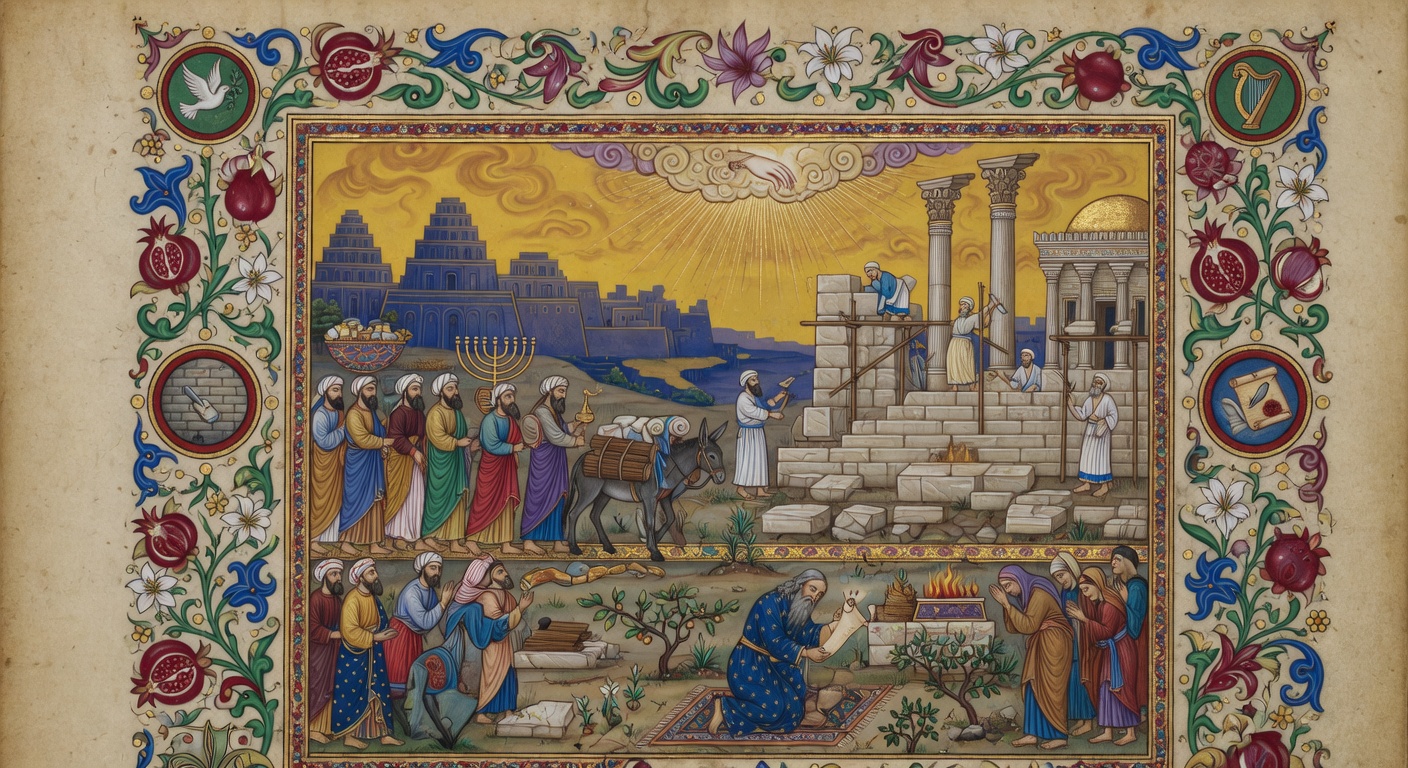
The chapter opens by crediting Cyrus's decree to the direct action of Yahweh stirring his spirit, portraying a pagan emperor as an unwitting agent of divine will in a manner that echoes the 'stirring' language used of earlier foreign rulers like the Pharaoh in Exodus.
 1ow in the first year of Cyrus king of Persia, that the word of the LORD by the mouth of Jeremiah might be fulfilled, the LORD stirred up the spirit of Cyrus king of Persia, that he made a proclamation throughout all his kingdom, and put it also in writing, saying,
2 Thus saith Cyrus king of Persia, The LORD God of heaven hath given me all the kingdoms of the earth; and he hath charged me to build him an house at Jerusalem, which is in Judah.
3 Who is there among you of all his people? his God be with him, and let him go up to Jerusalem, which is in Judah, and build the house of the LORD God of Israel, (he is the God,) which is in Jerusalem.
4 And whosoever remaineth in any place where he sojourneth, let the men of his place help him with silver, and with gold, and with goods, and with beasts, beside the freewill offering for the house of God that is in Jerusalem.
5 Then rose up the chief of the fathers of Judah and Benjamin, and the priests, and the Levites, with all them whose spirit God had raised, to go up to build the house of the LORD which is in Jerusalem.
6 And all they that were about them strengthened their hands with vessels of silver, with gold, with goods, and with beasts, and with precious things, beside all that was willingly offered.
7 Also Cyrus the king brought forth the vessels of the house of the LORD, which Nebuchadnezzar had brought forth out of Jerusalem, and had put them in the house of his gods;
8 Even those did Cyrus king of Persia bring forth by the hand of Mithredath the treasurer, and numbered them unto Sheshbazzar, the prince of Judah.
9 And this is the number of them: thirty chargers of gold, a thousand chargers of silver, nine and twenty knives,
10 Thirty basons of gold, silver basons of a second sort four hundred and ten, and other vessels a thousand.
11 All the vessels of gold and of silver were five thousand and four hundred. All these did Sheshbazzar bring up with them of the captivity that were brought up from Babylon unto Jerusalem.
← → arrow keys to navigate chapters · spacebar to play/pause audio
Did You Know?
The chapter opens by crediting Cyrus's decree to the direct action of Yahweh stirring his spirit, portraying a pagan emperor as an unwitting agent of divine will in a manner that echoes the 'stirring' language used of earlier foreign rulers like the Pharaoh in Exodus.
Ezra 1:1 explicitly ties the return to the fulfillment of Jeremiah's seventy-year prophecy, creating a deliberate bridge between the prophetic corpus and the post-exilic historical narrative rather than treating the events as merely political.
The detailed enumeration and restitution of the temple vessels originally taken by Nebuchadnezzar functions as a theological statement of cultic continuity, signaling that the new temple will inherit the sacred objects of the Solomonic era rather than starting anew.
Cyrus's proclamation in verses 2-4 mirrors the language and structure of the Cyrus Cylinder, yet reframes the Persian king's universal claims through a strictly Yahwistic lens by declaring that 'the God of heaven' has given him all kingdoms.
The handover of the vessels to Sheshbazzar (vv. 8, 11) introduces an enigmatic Judean leader whose brief appearance here, distinct from the later prominence of Zerubbabel, has prompted longstanding questions about possible dual leadership or name variations in the early return community.
Commentary & Study Notes Jamieson-Fausset-Brown (1871) · Public Domain in the first year of Cyrus king of Persia — The Persian empire, including Persia, Media, Babylonia, and Chaldea, with many smaller dependencies, was founded by Cyrus, 536 B.C. [HAL…
Classic verse-by-verse commentary on Ezra 1 from Jamieson, Fausset & Brown (1871). Covers: Proclamation of cyrus for building the temple; Cyrus restores the vessels.
- 1
- in the first year of Cyrus king of Persia — The Persian empire, including Persia, Media, Babylonia, and Chaldea, with many smaller dependencies, was founded by Cyrus, 536 B.C. [HALES]. that the word of the Lord by the mouth of Jeremiah might be fulfilled — (See Jer 25:12; 29:10). This reference is a parenthetic statement of the historian, and did not form part of the proclamation.
- 2
- The Lord God of heaven hath given me all the kingdoms of the earth — Though this is in the Oriental style of hyperbole (see also Da 4:1), it was literally true that the Persian empire was the greatest ruling power in the world at that time. he hath charged me to build him an house at Jerusalem — The phraseology of this proclamation, independently of the express testimony of JOSEPHUS, affords indisputable evidence that Cyrus had seen (probably through means of Daniel, his venerable prime minister and favorite) those prophecies in which, two hundred years before he was born, his name, his victorious career, and the important services he should render to the Jews were distinctly foretold (Isa 44:28; 46:1-4). The existence of predictions so remarkable led him to acknowledge that all his kingdoms were gifts bestowed on him by "the Lord God of heaven," and prompted him to fulfil the duty which had been laid upon him long before his birth. This was the source and origin of the great favor he showed to the Jews. The proclamation, though issued "in the first year of Cyrus" [Ezr 1:1], did not take effect till the year following.
Read all 8 notes on Ezra 1 →