Numbers 19 KJV
The Red Heifer
Numbers Chapter 19: The Red Heifer
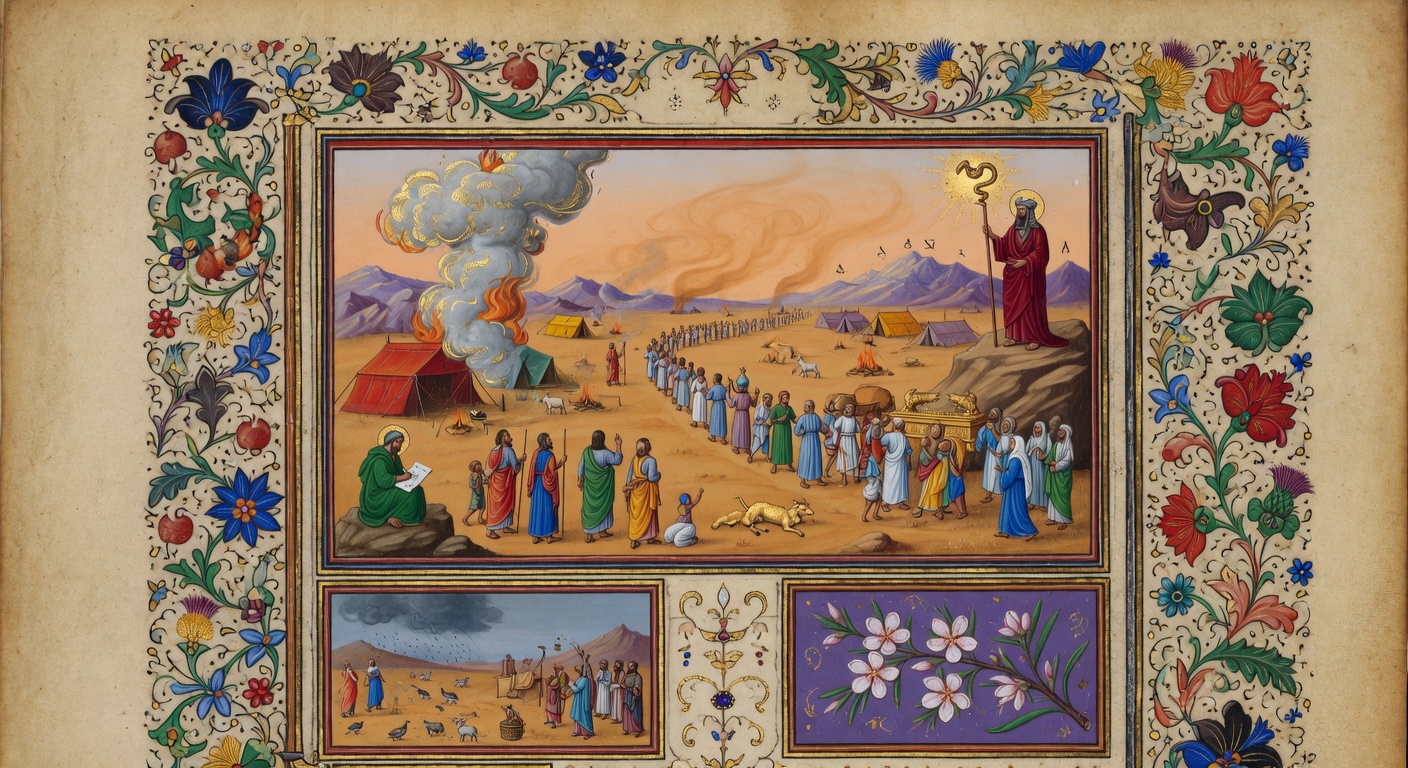
The ritual's requirement that the red heifer be burned entirely outside the camp, with its ashes then transported back for use, creates a spatial theology where defilement and purification straddle sacred boundaries in a manner distinct from all other offerings.
 1nd the LORD spake unto Moses and unto Aaron, saying,
2 This is the ordinance of the law which the LORD hath commanded, saying, Speak unto the children of Israel, that they bring thee a red heifer without spot, wherein is no blemish, and upon which never came yoke:
3 And ye shall give her unto Eleazar the priest, that he may bring her forth without the camp, and one shall slay her before his face:
4 And Eleazar the priest shall take of her blood with his finger, and sprinkle of her blood directly before the tabernacle of the congregation seven times:
5 And one shall burn the heifer in his sight; her skin, and her flesh, and her blood, with her dung, shall he burn:
6 And the priest shall take cedar wood, and hyssop, and scarlet, and cast it into the midst of the burning of the heifer.
7 Then the priest shall wash his clothes, and he shall bathe his flesh in water, and afterward he shall come into the camp, and the priest shall be unclean until the even.
8 And he that burneth her shall wash his clothes in water, and bathe his flesh in water, and shall be unclean until the even.
9 And a man that is clean shall gather up the ashes of the heifer, and lay them up without the camp in a clean place, and it shall be kept for the congregation of the children of Israel for a water of separation: it is a purification for sin.
10 And he that gathereth the ashes of the heifer shall wash his clothes, and be unclean until the even: and it shall be unto the children of Israel, and unto the stranger that sojourneth among them, for a statute for ever.
11 He that toucheth the dead body of any man shall be unclean seven days.
12 He shall purify himself with it on the third day, and on the seventh day he shall be clean: but if he purify not himself the third day, then the seventh day he shall not be clean.
13 Whosoever toucheth the dead body of any man that is dead, and purifieth not himself, defileth the tabernacle of the LORD; and that soul shall be cut off from Israel: because the water of separation was not sprinkled upon him, he shall be unclean; his uncleanness is yet upon him.
14 This is the law, when a man dieth in a tent: all that come into the tent, and all that is in the tent, shall be unclean seven days.
15 And every open vessel, which hath no covering bound upon it, is unclean.
16 And whosoever toucheth one that is slain with a sword in the open fields, or a dead body, or a bone of a man, or a grave, shall be unclean seven days.
17 And for an unclean person they shall take of the ashes of the burnt heifer of purification for sin, and running water shall be put thereto in a vessel:
18 And a clean person shall take hyssop, and dip it in the water, and sprinkle it upon the tent, and upon all the vessels, and upon the persons that were there, and upon him that touched a bone, or one slain, or one dead, or a grave:
19 And the clean person shall sprinkle upon the unclean on the third day, and on the seventh day: and on the seventh day he shall purify himself, and wash his clothes, and bathe himself in water, and shall be clean at even.
20 But the man that shall be unclean, and shall not purify himself, that soul shall be cut off from among the congregation, because he hath defiled the sanctuary of the LORD: the water of separation hath not been sprinkled upon him; he is unclean.
21 And it shall be a perpetual statute unto them, that he that sprinkleth the water of separation shall wash his clothes; and he that toucheth the water of separation shall be unclean until even.
22 And whatsoever the unclean person toucheth shall be unclean; and the soul that toucheth it shall be unclean until even.
← → arrow keys to navigate chapters · spacebar to play/pause audio
Did You Know?
The ritual's requirement that the red heifer be burned entirely outside the camp, with its ashes then transported back for use, creates a spatial theology where defilement and purification straddle sacred boundaries in a manner distinct from all other offerings.
Inclusion of cedar, scarlet wool, and hyssop in the burning links this rite to the leper-cleansing ceremony in Leviticus 14, forming a deliberate literary bridge between purification from skin disease and from corpse contamination.
Eleazar rather than Aaron is commanded to conduct the sacrifice, a detail that protects the high priest's perpetual sanctity while still allowing the community's need for purification to be met.
The ashes retain efficacy indefinitely once mixed with water, establishing an enduring, renewable sacrament against death's contagion that has no parallel in the Levitical system.
The seven-day purification sequence, with sprinkling on days three and seven, imposes a deliberate temporal rhythm that mirrors creation's structure and forces the unclean person to re-enter communal life only after a full week of separation.
Commentary & Study Notes Jamieson-Fausset-Brown (1871) · Public Domain This is the ordinance of the law — an institution of a peculiar nature ordained by law for the purification of sin, and provided at the public expense because it was for the good o…
Classic verse-by-verse commentary on Numbers 19 from Jamieson, Fausset & Brown (1871). Covers: The water of separation.
- 2
- This is the ordinance of the law — an institution of a peculiar nature ordained by law for the purification of sin, and provided at the public expense because it was for the good of the whole community. Speak unto the children of Israel, that they bring thee a red heifer without spot, &c. — This is the only case in which the color of the victim is specified. It has been supposed the ordinance was designed in opposition to the superstitious notions of the Egyptians. That people never offered a vow but they sacrificed a red bull, the greatest care being taken by their priests in examining whether it possessed the requisite characteristics, and it was an annual offering to Typhon, their evil being. By the choice, both of the sex and the color, provision was made for eradicating from the minds of the Israelites a favorite Egyptian superstition regarding two objects of their animal worship.
- 3-6
- ye shall give her unto Eleazar the priest that he may bring her forth without the camp — He was the second or deputy high priest, and he was selected for this duty because the execution of it entailed temporary defilement, from which the acting high priest was to be preserved with the greatest care. It was led "forth without the camp," in accordance with the law regarding victims laden with the sins of the people, and thus typical of Christ (Heb 13:12; also Le 24:14). The priest was to sprinkle the blood "seven times" before — literally, "towards" or "near" the tabernacle, a description which seems to imply either that he carried a portion of the blood in a basin to the door of the tabernacle (Le 4:17), or that in the act of sprinkling he turned his face towards the sacred edifice, being disqualified through the defiling influence of this operation from approaching close to it. By this attitude he indicated that he was presenting an expiatory sacrifice, for the acceptance of which he hoped, in the grace of God, by looking to the mercy seat. Every part of it was consumed by fire except the blood used in sprinkling, and the ingredients mixed with the ashes were the same as those employed in the sprinkling of lepers (Le 14:4-7). It was a water of separation — that is, of "sanctification" for the people of Israel.
Read all 7 notes on Numbers 19 →