2 Chronicles 30 KJV
Hezekiah Celebrates Passover
2 Chronicles Chapter 30: Hezekiah Celebrates Passover
Hezekiah's postponement of Passover to the second month, invoking the Numbers 9 exception for uncleanness or travel, enabled northern Israelites still recovering from Assyrian conquest to participate, revealing a deliberate prioritization of covenantal inclusion over calendrical precision.
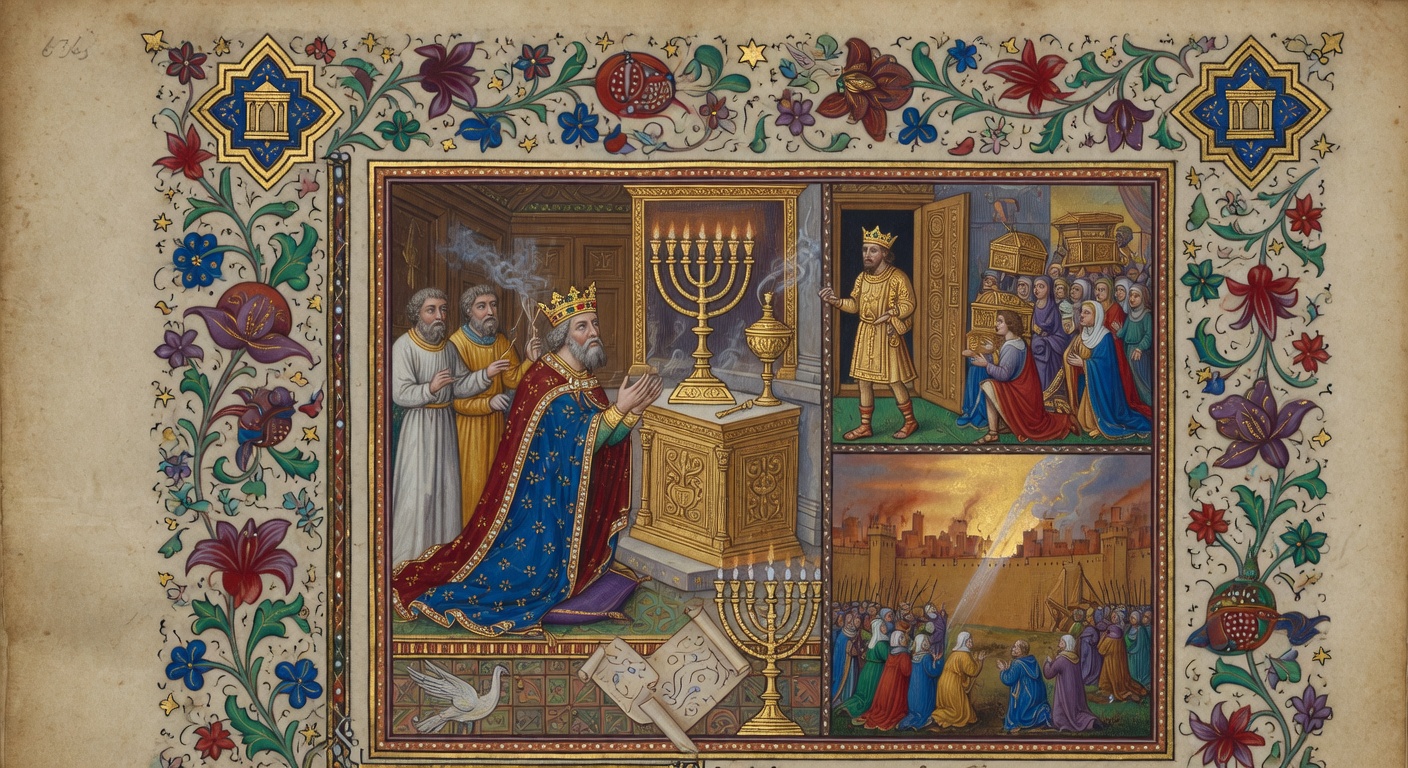
 1nd Hezekiah sent to all Israel and Judah, and wrote letters also to Ephraim and Manasseh, that they should come to the house of the LORD at Jerusalem, to keep the passover unto the LORD God of Israel.
2 For the king had taken counsel, and his princes, and all the congregation in Jerusalem, to keep the passover in the second month.
3 For they could not keep it at that time, because the priests had not sanctified themselves sufficiently, neither had the people gathered themselves together to Jerusalem.
4 And the thing pleased the king and all the congregation.
5 So they established a decree to make proclamation throughout all Israel, from Beersheba even to Dan, that they should come to keep the passover unto the LORD God of Israel at Jerusalem: for they had not done it of a long time in such sort as it was written.
6 So the posts went with the letters from the king and his princes throughout all Israel and Judah, and according to the commandment of the king, saying, Ye children of Israel, turn again unto the LORD God of Abraham, Isaac, and Israel, and he will return to the remnant of you, that are escaped out of the hand of the kings of Assyria.
7 And be not ye like your fathers, and like your brethren, which trespassed against the LORD God of their fathers, who therefore gave them up to desolation, as ye see.
8 Now be ye not stiffnecked, as your fathers were, but yield yourselves unto the LORD, and enter into his sanctuary, which he hath sanctified for ever: and serve the LORD your God, that the fierceness of his wrath may turn away from you.
9 For if ye turn again unto the LORD, your brethren and your children shall find compassion before them that lead them captive, so that they shall come again into this land: for the LORD your God is gracious and merciful, and will not turn away his face from you, if ye return unto him.
10 So the posts passed from city to city through the country of Ephraim and Manasseh even unto Zebulun: but they laughed them to scorn, and mocked them.
11 Nevertheless divers of Asher and Manasseh and of Zebulun humbled themselves, and came to Jerusalem.
12 Also in Judah the hand of God was to give them one heart to do the commandment of the king and of the princes, by the word of the LORD.
13 And there assembled at Jerusalem much people to keep the feast of unleavened bread in the second month, a very great congregation.
14 And they arose and took away the altars that were in Jerusalem, and all the altars for incense took they away, and cast them into the brook Kidron.
15 Then they killed the passover on the fourteenth day of the second month: and the priests and the Levites were ashamed, and sanctified themselves, and brought in the burnt offerings into the house of the LORD.
16 And they stood in their place after their manner, according to the law of Moses the man of God: the priests sprinkled the blood, which they received of the hand of the Levites.
17 For there were many in the congregation that were not sanctified: therefore the Levites had the charge of the killing of the passovers for every one that was not clean, to sanctify them unto the LORD.
18 For a multitude of the people, even many of Ephraim, and Manasseh, Issachar, and Zebulun, had not cleansed themselves, yet did they eat the passover otherwise than it was written. But Hezekiah prayed for them, saying, The good LORD pardon every one
19 That prepareth his heart to seek God, the LORD God of his fathers, though he be not cleansed according to the purification of the sanctuary.
20 And the LORD hearkened to Hezekiah, and healed the people.
21 And the children of Israel that were present at Jerusalem kept the feast of unleavened bread seven days with great gladness: and the Levites and the priests praised the LORD day by day, singing with loud instruments unto the LORD.
22 And Hezekiah spake comfortably unto all the Levites that taught the good knowledge of the LORD: and they did eat throughout the feast seven days, offering peace offerings, and making confession to the LORD God of their fathers.
23 And the whole assembly took counsel to keep other seven days: and they kept other seven days with gladness.
24 For Hezekiah king of Judah did give to the congregation a thousand bullocks and seven thousand sheep; and the princes gave to the congregation a thousand bullocks and ten thousand sheep: and a great number of priests sanctified themselves.
25 And all the congregation of Judah, with the priests and the Levites, and all the congregation that came out of Israel, and the strangers that came out of the land of Israel, and that dwelt in Judah, rejoiced.
26 So there was great joy in Jerusalem: for since the time of Solomon the son of David king of Israel there was not the like in Jerusalem.
27 Then the priests the Levites arose and blessed the people: and their voice was heard, and their prayer came up to his holy dwelling place, even unto heaven.
← → arrow keys to navigate chapters · spacebar to play/pause audio
Did You Know?
Hezekiah's postponement of Passover to the second month, invoking the Numbers 9 exception for uncleanness or travel, enabled northern Israelites still recovering from Assyrian conquest to participate, revealing a deliberate prioritization of covenantal inclusion over calendrical precision.
The narrative notes that some northerners from Asher, Manasseh, and Zebulun humbled themselves and journeyed to Jerusalem while others mocked the royal messengers, capturing a divided remnant response that underscores the chapter's theme of voluntary repentance amid political collapse.
Hezekiah's intercession for those who ate the lamb while ritually unclean, followed by the statement that the Lord 'healed' the people, presents an instance where divine mercy overrides strict purity requirements based on the intent of the heart.
The assembly's unanimous decision to extend the feast another seven days, resulting in fourteen consecutive days of observance, deliberately parallels Solomon's temple dedication yet expands its scope by incorporating participants from the fallen northern tribes.
Levites slaughtering Passover lambs on behalf of ritually unprepared laity temporarily broadens access to the central sacrifice, illustrating a revival dynamic in which practical necessity reshapes priestly roles to accommodate widespread return to Yahweh worship.
Commentary & Study Notes Jamieson-Fausset-Brown (1871) · Public Domain Hezekiah sent to all... Judah... to come to... Jerusalem, to keep the passover — This great religious festival had not been regularly observed by the Hebrews in their national capa…
Classic verse-by-verse commentary on 2 Chronicles 30 from Jamieson, Fausset & Brown (1871). Covers: Hezekiah proclaims a passover; The assembly destroys the altars of idolatry.
- 1-5
- Hezekiah sent to all... Judah... to come to... Jerusalem, to keep the passover — This great religious festival had not been regularly observed by the Hebrews in their national capacity for a long time because of the division of the kingdom and the many disorders that had followed that unhappy event. Hezekiah longed extremely to see its observance revived; and the expression of his wishes having received a hearty response from the princes and chief men of his own kingdom, the preparatory steps were taken for a renewed celebration of the national solemnity. letters also to Ephraim and Manasseh — The names of these leading tribes are used for the whole kingdom of Israel. It was judged impossible, however, that the temple, the priests, and people could be all duly sanctified at the usual time appointed for the anniversary, namely, the fourteenth day of the first month (Nisan). Therefore it was resolved, instead of postponing the feast till another year, to observe it on the fourteenth day of the second month; a liberty which, being in certain circumstances (Nu 9:6-13) granted to individuals, might, it was believed, be allowed to all the people. Hezekiah's proclamation was, of course, authoritative in his own kingdom, but it could not have been made and circulated in all the towns and villages of the neighboring kingdom without the concurrence, or at least the permission, of the Israelitish sovereign. Hoshea, the reigning king, is described as, though evil in some respects, yet more favorably disposed to religious liberty than any of his predecessors since the separation of the kingdom. This is thought to be the meaning of the mitigating clause in his character (2Ki 17:2).
- 6
- the posts — that is, runners, or royal messengers, who were taken from the king's bodyguard (2Ch 23:1, 2). Each, well mounted, had a certain number of miles to traverse. Having performed his course, he was relieved by another, who had to scour an equal extent of ground; so that, as the government messengers were despatched in all directions, public edicts were speedily diffused throughout the country. The proclamation of Hezekiah was followed by a verbal address from himself, piously urging the duty, and setting forth the advantages, of a return to the pure faith and institutions which God had delivered to their ancestors through Moses. the remnant of you, that are escaped out of the hand of the kings of Assyria — This implies that several expeditions against Israel had already been made by Assyrian invaders — by Pul (2Ki 15:19), but none of the people were then removed; at a later period by Tiglath-pileser, when it appears that numbers among the tribes east of Jordan (1Ch 5:26), and afterwards in the northern parts of Israel (2Ki 15:20), were carried into foreign exile. The invasion of Shalmaneser cannot be alluded to, as it did not take place till the sixth year of Hezekiah's reign (2Ki 17:6; 18:9-12).
Read all 9 notes on 2 Chronicles 30 →